Ohio Marketplace health insurance in 2025

Compare ACA plans and check subsidy savings from a third-party insurance agency.


Ohio health insurance Marketplace guide
This guide, including the FAQs below, will help you understand your health insurance options in Ohio and select the appropriate health insurance plan for you and your family. For many people, an ACA Marketplace/exchange plan, commonly referred to as Obamacare, is a good option, and most enrollees qualify for financial assistance with the cost of their Ohio Marketplace coverage.3
People in Ohio use HealthCare.gov to enroll in ACA Marketplace plans. The state operates a marketplace plan management exchange. This means that while the federal government manages the exchange, the state oversees and certifies qualified health plans (QHPs) for sale on the exchange.
For 2025, there are 13 insurers offering coverage in Ohio’s exchange, including one new carrier (see rate change details below). Plan availability varies from one area to another, but residents in most areas of Ohio can select from at least five insurers’ plans for 2025.4
Frequently asked questions about health insurance in Ohio
Who can buy Marketplace health insurance?
To qualify for health coverage through the Marketplace in Ohio, you must:5
- Live in Ohio
- Be either a United States citizen or national, or be lawfully present
- Not be incarcerated
- Not be enrolled in Medicare
Eligibility for financial assistance (premium subsidies and cost-sharing reductions) depends on your income and how it compares with the cost of the second-lowest-cost Silver plan in your area – which depends on your age and location. In addition, to qualify for financial assistance with your Marketplace plan you must:
- Not have access to affordable health coverage through your employer. If your employer offers coverage but you feel it’s too expensive, you can use our Employer Health Plan Affordability Calculator to see if you might qualify for premium subsidies in the Marketplace.
- Not be eligible for Medicaid or CHIP.
- Not be eligible for premium-free Medicare Part A.6
- File a joint tax return if you’re married7 (with very limited exceptions)8
- Not be able to be claimed as a tax dependent by someone else.7
When can I enroll in an ACA-compliant plan in Ohio?
In Ohio, you can sign up for an ACA-compliant individual or family health insurance between November 1 and January 15 during open enrollment. Your coverage starts on January 1 if you enroll by December 15. But if you apply between December 16 and January 15, your coverage will begin on February 1.9
Outside of the annual open enrollment window, you may be eligible to enroll if you experience a qualifying life event, such as giving birth or losing other health coverage. (There’s also an extended special enrollment period for people who lose Medicaid or CHIP between March 31, 2023 and November 20, 2024.10)
Note that some people can enroll year-round even without a specific qualifying life event.
How do I enroll in a Marketplace plan in Ohio?
To enroll in a Marketplace plan in Ohio, you can:
- Visit HealthCare.gov, a platform where you can shop, compare, and buy individual and family health plans.
- Purchase individual and family health coverage with the help of an insurance agent or broker, a Navigator or certified application counselor.
- Enroll via an approved enhanced direct enrollment entity.11
- You can also call HealthCare.gov’s contact center by dialing 1-800-318-2596 (TTY: 1-855-889-4325). The call center is available 24 hours a day, seven days a week, but it’s closed on holidays.
How can I find affordable health insurance in Ohio?
You can find affordable health insurance options in Ohio through HealthCare.gov – the ACA Marketplace.
Under the Affordable Care Act, you may qualify for income-based subsidies, known as Advance Premium Tax Credits (APTC). These credits can reduce your premium and lower your overall costs.
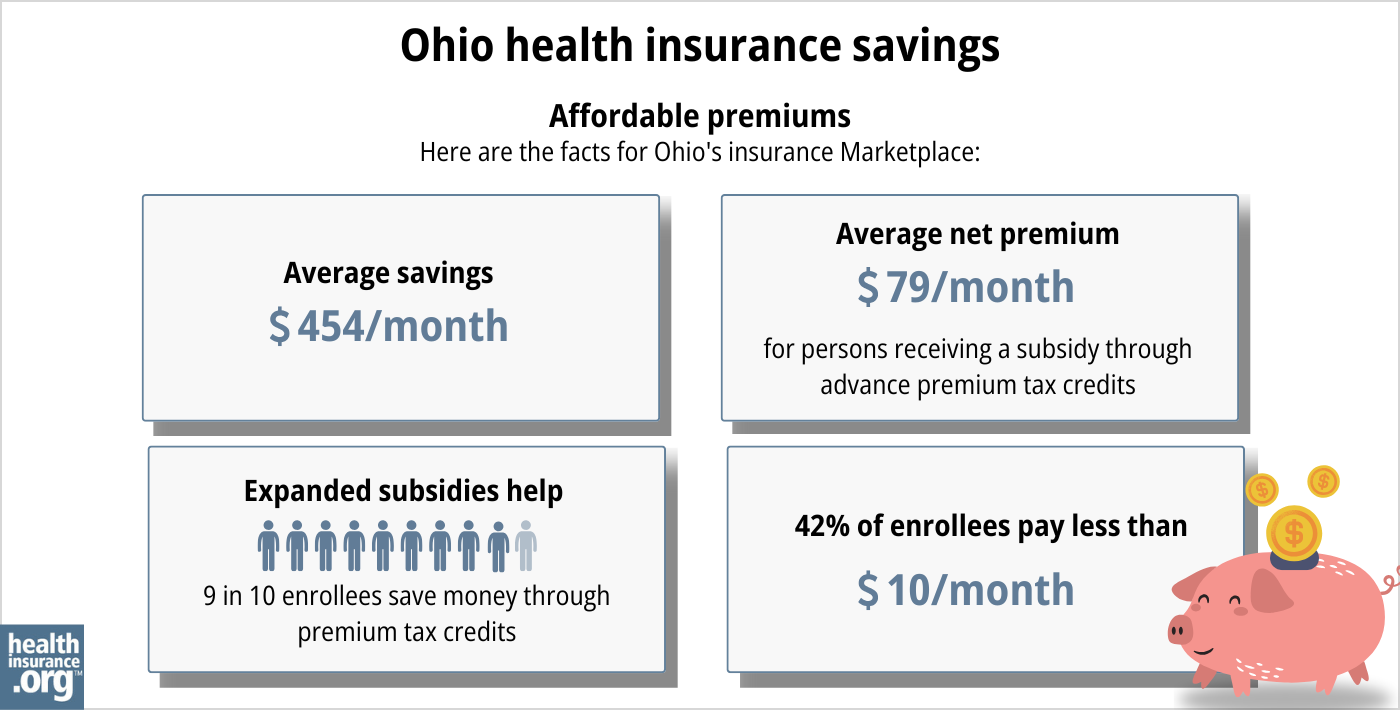
As of early 2024, nine out of ten Ohio Marketplace enrollees were receiving APTC. The subsidies averaged about $499/month, and the average net premium paid by enrollees was about $130/month.12
(The numbers above are based on effectuated enrollment in early 2024. The chart below is a little different; it shows some different metrics, and uses data from all applications submitted during the open enrollment period for 2024 coverage.)
If your household income isn’t more than 250% of the federal poverty level, you may also be eligible for cost-sharing reductions (CSR). CSRs help lower your deductibles and out-of-pocket expenses. With APTCs and CSRs, an ACA plan may be a cost-effective health insurance option.
Low-cost health insurance is also available through Medicaid. Use our guide to see if you qualify for Medicaid in Ohio.
Source: CMS.gov13
How many insurers offer Marketplace coverage in Ohio?
Are Marketplace health insurance premiums increasing in Ohio?
The following average rate changes were approved for Ohio’s Marketplace insurers for 2025, calculated before premium subsidies are applied:16
Ohio’s ACA Marketplace Plan 2025 APPROVED Rate Increases by Insurance Company |
|
|---|---|
| Issuer | Percent Increase |
| Aetna Health, Inc. | 17.43% |
| AultCare Insurance Company | 9.69% |
| Buckeye Community Health Plan | -4.4% |
| CareSource Ohio, Inc. | 10.2% |
| Community Insurance Company(Anthem BCBS) | 6.84% |
| Medical Health Insuring Corp. (MedMutual) | 3.29% |
| Molina Healthcare of Ohio, Inc. | 0.48% |
| Oscar Buckeye State Insurance Corp | 4.64% |
| Oscar Insurance Corporation of Ohio | 7.58% |
| Paramount Insurance Company | -2.59% |
| Summa Insurance Company, Inc. | 10.51% |
| UnitedHealthcare of Ohio, Inc. | 6.56% |
| Antidote Health Plan of Ohio | New for 2025 |
Source: Ohio Rate Review Submissions16 and Ohio SERFF15
The rate changes for 2025 were approved without any changes during the rate review process, and amount to a weighted average rate increase of 3.9%.17
But that’s calculated before premium subsidies (premium tax credits) are applied. Most Ohio exchange enrollees receive premium tax credits, so they don’t pay the full premium.12 For those who qualify for subsidies, changes in plan rates and subsidy amounts determine their net rate change.
For perspective, here’s how average unsubsidized premiums have changed in Ohio over the years:
- 2015: Average increase of 4%18
- 2016: Average semi-weighted increase of 9.4%19
- 2017: Average semi-weighted increase of 17.3%20
- 2018: Average increase of 34%21
- 2019: Average increase of 6.3%22
- 2020: Average decrease of 7.7%23
- 2021: Average decrease of 0.4%24
- 2022: Average increase of 4.8%25
- 2023: Average semi-weighted increase of 6.85%26
- 2024: Average increase of 7.8%27
How many people are insured through Ohio’s Marketplace?
During the open enrollment period for 2024 coverage, 477,793 people enrolled in private health plans through Ohio’s Marketplace.28
This was far higher than any other year; the previous record high had come in 2023, when 294,644 people enrolled through Ohio’s Marketplace during open enrollment.29
The surge in enrollment in recent years is primarily due to the American Rescue Plan (ARP) making ACA’s premium subsidies more substantial. Under the ARP, subsidies are larger and more widely available. And this has been extended through the end of 2025 by the Inflation Reduction Act.30
The 2024 enrollment growth was also partially due to the “unwinding” of the pandemic-era Medicaid continuous coverage rule. Medicaid disenrollments resumed in Ohio in the spring of 2023, after being paused for three years. By April 2024, more than 190,000 Ohio residents had transitioned from Medicaid to a Marketplace plan. 31

Source: 2014,32 2015,33 2016,34 2017,35 2018,36 2019,37 2020,38 2021,39 2022,40 2023,41 2024,42 202543
What health insurance resources are available to Ohio residents?
Healthcare.gov: This is the federal website where you can enroll in a health insurance plan through the ACA Marketplace.
Ohio Medicaid: Eligible individuals and families can enroll in Medicaid, which provides low-cost or free health coverage. You can also enroll in Medicaid through Healthcare.gov or call (800) 318-2596.
Ohio Department of Insurance (ODI): To receive assistance with insurance and Medicare, call an ODI representative at (800) 686-1526.
Ohio Department of Job and Family Services: You can get help if you’re struggling to afford health coverage or want to know more about Medicaid eligibility or benefits.
Ohio Senior Health Insurance Information Program (OSHIP): OSHIP offers free health insurance information to people on Medicare.
Louise Norris is an individual health insurance broker who has been writing about health insurance and health reform since 2006. She has written dozens of opinions and educational pieces about the Affordable Care Act for healthinsurance.org.

Looking for more information about other options in your state?
Need help navigating health insurance options in Ohio?
Explore more resources for options in Ohio including short-term health insurance, dental insurance, Medicaid and Medicare.
Speak to a sales agent at a licensed insurance agency.
Footnotes
- ”2025 OEP State-Level Public Use File (ZIP)” Centers for Medicare & Medicaid Services, Accessed May 13, 2025 ⤶ ⤶
- ”Rate Review Submissions” RateReview.HealthCare.gov. Accessed Jan. 7, 2025 ⤶
- ”Effectuated Enrollment: Early 2024 Snapshot and Full Year 2023 Average” CMS.gov, July 2, 2024 ⤶
- ”Plan Year 2025 Qualified Health Plan Choice and Premiums in HealthCare.gov Marketplaces” Centers for Medicare & Medicaid Services. Oct. 25, 2024 ⤶ ⤶
- ”A quick guide to the Health Insurance Marketplace” HealthCare.gov ⤶
- Medicare and the Marketplace, Master FAQ. Centers for Medicare and Medicaid Services. Accessed November 2023. ⤶
- Premium Tax Credit — The Basics. Internal Revenue Service. Accessed MONTH. ⤶ ⤶
- Updates to frequently asked questions about the Premium Tax Credit. Internal Revenue Service. February 2024. ⤶
- “When can you get health insurance?” HealthCare.gov, 2023 ⤶
- ”HHS Takes Additional Actions to Help People Stay Covered During Medicaid and CHIP Renewals” CMS Newsroom. Mar. 28, 2024 ⤶
- “Entities Approved to Use Enhanced Direct Enrollment” CMS.gov, Aug. 9, 2024 ⤶
- ”Effectuated Enrollment: Early 2024 Snapshot and Full Year 2023 Average” CMS.gov, July 2, 2024 ⤶ ⤶
- “2025 Marketplace Open Enrollment Period Public Use Files” CMS.gov, May 2025 ⤶
- “Ohio Rate Review Submissions” HealthCare.gov, Accessed Aug. 20, 2024 ⤶
- ”Ohio SERFF Filing AHPO-134256597″ Ohio SERFF. Accessed Oct. 28, 2024 ⤶ ⤶
- “Ohio Rate Review Submissions” HealthCare.gov, Accessed Nov. 1, 2024 ⤶ ⤶
- ”Ohio: Preliminary avg. unsubsidized 2025 #ACA rate changes: +3.9%” ACA Signups. Sep. 9, 2024 ⤶
- Analysis Finds No Nationwide Increase in Health Insurance Marketplace Premiums. The Commonwealth Fund. December 2014. ⤶
- FINAL PROJECTION: 2016 Weighted Avg. Rate Increases: 12-13% Nationally* ACA Signups. October 2015. ⤶
- Final Touches: APPROVED Unsubsidized Rate Hikes For Washington, South Carolina, Ohio. ACA Signups. October 2016. ⤶
- Ohio premiums for Obamacare policies to rise by 34 percent on average, state says. Cleveland.com. September 2017. ⤶
- Ohio: APPROVED 2019 #ACA Rates: 6.3% INCREASE Instead Of ~4.9% DECREASE W/Out #ACASabotage. ACA Signups. August 2018. ⤶
- Ohio: APPROVED 2020 #ACA Exchange Avg. Rate Changes: 7.7% *Decrease*. ACA Signups. August 2019. ⤶
- Ohio: Preliminary 2021 Avg. #ACA Premiums: +3.2% Or -0.4%?? ACA Signups. September 2020. ⤶
- Ohio: Approved Avg. 2022 #ACA Rate Changes: +4.8% Indy Market (Prelim Sm. Group: +5.1% Unweighted). ACA Signups. October 2021. ⤶
- UPDATED: FINAL Unsubsidized 2023 Premiums: +6.2% Across All 50 States +DC. ACA Signups. Accessed November 2023. ⤶
- ”Ohio: *Final* avg. unsubsidized 2024 #ACA rate changes: +7.8%” ACA Signups. Oct. 31, 2023 ⤶
- Marketplace 2024 Open Enrollment Period Report: Final National Snapshot. Centers for Medicare and Medicaid Services. January 2024. ⤶
- “Health Insurance Marketplaces 2023 Open Enrollment Report” CMS.gov, 2023 ⤶
- “Health Insurance Marketplaces 2023 Open Enrollment Report” CMS.gov, Accessed August 2023 ⤶
- HealthCare.gov Marketplace Medicaid Unwinding Report. Centers for Medicare and Medicaid Services. Data through April 2024; Accessed Aug. 20, 2024 ⤶
- “ASPE Issue Brief (2014) ” ASPE, 2015 ⤶
- “ Health Insurance Marketplaces 2015 Open Enrollment Period: March Enrollment Report ”, HHS.gov, 2015 ⤶
- “ HEALTH INSURANCE MARKETPLACES 2016 OPEN ENROLLMENT PERIOD: FINAL ENROLLMENT REPORT ” HHS.gov, 2016 ⤶
- “ 2017 Marketplace Open Enrollment Period Public Use Files” CMS.gov, 2017 ⤶
- “ 2018 Marketplace Open Enrollment Period Public Use Files ” CMS.gov, 2018 ⤶
- “ 2019 Marketplace Open Enrollment Period Public Use Files” CMS.gov, 2019 ⤶
- “ 2020 Marketplace Open Enrollment Period Public Use Files ” CMS.gov, 2020 ⤶
- “ 2021 Marketplace Open Enrollment Period Public Use Files ” CMS.gov, 2021 ⤶
- “ 2022 Marketplace Open Enrollment Period Public Use Files ” CMS.gov, 2022 ⤶
- “ Health Insurance Marketplaces 2023 Open Enrollment Report ” CMS.gov, 2023 ⤶
- ”HEALTH INSURANCE MARKETPLACES 2024 OPEN ENROLLMENT REPORT” CMS.gov, 2024 ⤶
- “2025 Marketplace Open Enrollment Period Public Use Files” CMS.gov, May 2025 ⤶