Medicaid eligibility and enrollment in Kentucky
Medicaid enrollment in Kentucky is 113% higher than it was in 2013


Who is eligible for Medicaid in Kentucky?
Kentucky’s Medicaid eligibility levels are as follows (these limits include a built-in 5% income disregard that’s used for income-based Medicaid eligibility determinations):1
- Children up to age 1 with family income up to 200% of the federal poverty level (FPL)
- Children ages 1 to 18 with family income up to 64% of FPL
- Children with family income too high to qualify for Medicaid are eligible for the Kentucky Children’s Health Insurance Program (KCHIP); KCHIP is available to kids with family income up to 218% of FPL
- Pregnant women with family income up to 200% of FPL (coverage for the mother continues for 12 months after the baby is born)
- Parents and other adults are covered with incomes up to 138% of FPL
Kentucky Medicaid is also available to individuals who are disabled and those who are 65 or older, but eligibility rules for those populations include both income and asset/resource limits.
for 2026 coverage
0.0%

of Federal Poverty Level
Apply for Medicaid in Kentucky
Enroll online at Kynect. Apply by telephone by calling 1-855-459-6328 or TTY 1-855-326-4654. Apply in person at a local office of the Department for Community Based Services.
Eligibility: Children up to age 1 with family income up to 195% of FPL. Children ages 1-18 with family income up to 159% of FPL; children with family income up to 213% of FPL are eligible for the Kentucky Children’s Health Insurance Program. Pregnant women with family income up to 195% of FPL. Adults with income up to 138% of FPL. See the Programs and Services page for guidelines for elderly, disabled, and others who may qualify.



Did Kentucky expand Medicaid under the ACA?
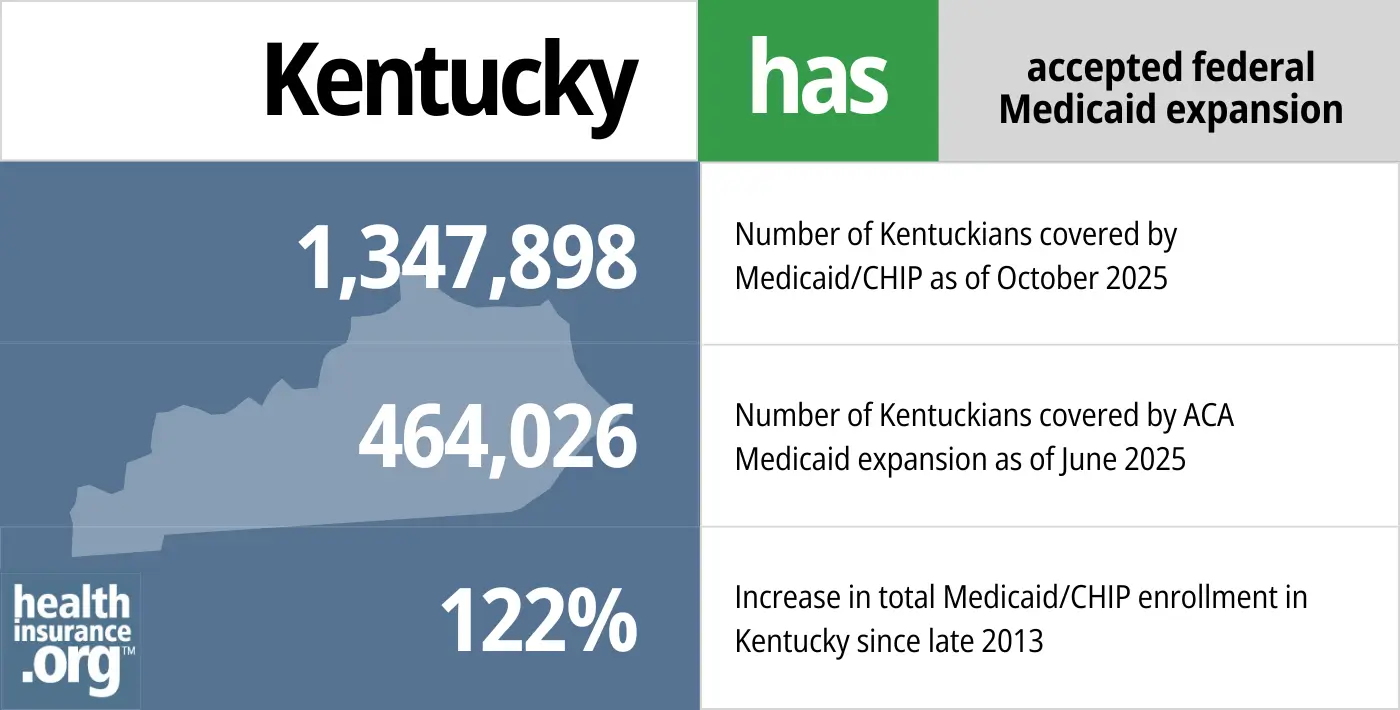
Yes, Kentucky accepted federal funding to expand Medicaid starting in 2014. As of early 2026, there were about 450,000 Kentucky residents covered under Medicaid expansion,2 amounting to just over a third of the 1.3 million total Medicaid/CHIP enrollees in Kentucky.3
Under H.R.1 (the “Big Beautiful Bill“) that was enacted by the federal government in 2025, the Medicaid expansion population will have a work requirement starting in 2027, as well as eligibility redeterminations every six months rather than once per year. That legislation also adds some cost-sharing for Medicaid expansion enrollees with income above the poverty level, starting in October 2028.
Kentucky has enacted legislation to codify those requirements into state law as well,4 so they would continue to be required in Kentucky even if federal rules were to change.
- 1,294,021 – Number of Kentuckians covered by Medicaid/CHIP as of March 20265
- 464,026 – Number of Kentuckians covered by ACA Medicaid expansion as of June 20256
- 113% – Increase in total Medicaid/CHIP enrollment in Kentucky since late 20137
Explore our other comprehensive guides to coverage in Kentucky



The ACA Marketplace allows individuals and families to shop for and enroll in ACA-compliant health insurance plans. Subsidies may be available based on household income to help lower costs.

Hoping to improve your smile? Dental insurance may be a smart addition to your health coverage. Our guide explores dental coverage options in Kentucky.

Use our guide to learn about Medicare, Medicare Advantage, and Medigap coverage available in Kentucky as well as the state’s Medicare supplement (Medigap) regulations.

Short-term health plans provide temporary health insurance for consumers who may find themselves without comprehensive coverage.
Frequently asked questions about Kentucky Medicaid eligibility and enrollment
How do I apply for Medicaid in Kentucky?
You can do any of the following to apply for Medicaid in Kentucky if you are under 65 (and don’t have Medicare):
- Enroll online using HealthCare.gov or Benefind.ky.gov.
- Apply by telephone (HealthCare.gov) by calling 1-800-318-2596 or TTY 1-855-889-4325, or Benefind at 1-855-306-8959 (these phone numbers are for applicants under age 65)
- Download a paper application. Mail your application to the DCBS Family Support P.O. Box 2104 Frankfort KY 40602. You may also fax your application to 1-502-573-2007.
If you are 65 or older or have Medicare, you can apply for Kentucky’s Medicare Savings Program, which is run by the state Medicaid office.
How does Medicaid provide assistance to Medicare beneficiaries in Kentucky?
Many Medicare beneficiaries also receive help through Medicaid with the expense of Medicare premiums, prescription drugs, and services that aren’t covered by Medicare — like long-term care.
Our guide to financial resources for Medicare enrollees in Kentucky includes overviews of those programs, including Medicare Savings Programs, long-term care benefits, and income guidelines for assistance.
How many people were disenrolled from Kentucky Medicaid after the pandemic?
To address the COVID pandemic, Medicaid disenrollments were paused nationwide from March 2020 through March 2023. People were not disenrolled from Medicaid during that time, even if their circumstances changed and they were no longer eligible for Medicaid. But the federal continuous coverage requirement ended March 31, 2023, and states had a 12-month “unwinding” period to redetermine eligibility for all Medicaid enrollees. People who were no longer eligible, as well as people who failed to respond to a renewal notice, were disenrolled from Medicaid.
The first round of disenrollments in Kentucky came at the end of May 2023. By June 2024, at the end of the unwinding process, 240,130 people had been disenrolled from Kentucky Medicaid. About 55% of them were disenrolled for procedural reasons, meaning the state didn’t have enough information to determine whether they were still eligible.8
The state had estimated that more than 236,000 people could potentially lose their Medicaid benefits in Kentucky during the unwinding period, which ended up being quite accurate. In addition to the people who were disenrolled for procedural reasons, others were disenrolled because their income had increased above the Medicaid-eligible limits, they had been eligible due to pregnancy and were now more than 12 months postpartum, or because they had aged out of Medicaid for children or Medicaid expansion (ie, turned 19 or 65).
People who lost Medicaid were able to transition to an employer’s plan (if available), Medicare, or to an individual/family plan obtained through Kynect. CMS reported that 29,632 Kentucky residents transitioned from Medicaid to a Kynect policy during the unwinding period.9
How many people are enrolled in Kentucky Medicaid?
As of March 2026, there were nearly 1.3 million people enrolled in Medicaid/CHIP in Kentucky.5
This was 113% higher than enrollment had been in 2013, before the ACA’s expansion of Medicaid took effect. Kentucky had the second-highest enrollment growth in the nation at that point, Second only to Nevada.7 Nationwide, Medicaid enrollment was 29% higher in March 2026 than it had been in 2013.
Kentucky Medicaid history and details
Does Kentucky have a Medicaid work requirement?
Starting in January 2027, Kentucky will have a Medicaid work requirement — also known as a community engagement requirement — for the Medicaid expansion population (adults age 19-64). This is required under federal legislation (the “Big Beautiful Bill“) that was enacted in 2025.
In 2026, Kentucky enacted legislation to codify those requirements into state law as well.4
Kentucky Medicaid expansion enrollees who don’t qualify for an exemption will need to comply with the work requirement in order to enroll in or renew their Medicaid coverage.
To comply, an enrollee can:10
- Complete at least 80 hours per month of work, job training, volunteering/community service, or a combination of those.
- Attend school at least half-time
- Earn at least $580/month (MAGI, which includes both earned and unearned income)
Kentucky’s previous state-specific medicaid work requirement never took effect, and was rescinded by Governor Andy Beshear in 2019. Governor Beshear took office in December 2019 and one of his first acts was to sign an executive order that rescinded former Governor Matt Bevin’s 2018 executive order that had begun the process of creating a Medicaid work requirement in Kentucky. Beshear’s administration notified CMS that the state was terminating the Kentucky HEALTH waiver, and the state stopped defending the program in the lawsuit that had held up the implementation of the work requirement since mid-2018.
Kentucky lawmakers continued trying to implement a Medicaid work requirement. Legislation (HB 7) was enacted in 2022 after lawmakers overrode Gov. Beshear’s veto. It called for the state to implement a Medicaid work requirement by April 2023, for non-disabled adults (19 – 59) without dependent children who had been enrolled in Medicaid for more than 12 months. That program never took effect either, but federal legislation enacted in 2025 requires a Medicaid expansion work requirement as of 2027. As noted above, Kentucky enacted legislation to codify the new federal rules in to state statute as well.
Kentucky Medicaid’s work requirement history
Kentucky residents elected Matt Bevin in November 2015 (incumbent Steve Beshear — Andy’s father — was term-limited and could not run). Bevin, a Tea Party Republican, had expressed his desire to pull back from the existing Medicaid expansion in Kentucky. Early in 2015, Bevin said he would eliminate Medicaid expansion entirely, but his position softened towards the end of the campaign. By 2016, Bevin no longer planned to eliminate coverage for the nearly half a million people who had obtained Medicaid under Kentucky’s expansion. Instead, he proposed that the state seek a Section 1115 waiver from the federal government to allow Kentucky to design its own version of Medicaid expansion.
In August 2016, Bevin did just that, submitting his Kentucky HEALTH Section 1115 demonstration waiver proposal to HHS for review. Bevin’s administration initially anticipated federal approval by summer 2017, and enactment of the waiver provisions as of January 2018. Ultimately, that time frame was pushed back a bit, with federal approval coming in January 2018, with the bulk of the waiver set to be implemented in July 2018.
The Kentucky HEALTH waiver applied to non-disabled Medicaid enrollees ages 19-64, and most of the provisions in the waiver constituted benefit cuts in an effort to control costs. But Kentucky HEALTH did not apply to disabled Medicaid enrollees, or to those younger than 19 or older than 64.
Kentucky’s waiver included a requirement that enrollees work at least 80 hours per month (or otherwise participate in “community engagement” activities — like job training or community service — for at least 80 hours per month). When Kentucky’s waiver was initially approved in January 2018, it was the first time that CMS approved a work requirement for Medicaid (Arkansas was able to implement their work requirement first, in June 2018, but Kentucky’s was approved first; the work requirement in Arkansas was later blocked by the same judge who blocked Kentucky’s work requirement).
A lawsuit was filed by consumer advocacy groups on behalf of several Kentucky residents who had Medicaid coverage, challenging the legality of the work requirement waiver. On June 29, 2018, just two days before Kentucky’s work requirement was scheduled to take effect, U.S. District Judge James E. Boasberg ruled that HHS should never have approved Kentucky’s waiver, as it conflicted with Medicaid’s mission. Boasberg wrote that the Secretary of HHS “never adequately considered whether Kentucky HEALTH would, in fact, help the state furnish medical assistance to its citizens, a central objective of Medicaid. This signal omission renders his determination arbitrary and capricious. The Court, consequently, will vacate the approval of Kentucky’s project and remand the matter to HHS for further review.”
Once the state’s waiver was blocked, the Bevin Administration indicated that they were considering ending Medicaid expansion in Kentucky in order to address budget shortfalls. But that did not come to pass.
In July 2018, HHS reopened a public comment period for the proposed Kentucky HEALTH waiver, ostensibly seeking public input on the waiver and how to address the court’s decision. They received nearly 8,500 comments expressing opposition to the proposed work requirement, and just 374 comments that were supportive of it. But in November, CMS reapproved the Kentucky HEALTH waiver, with very little in the way of changes. The work requirement was still included, as were monthly premiums and the elimination of retroactive coverage.
The new waiver approval was scheduled to take effect April 1, 2019, but on March 27, 2019, Judge Boasberg once again blocked implementation of Kentucky HEALTH, noting that Kentucky and HHS had not remedied the central flaw in the Kentucky HEALTH waiver: The fact that numerous people were likely to lose coverage if a work requirement was implemented. The state published a series of FAQs following the ruling, clarifying that Kentucky HEALTH was not being implemented on April 1 due to the court decision, and that a rescheduled implementation date had not been set. Kentucky’s Cabinet for Health and Family Services also issued a statement, emphatically disagreeing with Judge Boasberg’s ruling.
The Trump administration and the state of Kentucky appealed Boasberg’s ruling in April 2019, and oral arguments were heard by a three-judge panel on the U.S. Court of Appeals for the District of Columbia Circuit in October 2019. All three judges expressed concerns that mirrored Boasberg’s, casting doubt on whether the work requirement would prevail (and as noted above, Kentucky withdrew itself from the lawsuit as of December 2019).
Although Trump administration lawyers debated the semantics of the coverage losses (arguing — without much in the way of evidence — that work requirements will lead to people being covered by employer-sponsored plans or private plans in the individual market instead of Medicaid), it’s important to understand that when it comes to Medicaid work requirements, coverage loss is a feature, not a bug; work requirements are designed to reduce the number of people with Medicaid coverage. That makes it challenging for any state to design a mandatory work requirement in a manner that will avoid coverage losses.
Kentucky’s second waiver approval (which was subsequently blocked by the court) came just two weeks after MACPAC (the statute-created non-partisan federal agency that conducts data analysis for Medicaid and CHIP and makes recommendations to HHS for policy related to Medicaid and CHIP) sent a letter to HHS recommending that disenrollments for failing to comply with the Medicaid work requirement in Arkansas be paused until adjustments could be made to the program to “promote awareness, reporting, and compliance.”
Arkansas was the only state where a Medicaid work requirement had been implemented at that point, and more than 12,000 Arkansas residents had lost their coverage in the first few months after it took effect. The coverage losses in Kentucky were expected to be substantial, with 95,000 fewer people covered under the new waiver if it had been implemented. And that estimate might have been on the low side.
The Trump and Bevin administrations went to great lengths to point out that the lower anticipated enrollment under the waiver could have been due to a variety of factors, including people transitioning to commercial insurance, temporary suspensions, and the elimination of retroactive eligibility. The waiver approval also highlighted the fact that people who don’t comply with the reporting requirements for a Medicaid work requirement are choosing not to comply with the requirements, despite the fact that there are significant concerns that people might not be aware of the reporting requirements or fully understand how to comply with them. But any way you look at it, the point of the Kentucky HEALTH waiver was to reduce the number of people on Medicaid in Kentucky. And there is no mechanism to prevent these individuals from simply joining the ranks of the uninsured once they no longer have Medicaid coverage.
What was Kentucky trying to do with the Kentucky HEALTH waiver?
The Kentucky HEALTH Medicaid waiver was never implemented, despite being approved twice by the federal government. And Governor Beshear officially terminated the waiver as of late 2019. But here’s a summary of the changes the waiver would have made to Kentucky’s Medicaid program for adults age 19-64 (Kaiser Family Foundation has a more detailed summary here):
- Dental and vision services (limited coverage was already provided under Kentucky Medicaid), over the counter medications, and partial reimbursement for gym memberships would have been available via a new system called My Rewards Account. Although the Kentucky HEALTH waiver demonstration was scheduled to take effect in July 2018, Kentucky residents were able to start earning points in their My Rewards Accounts as of April 1, 2018. To earn credit in a My Rewards Account (which could then be used for the aforementioned services), Medicaid enrollees would need to complete various actions such as smoking cessation programs, job training, taking the GED, completing a financial literacy course, or a course on managing chronic health conditions. Although the stated intent was to lift people out of poverty and reduce spending on Medicaid, the proposal was widely panned by public health experts, and dentists question the wisdom of reducing dental benefits in an area where dental disease is widespread.
- A “community engagement” requirement (i.e., a work requirement) applicable to non-disabled Medicaid enrollees aged 19-64, although some populations would have been exempt. Each month, enrollees would have had to complete 80 hours of “community engagement activities,” (a job, job training, education, or community service). Bevin’s administration projected that about 350,000 Medicaid enrollees would have been subject to the community engagement requirement; various populations would have been exempt.
- Enrollees would have had to pay premiums in order to remain enrolled in Kentucky HEALTH. The premiums would have varied based on income, and would have ranged from $1/month to $15/month. Those with income above the poverty level (100 – 138% of the poverty level) who didn’t pay premiums for 60 days would have been locked out of the program for six months.
- Bevin’s administration projected that Medicaid enrollment in the state would have dropped by about 90,000 to 100,000 people as a result of the Kentucky HEALTH program (due in part to the community engagement requirement, but also the new premiums for some enrollees, and the various hoops that enrollees would have had to jump through in order to maintain coverage). Consumer advocates worried that some (many?) of the people who ultimately lost coverage as a result of the community engagement requirement would actually have been eligible for Medicaid under the new rules, but would have been stymied by the reporting requirements and other aspects of proving their eligibility.
- Able-bodied, non-pregnant adults enrolled in Kentucky Medicaid would have had a $1,000 “deductible” but it wouldn’t have worked like regular health insurance deductibles (some media outlets reported this as if members would have had to pay for their first $1,000 in medical costs, but that was not the case). Essentially, non-preventive services would have been tracked against a $1,000 balance in each member’s “Deductible Account.” At the end of the year, up to 50% of the remaining balance of the “deductible” would be transferred to the member’s My Rewards Account. It was an incentive intended to get enrollees to avoid unnecessary care, in order to keep the credit in the deductible account and then transfer some of it over to the My Rewards Account. The waiver approval described the Deductible Account as “an educational tool to encourage appropriate health care utilization” and noted that “the Deductible Account is also likely to prepare beneficiaries to manage their coverage in the commercial market, where plans often impose deductibles.” But enrollees who use up the virtual money in their Deductible Accounts (ie, by receiving non-preventive care during the year) would still have been able to access medical care for the remainder of the year, and no money would have come out of the enrollees’ pockets for this program.
- Retroactive eligibility would no longer have been available for Kentucky HEALTH enrollees, except for pregnant women and former foster care youth. Retroactive eligibility allows people to sign up for Medicaid with an effective date up to three months earlier. This program is particularly useful for hospitals, as it allows them to help uninsured (but Medicaid-eligible) patients to enroll in Medicaid and be covered for the care that they receive as soon as they enter the hospital, rather than having to wait for enrollment to take effect.
- In granting approval for Kentucky’s waiver, CMS noted that “The approval of the waiver of retroactive eligibility encourages beneficiaries to obtain and maintain health coverage, even when healthy. This is intended to increase continuity of care by reducing gaps in coverage when beneficiaries churn on and off Medicaid or sign up for Medicaid only when sick.” However, the new premium requirements and community engagement requirements would have resulted in some people losing access to Medicaid, and hospitals would likely have seen more uninsured patients. Since they wouldn’t have been able to enroll people in Kentucky HEALTH retroactively, the result could have been more uncompensated care for Kentucky hospitals.
While the language of Kentucky’s waiver and the CMS approval letter was couched in positivity (ie, empowering patients, encouraging community engagement, etc.), Bevin’s underlying position all along was that the state couldn’t afford to have half a million new enrollees in its Medicaid program under the ACA, and his objective was to trim the Medicaid roles in Kentucky.
Although Medicaid expansion waivers are certainly better than rejecting expansion altogether, they tend to limit enrollment more than straight expansion. That’s because waivers typically include some way for enrollees to have “skin in the game,” including premiums for some enrollees. But numerous studies have shown that imposing premiums on very low-income people tends to result in fewer people obtaining coverage. And there is no doubt that work requirements also result in fewer people obtaining and maintaining Medicaid coverage — we saw that happen in 2018 in Arkansas.
Kentucky Medicaid history
Despite former Gov. Beshear’s conviction about the benefits of expanding Medicaid, Kentucky did not announce the decision until May 2013. Beshear cited concerns about the cost in explaining why the state’s decision came slower than in other states that adopted expansion. But Beshear strongly advocated for both Medicaid expansion and a state-run marketplace (Kynect). His administration touted both the public health and economic benefits of Medicaid expansion, including improved health outcomes through access to health insurance, the creation of nearly new 17,000 jobs, and a $15.6 billion impact on the state economy over seven years.
The Kentucky legislature did not authorize Medicaid expansion, which was a concern for Senate President Robert Stivers. However, Kentucky’s Medicaid eligibility rules are defined in state regulations, which can be changed by executive order. Accordingly, legislative approval was not needed.
While Kentucky Medicaid expansion was secure during its first couple of years, analysis by the Rockefeller Institute indicated that the lack of legislative approval could leave the program in jeopardy after Beshear left office. That is exactly the scenario the state encountered when Governor Bevin’s administration took over.
Bevin would have been able to roll back Medicaid expansion without legislative action, although he backed off from that tactic very early on, favoring an 1115 waiver to make changes to the existing program instead. The Trump administration twice approved Kentucky’s waiver proposal (which hinged in large part on a work requirement for able-bodied adults enrolled in Medicaid), but a federal judge blocked implementation of the program and Gov. Andy Beshear officially rescinded the work requirement in late 2019.

Explore Marketplace, short-term, dental, and Medicare options in Kentucky
See Kentucky coverage guidesNeed help? Speak to a licensed agency partner about Kentucky health insurance options
Call 888-383-5527Footnotes
- ”With respect to MAGI conversion, how will the 5% disregard be applied?” Medicaid.gov. Accessed July 5, 2026 ⤶
- ”Kentucky Medicaid bill could hit low-income patients hardest” WPSD Local 6. Mar. 30, 2026 ⤶
- “March 2026 Medicaid & CHIP Enrollment Data Highlights” , Medicaid.gov, Accessed July 5, 2026 ⤶
- ”Kentucky HB2” BillTrack50. Enacted Apr. 14, 2026 ⤶ ⤶
- “October 2025 Medicaid & CHIP Enrollment Data Highlights” , Medicaid.gov, Accessed February 2026 ⤶ ⤶
- “Medicaid Enrollment – New Adult Group”, Medicaid.gov, Accessed February 2026 ⤶
- “Total Monthly Medicaid & CHIP Enrollment and Pre-ACA Enrollment”, KFF.org, Accessed July 5, 2026 ⤶ ⤶
- ”Medicaid/CHIP Monthly Enrollment Tracker, State data (Kentucky)” KFF.org. July 1, 2026 ⤶
- ”State-based Marketplace (SBM) Medicaid Unwinding Report” Medicaid.gov. Updated Dec. 27, 2024 ⤶
- ”Medicaid Community Engagement” Kentucky Medicaid. Accessed July 5, 2026 ⤶