Florida Health Insurance Marketplace for 2026

Compare ACA plans and check subsidy savings from a licensed third-party health insurance agency.
Florida ACA Marketplace quick facts


Florida health insurance Marketplace guide
This guide, including the FAQs below, will help you understand the Florida health insurance options available to you and your family. Many people find that an Affordable Care Act (ACA) Marketplace plan – or Obamacare – helps them save money on health insurance expenses.
Florida uses the federally-facilitated Health Insurance Marketplace: HealthCare.gov. Individual and family plans on the ACA exchange in Florida are available for:3
- Self-employed people
- People who retired early and need coverage until they become eligible for Medicare
- People who work for small businesses without health benefits
Florida’s Marketplace has by far the highest enrollment in the U.S. Almost one out of every five Marketplace enrollees is in Florida.4
Sixteen private insurance companies are offering coverage through the Florida Health Insurance Marketplace for 2026,5 with plan availability varying from one area to another.6 But as explained below, there are some changes in the list of participating insurers for 2026. Premium changes for 2026 are also detailed below.
Florida banned surprise balance billing starting in mid-2016, for state-regulated health plans.7 Florida’s law was lauded as a model for other states that wanted to implement similar consumer protections. The federal No Surprises Act took effect in 2022, providing nationwide protection from surprise balance bills, including for people with self-insured plans (which aren’t regulated by state laws).
Frequently asked questions about health insurance in Florida
Who can buy Marketplace health insurance in Florida?
To qualify for Florida Health Insurance Marketplace coverage, you must:3
- Live in Florida
- Be a U.S. citizen, national, or lawfully present in the U.S.
- Not be incarcerated
- Not be enrolled in Medicare
But those rules just allow a person to enroll in coverage through the exchange. Eligibility for financial assistance (premium subsidies and/or cost-sharing reductions) through the Health Insurance Marketplace depends on how your household income compares with the cost of the second-lowest-cost Silver plan in your area.
In addition, to qualify for financial assistance with your Marketplace plan you must:
- Not be eligible for Medicaid or CHIP (Florida KidCare), or premium-free Medicare Part A.8
- Not have access to affordable employer-sponsored health coverage. If your employer (or your spouse’s employer) offers coverage but you feel it’s too expensive, you can use our Employer Health Plan Affordability Calculator to learn whether you might be eligible for premium subsidies in the Florida Marketplace.
- If married, file a tax return jointly with your spouse.9
- Not be able to be claimed by someone else as a tax dependent.9
When can I enroll in an ACA-compliant plan in Florida?
The open enrollment period to sign up for ACA-compliant individual and family health insurance in Florida runs from November 1 to January 15.10
- Enroll by December 15 for coverage to start January 1.
- If you enroll between December 16 and January 15, coverage will begin on February 1.
Open enrollment will be shorter, however, starting in the fall of 2026. Due to a rule change that was finalized in 2025, the open enrollment period will still start on November 1, but it will end on December 15. All plans selected during open enrollment will take effect January 1.
If you miss open enrollment, you can still enroll or switch plans if you meet the special enrollment period (SEP) requirements. Most SEPs require a qualifying life event like losing coverage, getting married, or permanently moving, but Native Americans can enroll year-round.11
How do I enroll in a Florida health insurance Marketplace plan?
To sign up for a Florida Health Insurance Marketplace plan, you have several enrollment options:
- Online through HealthCare.gov.
- By calling the Marketplace Call Center at (800) 318-2596.
- With the help of licensed agents, navigators, or certified application counselors or an approved enhanced direct enrollment entity.12
- Mailing in a paper application
Go to localhelp.HealthCare.gov to find a navigator, certified application counselor, or agent in your area.
How can I find affordable health insurance in Florida?
You can find affordable individual and family health insurance in Florida through HealthCare.gov, which is Florida’s ACA exchange/Marketplace.
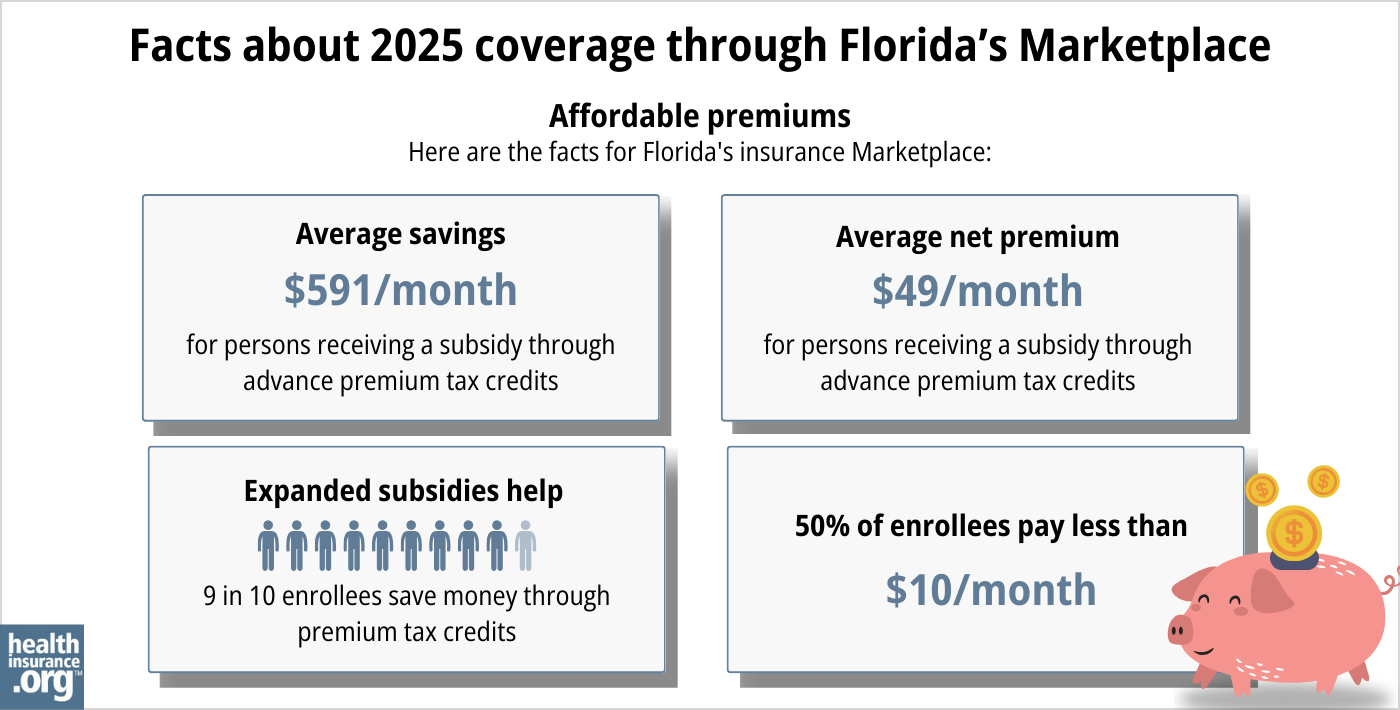
During open enrollment for 2025 coverage, more than 97% of Florida’s Health Insurance Marketplace enrollees qualified for premium subsidies.13 These subsidies, called Advance Premium Tax Credits (APTC), lower your monthly premiums.
The subsidies averaged $591/month, and the average subsidy-eligible enrollee was paying about $49/month for their coverage after the subsidies were applied.13
If your household income is between 100% and 250% of the federal poverty level and you select a Silver plan through the Florida Health Insurance Marketplace, you will also receive cost-sharing reductions (CSR). As of early 2025, two-thirds of Florida’s Marketplace enrollees were receiving CSR benefits.14
While APTCs help reduce health insurance costs, CSRs reduce out-of-pocket costs like deductibles, copayments, or coinsurance.
Source: CMS.gov 13
Medicaid and Florida KidCare (CHIP) are options for affordable health insurance in Florida if you qualify for either program.
Alternatively, short-term plans offer low-cost health coverage, for people who aren’t eligible for Medicaid or a Marketplace subsidy. These plans can also be used for temporary coverage by people who missed the annual enrollment period for ACA-compliant coverage. But short-term health insurance is much less robust than ACA-compliant coverage, generally does not cover pre-existing conditions or all of the essential health benefits, and should not be considered an adequate substitute for ACA-compliant major medical coverage.
How many insurers offer Marketplace health insurance in Florida?
Sixteen insurers are offering coverage through the Florida Health Insurance Marketplace for 2026, including two separate Cigna entities)5 (coverage areas vary by carrier).15
There were 15 participating carriers for 2025, but there are some changes for 2026:
- Aetna is exiting at the end of 2025 (as is the case in all states where they offer individual market coverage), so Aetna enrollees will need to select new coverage during the open enrollment period that begins November 1, 2025.
- Community Care Network Inc. (22 Health) is new for 20265 (plans only available in Broward County).15
- Cigna already offers Marketplace plans in 2025 (Cigna Health and Life Insurance Company), but is adding new HMO plans in 2026 that are sold under a separate entity (Cigna Healthcare of Florida, Inc.)
How much is health insurance in Florida and will premiums rise in 2025?
The following average rate changes have been approved for 2026 for individual/family plans sold through Florida’s Health Insurance Marketplace, amounting to an overall weighted average rate increase of 31.5% (before any subsidies are applied).5 (As described below, after-subsidy premium increases are much more significant, due to the expiration of the federal subsidy enhancements that have been in effect since 2021.)
Florida’s ACA Marketplace Plan 2026 APPROVED Rate Increases by Insurance Company |
|
|---|---|
| Issuer | Percent Increase |
| Aetna CVS Health / Coventry Health Plan of Florida | Exiting market |
| Community Care Network, Inc. (22 Health) | New for 2026 |
| AmeriHealth Caritas | 37.2% |
| AvMed | 24.5% |
| Blue Cross Blue Shield of Florida, Inc. | 29.6% |
| Capital Health Plan | 29.7% |
| Centene Venture Company Florida (Celtic/Ambetter) |
37.9% |
| Cigna Health & Life Ins. Co. | 29.5% |
| Cigna (HMO) | New for 2026 |
| Florida Health Care Plan, Inc. | 26.2% |
| Health First Commercial Plans | 23.2% |
| Health Options (Florida Blue HMO) | 29% |
| Molina Healthcare of Florida, Inc. | 40.8% |
| Oscar Insurance Company of Florida | 26.4% |
| Sunshine State Health Plan | 48.7% |
| UnitedHealthcare | 29.9% |
| Simply Healthcare Plans, Inc. (Wellpoint) | 27.2% |
Source: FLOIR (Florida Office of Insurance Regulation)5
Average rate changes are calculated before subsidies are applied. Most Florida exchange enrollees receive subsidies that cover the majority of the premium cost.16 But unless Congress takes action to extend the federal subsidy enhancements that have been in place since 2021, the enhancements will expire at the end of 2025. That will result in smaller subsidies in 2026, and some people losing their subsidy altogether. If that happens, coverage will be significantly less affordable, and fewer people will enroll in Marketplace plans for 2026.
As of October 31, a day before the start of open enrollment, Congress had not agreed to extend the subsidy enhancements. As a result, here are some examples of the sort of net premium increases that people are seeing in Fort Lauderdale:17
- 40-year-old earning $40,000:
- Lowest-cost plan in 2025 is $34/month
- Lowest-cost plan in 2026 is $110/month
- 60-year-old earning $63,000:
- Lowest-cost plan in 2025 is $191/month
- Lowest-cost plan in 2026 is $1,064/month (due to the subsidy cliff)
For perspective, here’s a summary of how full price premiums in Florida’s ACA-compliant market have changed over the years:
- 2015: Average increase of 7%18
- 2016: Average increase of 9.5%19
- 2017: Average increase of 19.1%20
- 2018: Average increase of 44.7%21 (federal funding for cost-sharing reductions was eliminated)
- 2019: Average increase of 5.2%22
- 2020: Average increase of 0%23
- 2021: Average increase of 3.1%24
- 2022: Average increase of 6.6%25
- 2023: Average increase of 7.2%26
- 2024: Average increase of 5.3%27
- 2025: Average increase of 7.5%28
How many people are insured through Florida’s Marketplace?
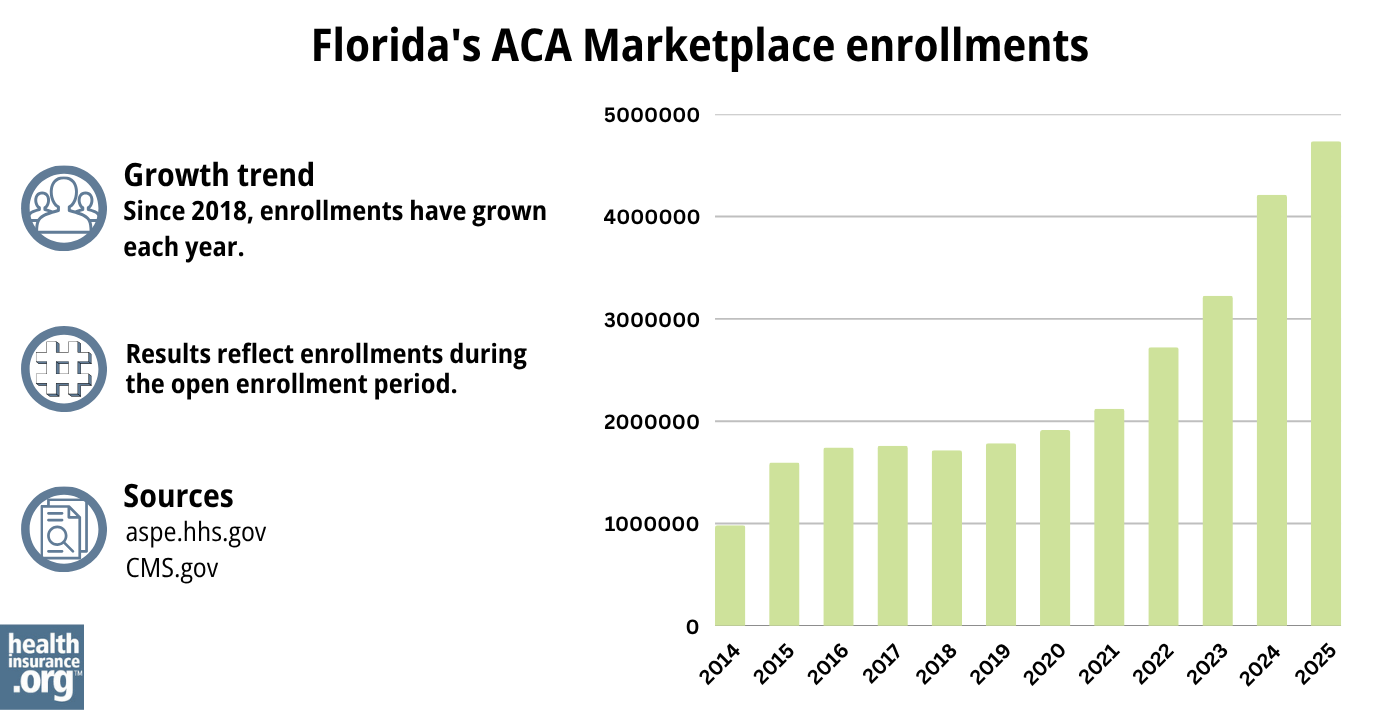
During the open enrollment period for 2025 coverage, a significant new record high of 4,735,415 people enrolled in health insurance through Florida’s Marketplace.29
Enrollment has been increasing for several years in a row (see chart below). The enrollment growth in recent years is due in part to the American Rescue Plan, which improved affordability starting in 2021. The Inflation Reduction Act then extended these improvements until 2025, ensuring coverage remains more affordable than it was before the ARP became law.30
The enrollment spike in 2024 and 2025 is also due to the “unwinding” of the pandemic-era Medicaid continuous coverage rule. Medicaid disenrollments resumed in 2023 after a three-year pause, and some people who previously had Medicaid transitioned to Marketplace coverage instead.
Source: 2014,31 2015,32 2016,33 2017,34 2018,35 2019,36 2020,37 2021,38 2022,39 2023,40 2024,41 202529
What health insurance resources are available to Florida residents?
Healthcare.gov
This is the ACA Marketplace, where you can enroll in a health insurance plan online. You may also get help by calling (800) 318-2596.
Florida Consumer Action Network (FCAN)
Nonprofit consumer advocacy group that helps Floridians understand their health insurance options.
Florida KidCare
Florida’s health insurance program for children.
FloridaHealthFinder.gov
State-run site to compare and enroll in health plans.
Federally funded Navigator organizations:
- University of Florida/Florida Covering Kids & Families – Helps people enroll in and understand health coverage.
- Urban League of Broward County – Helps underserved and vulnerable populations.
Florida Office of Insurance Regulation
Licenses and oversees health insurers, brokers, and agents. Helps consumers with complaints. Reviews annual health insurance rate changes.
Medicare Rights Center
National service with a call center providing advice and information for people with Medicare.
Louise Norris is an individual health insurance broker who has been writing about health insurance and health reform since 2006. She has written hundreds of opinions and educational pieces about the Affordable Care Act for healthinsurance.org.

Looking for more information about other options in your state?
Need help navigating health insurance options in Florida?
Explore more resources for options in FL including short-term health insurance, dental, Medicaid and Medicare.
Speak to a sales agent at a licensed insurance agency.
Footnotes
- ”2025 OEP State-Level Public Use File (ZIP)” Centers for Medicare & Medicaid Services, Accessed May 13, 2025 ⤶ ⤶
- ”Individual PPACA Market Monthly Premiums for Plan Year 2026” Florida Office of Insurance Regulation. Aug. 14, 2025 *The above is based on the most current data available. ⤶
- ”A quick guide to the Health Insurance Marketplace” HealthCare.gov ⤶ ⤶
- ”Effectuated Enrollment: Early 2024 Snapshot and Full Year 2023 Average” CMS.gov, July 2, 2024 ⤶
- “Individual PPACA Market Monthly Premiums for Plan Year 2026” Florida Office of Insurance Regulation. Oct. 16, 2025 ⤶ ⤶ ⤶ ⤶ ⤶
- ”Individual Market Availability by Company” Florida Office of Insurance Regulation. Accessed Nov. 2, 2025 ⤶
- ”Florida House Bill 221” BillTrack50. Enacted 2015. ⤶
- Medicare and the Marketplace, Master FAQ. Centers for Medicare and Medicaid Services. Accessed November 2023. ⤶
- Premium Tax Credit — The Basics. Internal Revenue Service. Accessed May 10, 2024 ⤶ ⤶
- “A quick guide to the Health Insurance Marketplace®” HealthCare.gov, Accessed August, 2023 ⤶
- “AIAN ACA 2021” CMS.gov, Accessed September 2023 ⤶
- “Entities Approved to Use Enhanced Direct Enrollment” CMS.gov, Aug. 9, 2025 ⤶
- “2025 Marketplace Open Enrollment Period Public Use Files” CMS.gov, May 2025 ⤶ ⤶ ⤶
- ”Effectuated Enrollment: Early 2025 Snapshot and Full Year 2024 Average” CMS.gov, July 24, 2025 ⤶
- ”Individual Market Availability by Company” Florida Office of Insurance Regulation. Accessed Nov. 6, 2025 ⤶ ⤶
- ”Effectuated Enrollment: Early 2025 Snapshot and Full Year 2024 Average” CMS.gov, July 24, 2025 ⤶
- ”See Plans & Prices” (zip 33301) HealthCare.gov. Accessed Oct. 31, 2025 ⤶
- Analysis Finds No Nationwide Increase in Health Insurance Marketplace Premiums. The Commonwealth Fund. December 2014. ⤶
- Individual PPACA Market Monthly Premiums for Plan Year 2016. Florida Office of Insurance Regulation, August 2015. ⤶
- Individual PPACA Market Monthly Premiums for Plan Year 2017. Florida Office of Insurance Regulation, September 2016. ⤶
- 2018 Rate Hikes. ACA Signups. October 2017. ⤶
- 2019 Rate Hikes. ACA Signups. October 2018. ⤶
- 2020 Rate Changes. ACA Signups. October 2019. ⤶
- Individual PPACA Market Monthly Premiums for Plan Year 2021 Florida Office of Insurance Regulation, September 2020. ⤶
- Florida Office of Insurance Regulation Announces 2022 PPACA Individual Market Health Insurance Plan Rates. Florida Office of Insurance Regulation, September 2021. ⤶
- Individual PPACA Market Monthly Premiums for Plan Year 2023 Florida Office of Insurance Regulation, September 2022 ⤶
- Individual PPACA Market Monthly Premiums for Plan Year 2024 Florida Office of Insurance Regulation, August 2023. ⤶
- ”Individual PPACA Market Monthly Premiums for Plan Year 2025” Florida Office of Insurance Regulation, Aug. 28, 2024 ⤶
- “2025 Marketplace Open Enrollment Period Public Use Files” CMS.gov, May 2025 ⤶ ⤶
- “Health Insurance Marketplaces 2023 Open Enrollment Report” CMS.gov, Accessed August 2023 ⤶
- “ASPE Issue Brief (2014) ” ASPE, 2015 ⤶
- “ Health Insurance Marketplaces 2015 Open Enrollment Period: March Enrollment Report ”, HHS.gov, 2015 ⤶
- “ HEALTH INSURANCE MARKETPLACES 2016 OPEN ENROLLMENT PERIOD: FINAL ENROLLMENT REPORT” HHS.gov, 2016 ⤶
- “2017 Marketplace Open Enrollment Period Public Use Files ” CMS.gov, 2017 ⤶
- “ 2018 Marketplace Open Enrollment Period Public Use Files ” CMS.gov, 2018 ⤶
- “2019 Marketplace Open Enrollment Period Public Use Files ” CMS.gov, 2019 ⤶
- “ 2020 Marketplace Open Enrollment Period Public Use Files ” CMS.gov, 2020 ⤶
- “ 2021 Marketplace Open Enrollment Period Public Use Files ” CMS.gov, 2021 ⤶
- “ 2022 Marketplace Open Enrollment Period Public Use Files ” CMS.gov, 2022 ⤶
- “ Health Insurance Marketplaces 2023 Open Enrollment Report ” CMS.gov, 2023 ⤶
- ”HEALTH INSURANCE MARKETPLACES 2024 OPEN ENROLLMENT REPORT” CMS.gov, 2024 ⤶