Find Georgia Health Insurance Marketplace Coverage for 2026

Need guidance? A licensed agent can help you:
- Compare plans in your area
- Understand costs and benefits
- Check your savings eligibility
- Enroll when you’re ready
Georgia Health Insurance Marketplace Guide
We created this Georgia health insurance guide, including the FAQs below, to help you understand the health insurance options and possible financial assistance available for you and your family.
Georgia’s ACA Marketplace (exchange) is a platform where a variety of private health insurers offer health insurance for people who need to buy their own individual or family health coverage. This includes people who don’t qualify for Medicare or Medicaid, and also don’t have an offer of health insurance from an employer.
Eight insurers will offer plans through Georgia’s Marketplace for 2027. There were nine in 2026, but two carriers are exiting at the end of 2026 and another is joining. You can see more details below about the participating insurers and their significant proposed premium increases for 2027.
From 2014 through 2024, Georgia used the federally-facilitated health insurance Marketplace, HealthCare.gov. But starting with the 2025 plan year, Georgia has a state-based Marketplace, known as Georgia Access.
Depending on your income and other circumstances, you may be eligible for financial assistance that will reduce your monthly insurance premium (the amount you pay to enroll in the coverage) and possibly your out-of-pocket expenses. These subsidies are only available through Georgia Access (but unlike other state-run Marketplaces, consumers can enroll in Georgia Access coverage via an EDE‘s website, rather than having to use the Georgia Access website directly).
Who can buy health insurance on Georgia's Marketplace?
To enroll in private health coverage through the Marketplace in Georgia, you must:1
- Be a resident of Georgia
- Be lawfully present in the United States
- Not be incarcerated
- Not have Medicare coverage
Those are the only qualifications you need to meet in order to enroll in a Marketplace plan, but qualifying for financial assistance (premium subsidies and cost-sharing reductions) is different, and has some additional parameters.
Eligibility for Marketplace financial assistance depends on your income and how it compares with the cost of the second-lowest-cost Silver plan in your area. In addition, to qualify for Marketplace financial assistance you must:
- Not have access to affordable employer-sponsored health coverage. If your employer offers coverage but you feel it’s too expensive, you can use our Employer Health Plan Affordability Calculator to see if you might qualify for premium subsidies in the Marketplace.
- Not be eligible for Medicaid or PeachCare for Kids (Georgia CHIP).
- Not be eligible for premium-free Medicare Part A.2
- If married, file a joint tax return.3
- Not be able to be claimed by someone else as a tax dependent.3
When can I enroll in an Affordable Care Act (ACA)-compliant health plan in Georgia?
You can sign up for a 2027 ACA-compliant individual or family health plan in Georgia between November 1, 2026 and January 15, 2027, which is the annual open enrollment period.4
Outside of the annual open enrollment period, your opportunity to enroll or make a plan change is limited. It’s generally only available if you experience a qualifying life event, such as giving birth or losing other health coverage. But Native Americans can enroll year-round without a qualifying life event.
Enrollment in Georgia Medicaid and PeachCare for Kids (CHIP) is available year-round, so if you’re eligible for either of these programs, you can enroll anytime.
Georgia ACA Marketplace quick facts


Frequently asked questions about health insurance in Georgia
How do I enroll in a Marketplace plan in Georgia?
In Georgia, you can sign up for ACA Marketplace coverage through Georgia Access, which is the state-based Marketplace in Georgia.
To enroll in an ACA Marketplace plan in Georgia, you can:
- Visit Georgia Access, which is Georgia’s health insurance Marketplace. This platform will let you compare the available plans, determine your eligibility for financial assistance, and enroll in the coverage that best meets your needs.
- Purchase individual and family health coverage with the help of an insurance agent or broker, a Navigator or certified application counselor, or an approved enhanced direct enrollment entity.
- Even after Georgia transitioned from HealthCare.gov to Georgia Access, enhanced direct enrollment entities can still enroll people in Marketplace coverage in Georgia. None of the other fully state-based exchanges use EDEs, so Georgia is unique in this regard.7
You can reach the Georgia Access call center by dialing 1-888-687-1503.
How can I find affordable health insurance in Georgia?
You may find affordable health insurance options in Georgia by enrolling in a plan through Georgia Access – especially if you’re eligible for financial assistance.
Income-based subsidies called Advance Premium Tax Credits (APTC) are available due to the Affordable Care Act. APTCs can help lower your premium payments each month, and most enrollees are eligible for these subsidies.
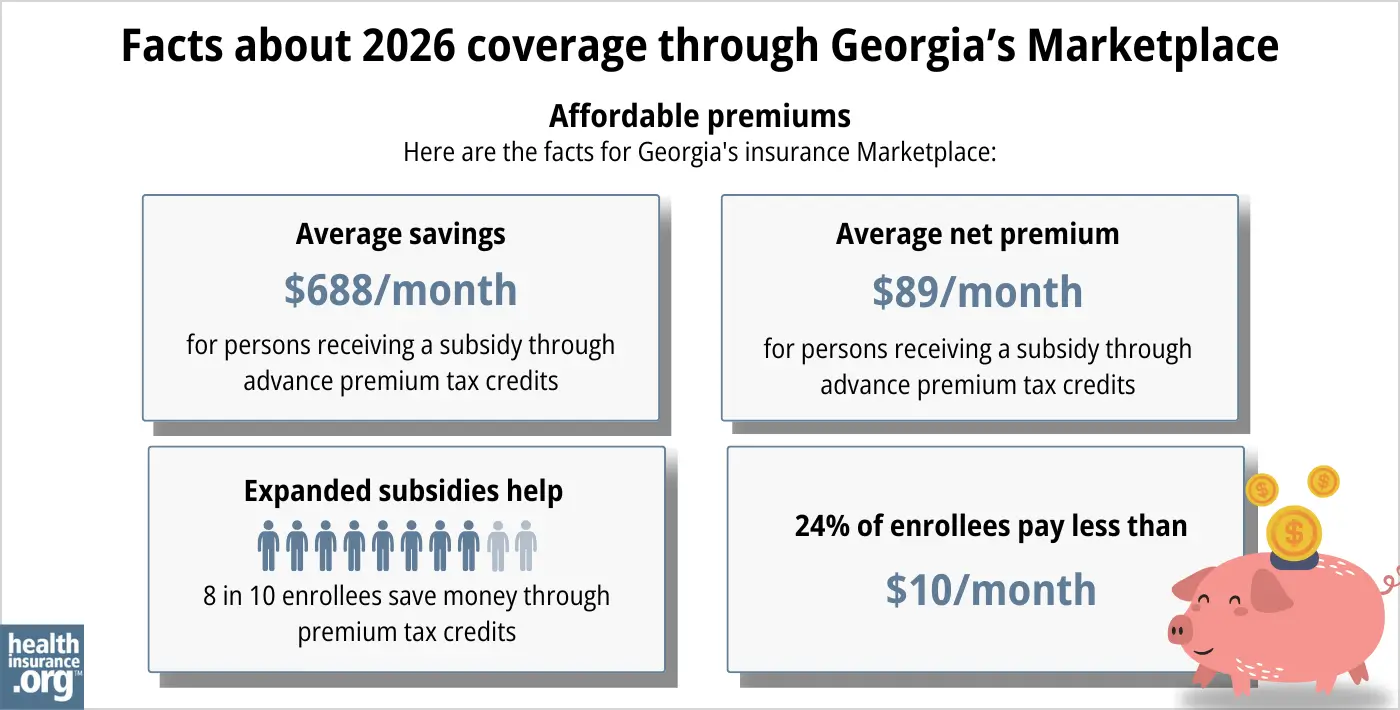
89% of the people who enrolled in coverage through Georgia’s Marketplace for 2026 were receiving premium subsidies.8 Those subsidies saved them an average of $688/month. After subsidies were applied, the average subsidy-eligible enrollee’s monthly cost was about $89/month.8
Source: CMS.gov8
Although most Georgia Marketplace enrollees are eligible for premium subsidies, the state’s reinsurance program, which took effect in 2022, helps to keep premiums lower than they would otherwise be for people who aren’t subsidy-eligible.9
If your household income isn’t more than 250% of the federal poverty level, you may also qualify for cost-sharing reductions (CSR), which are another type of ACA subsidy. These subsidies can lower your deductibles and out-of-pocket expenses as long as you select a Silver-level plan.
Fifty-one percent of Georgia’s Marketplace enrollees were receiving CSR benefits as of 2026.10 But this was down from the year before, when two-thirds were receiving CSR benefits,11 because many enrollees downgraded to Bronze plans for 2026 (CSR benefits are only available on Silver plans, but people downgraded to Bronze to mitigate the premium increases stemming from the expiration of federal subsidy enhancements).
Depending on your income and circumstances, you may find that you’re eligible for free or low-cost health coverage through Medicaid or PeachCare for Kids (Georgia CHIP).
Georgia partially expanded Medicaid in mid-2023 (up to 100% of the poverty level) but imposed a work requirement for eligibility. This has significantly limited the number of people who are newly eligible for coverage under the program, which is called Georgia Pathways to Coverage. As of May 2026, fewer than 18,000 people were enrolled in the Pathways program.12
Learn more about whether you might meet the criteria for Medicaid in Georgia.
How many insurers offer Marketplace coverage in Georgia?
Eight insurers are offering coverage through Georgia Access for 2027, with varying service areas:13
- Antidote Health Plan (new for 2027)14
- Alliant
- Ambetter from Peach State Health Plan (Centene)
- Anthem Blue Cross and Blue Shield (BCBS of Georgia)
- AMGP Georgia Managed Care (Anthem BCBS)
- CareSource
- Kaiser
- Oscar
Two carriers that offer plans in 2026, Cigna and United Healthcare, are exiting the Georgia Marketplace at the end of 2026 and will not offer coverage in 2027.15
UnitedHealthcare and Cigna enrollees will need to select new coverage from a different insurer during the open enrollment period that begins November 1, 2026 in Georgia.
But Antidote Health Plan will newly enter Georgia’s Marketplace for 2027, with plans that will be available for purchase during open enrollment in the fall of 2026.16
There were nine participating insurers in Georgia’s Marketplace for 2025, but Aenta exited the Marketplace at the end of 2025, in all states where they offered coverage.
Mending (formerly Taro Health) had planned to join the Georgia Marketplace for 2026,17 but confirmed via email in October 2025 that they would not enter Georgia for 2026, and were reconsidering that as a possibility for 2027. However, Mending announced in June 2026 that they are exiting the insurance business and would be discontinuing plans at the end of 2026 in the two states where they offer Marketplace coverage.18
Are Marketplace health insurance premiums increasing in Georgia?
For 2027, the following average rate increases have been proposed by Georgia’s Marketplace insurers, amounting to a weighted average increase of 20.7%, calculated before subsidies are applied.19
Georgia’s ACA Marketplace Plan 2027 PROPOSED Rate Increases by Insurance Company |
|
|---|---|
| Issuer | Percent Increase |
| Antidote Health Plan of Georgia | New for 2027 |
| Alliant | 21.5% |
| Ambetter from Peach State Health Plan (Centene) | 18% |
| AMGP Georgia Managed Care, dba Anthem Blue Cross and Blue Shield | 12.2% |
| Anthem Blue Cross and Blue Shield (BCBS of GA) | 16.9% |
| CareSource | 27.4% |
| Cigna | Exiting market |
| Kaiser | 20.2% |
| Oscar | 26.9% |
| UnitedHealthcare | Exiting market |
Source: ACA Signups20
Average rate increases are for full-price plans, but almost nine out of ten Georgia Marketplace enrollees receive premium tax credits in 2026,21 which will grow to keep pace with the cost of the benchmark (second-lowest-cost Silver) plan in each area.
However, those subsidies are available to fewer people in 2026 (89% of Georgia enrollees, down from 93% in 2025)21 and cover a smaller percentage of total premiums, because Congress did not extend the subsidy enhancements that expired at the end of 2025. The average net premium (including people who pay full price) in Georgia was $74/month in 2025,22 and grew to $164/month in 2026.23
The expiration of the subsidy enhancements was a driving factor for the large rate increases that were approved for 202624 (healthy enrollees are more likely to drop their coverage when it becomes more expensive, leading to an overall risk pool that’s less healthy).
If the cost of your current plan increases, you can explore other plans in the exchange that may be less expensive and offer similar benefits. Plan changes are possible during open enrollment, or with certain qualifying life events.
For perspective, here’s a summary of how average rates have changed over the years for Georgia’s ACA-compliant individual/family market:
- 2015: Average increase of 1%25
- 2016: Average increase of 10.3%26
- 2017: Average increase of 32.8%27
- 2018: Average increase of 54.2%28 (federal funding for cost-sharing reductions was eliminated)
- 2019: Average increase of 3.9%29
- 2020: Average decrease of 0.9%30
- 2021: Average increase of 4.8%31
- 2022: Average decrease of 2.2%32
- 2023: Average increase of 10.1%33
- 2024: Average increase of 17.4%34
- 2025: Average increase of 9.9%35
- 2026: Average increase of 34.6%24
How many people are insured through the Georgia Marketplace?
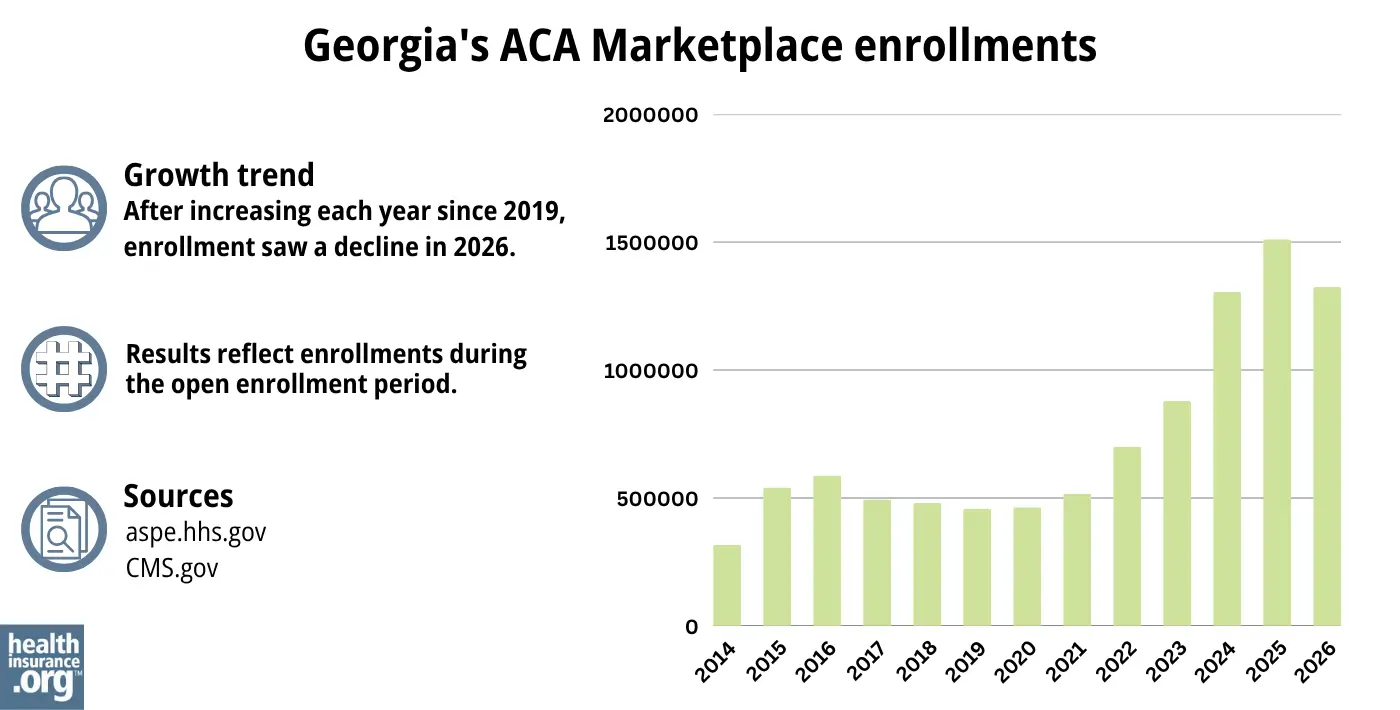
During the open enrollment period for 2026 coverage, 1,324,295 people enrolled in private plans through Georgia’s health insurance Marketplace.8
The chart below shows Georgia’s Marketplace enrollment over time. For several years, it hovered a little above or a little below 500,000 people, but has increased drastically in the last few years.
The increase was driven in large part by the enhanced premium subsidies created by the American Rescue Plan and the Inflation Reduction Act. But those expired at the end of 2025, leading to a significant decline in enrollment for 2026.
The enrollment growth for 2024 was also driven by the fact that many people were disenrolled from Medicaid, after disenrollments had been paused for three years during the pandemic. CMS reported that by April 2024, more than 265,000 people who had been disenrolled from Georgia Medicaid had transitioned to Marketplace coverage.36
Source: 2014,37 2015,38 2016,39 2017,40 2018,41 2019,42 2020,43 2021,44 2022,45 2023,46 2024,47 202548 20268
What health insurance resources are available to Georgia residents?
Georgia Access: The Marketplace in Georgia. This is the platform where residents can enroll in coverage and obtain income-based financial assistance.
Georgia Department of Community Health (DCH) – Administers Georgia Medicaid and PeachCare for Kids.
Georgia Office of Insurance and Safety Fire Commissioner – Regulates and licenses health insurance products sold in the state, as well as the brokers and agents who sell them.
Georgia SHIP – A resource for Medicare beneficiaries and their caregivers, providing counseling and assistance with various Medicare issues.

Explore short-term, dental, Medicaid & Medicare options in Georgia
See Georgia coverage guidesNeed help? Speak to a licensed agency partner about Georgia health insurance options
Call 888-383-5527Footnotes
- ”A quick guide to the Health Insurance Marketplace” HealthCare.gov ⤶
- Medicare and the Marketplace, Master FAQ. Centers for Medicare and Medicaid Services. Accessed Dec. 17, 2025 ⤶
- Premium Tax Credit – The Basics. Internal Revenue Service. Accessed Dec. 17, 2025 ⤶ ⤶
- ”Georgia Access Plan Year (PY) 2027 Qualified Health Plan (QHP) Application Instructions for Issuers” Georgia Access. Updated June 30, 2026 ⤶
- ”2026 OEP State-Level Public Use File (ZIP)” Centers for Medicare & Medicaid Services, Accessed July 9, 2026 ⤶ ⤶
- ”Part III Actuarial Memorandum, Mending Health, Georgia individual market 2026” ACA Signups. Accessed July 23, 2025 *The above is based on the most current data available. ⤶
- ”Enhanced Direct Enrollment Partners” Georgia Access. Accessed July 17, 2026 ⤶
- ”2026 Marketplace Open Enrollment Period Public Use Files” CMS.gov. April 2026 ⤶ ⤶ ⤶ ⤶ ⤶
- Georgia: State Innovation Waiver under section 1332 of the PPACA. Centers for Medicare and Medicaid Services. November 1, 2020. ⤶
- ”2026 Marketplace Open Enrollment Period Public Use Files” (Columns H and AJ). Centers for Medicare & Medicaid Services. Accessed July 23, 2025 ⤶
- ”2025 Marketplace Open Enrollment Period Public Use Files” (Columns H and AE) Centers for Medicare & Medicaid Services. Accessed July 23, 2025 ⤶
- ”Georgia Pathways Data Tracker” GeorgiaPathways.org. Accessed July 17, 2026 ⤶
- “Georgia Rate Review Submissions” RateReview.HealthCare.gov, Accessed Sep. 22, 2026. And “Georgia ACA rates on track for 20% or more increase for 2027 coverage” The Current. Aug. 31, 2026 ⤶
- “SERFF Tracking Number AHPO-134960759” Georgia SERFF. Accessed Sep. 28, 2026 ⤶
- “Georgia ACA rates on track for 20% or more increase for 2027 coverage” The Current. Aug. 31, 2026 ⤶
- ”2027 Rate Changes – Georgia +20.7% for unsubsidized indy market enrollees” ACA Signups. July 13, 2026 ⤶
- ”Part III Actuarial Memorandum, Mending Health, Georgia individual market 2026” ACA Signups. Accessed July 23, 2025 ⤶
- ”Mending to exit insurance business amid direct primary care push” Becker’s Payer Issues. June 9, 2026 ⤶
- “2027 Rate Changes – Georgia +20.7% for unsubsidized indy market enrollees” ACA Signups. July 13, 2026 ⤶
- “2027 Rate Changes – Georgia +20.7% for unsubsidized indy market enrollees” ACA Signups. July 13, 2026. And “Georgia ACA rates on track for 20% or more increase for 2027 coverage” The Current. Aug. 31, 2026 ⤶
- “2026 Marketplace Open Enrollment Period Public Use Files” CMS.gov. April 2026 ⤶ ⤶
- “2025 Marketplace Open Enrollment Period Public Use Files” (Column AB) Centers for Medicare & Medicaid Services. Accessed July 23, 2025 ⤶
- “2026 Marketplace Open Enrollment Period Public Use Files” (Column AG) CMS.gov. April 2026 ⤶
- “2026 Gross Rate Changes – Georgia: +34.6%; ~1.3 million enrollees are in for a hell of a shock this fall (updated)” ACA Signups. Oct. 16, 2025 ⤶ ⤶
- “Analysis Finds No Nationwide Increase in Health Insurance Marketplace Premiums” The Commonwealth Fund. December 2014. ⤶
- “FINAL PROJECTION: 2016 Weighted Avg. Rate Increases: 12-13% Nationally*” ACA Signups. October 2015. ⤶
- “Avg. UNSUBSIDIZED Indy Mkt Rate Hikes: 25% (49 States + DC)” ACA Signups. October 2016. ⤶
- “2018 Rate Hikes” ACA Signups. October 2017. ⤶
- “Georgia: APPROVED 2019 #ACA Rate Hikes: 3.9%…Would Likely Have DROPPED ~8% Without #ACASabotage” ACA Signups. August 2018. ⤶
- “Georgia: *Final* Avg. 2020 #ACA Premiums Rate Change: 0.9% Decrease” ACA Signups. October 2019. ⤶
- “Georgia: Approved Avg. 2021 #ACA Premiums: +4.8% (Was -1.3%)” ACA Signups. September 2020 ⤶
- “2022 Rate Changes” ACA Signups. October 2021. ⤶
- “UPDATED: FINAL Unsubsidized 2023 Premiums: +6.2% Across All 50 States +DC” ACA Signups. Accessed November 2023. ⤶
- “Georgia: Final Avg. Unsubsidized 2024 #ACA Rate Changes: +17.4%” ACA Signups. August 2023. ⤶
- “Georgia: Preliminary avg. unsubsidized 2025 #ACA rate changes: +9.9%; Aetna pulling out of sm. group market?” ACA Signups. Aug. 29, 2024 ⤶
- ”HealthCare.gov Marketplace Medicaid Unwinding Report” Centers for Medicare & Medicaid Services. Data through April 2024; Accessed Aug. 15, 2024 ⤶
- “ASPE Issue Brief (2014)” ASPE, 2015 ⤶
- “Health Insurance Marketplaces 2015 Open Enrollment Period: March Enrollment Report”, HHS.gov, 2015 ⤶
- “HEALTH INSURANCE MARKETPLACES 2016 OPEN ENROLLMENT PERIOD: FINAL ENROLLMENT REPORT” HHS.gov, 2016 ⤶
- “2017 Marketplace Open Enrollment Period Public Use Files” CMS.gov, 2017 ⤶
- “2018 Marketplace Open Enrollment Period Public Use Files” CMS.gov, 2018 ⤶
- “2019 Marketplace Open Enrollment Period Public Use Files” CMS.gov, 2019 ⤶
- “2020 Marketplace Open Enrollment Period Public Use Files” CMS.gov, 2020 ⤶
- “2021 Marketplace Open Enrollment Period Public Use Files” CMS.gov, 2021 ⤶
- “2022 Marketplace Open Enrollment Period Public Use Files” CMS.gov, 2022 ⤶
- “Health Insurance Marketplaces 2023 Open Enrollment Report” CMS.gov, 2023 ⤶
- ”HEALTH INSURANCE MARKETPLACES 2024 OPEN ENROLLMENT REPORT” CMS.gov, 2024 ⤶
- “2025 Marketplace Open Enrollment Period Public Use Files” CMS.gov, May 2025 ⤶