Find Indiana Health Insurance Marketplace Coverage for 2026

Compare ACA plans and check subsidy savings from a licensed third-party health insurance agency.
Indiana Marketplace quick facts


Indiana health insurance Marketplace guide
Indiana uses the federally-facilitated health insurance Marketplace, HealthCare.gov, where five private insurance companies offer individual/family coverage for 2026.4 There were six participating insurers in 2025, but Aetna exited the Marketplace nationwide for 2026.
The overall weighted average rate increase for 2026 was 26.5%, before subsidies are applied (see details below). But the increase in after-subsidy premiums is far larger due to the expiration of the subsidy enhancements that had been in place since 2021.
Marketplace plans are designed to serve those without access to employer-sponsored coverage or government-run coverage like Medicare or Medicaid. This includes self-employed individuals, people who work for small businesses that don’t offer health benefits, and early retirees who aren’t yet eligible for Medicare.
Many people find Affordable Care Act (ACA) Marketplace plans to be budget-friendly. A record high of more than 359,000 people enrolled in private health plans through the Indiana Health Insurance Marketplace during the open enrollment period for 2025 coverage.5
If you buy a plan through the Indiana Health Insurance Marketplace, you may qualify for financial assistance through an advance premium tax credit (premium subsidy) and also possibly a subsidy that reduces your out-of-pocket costs when you get medical care.6
Starting in 2024, small businesses (fewer than 50 employees) in Indiana can qualify for two years of state tax credits if they offer a new ICHRA benefit to their employees, as long as certain parameters are met.7
Frequently asked questions about health insurance in Indiana
Who can buy Marketplace health insurance in Indiana?
You can buy individual/family health insurance from Indiana’s Marketplace if:8
- You live in Indiana.
- You are lawfully present in the U.S.
- You don’t have Medicare.
- You are not incarcerated.
Marketplace financial assistance, such as premium subsidies and cost-sharing reductions, depends on your household income. In addition, to qualify for financial assistance, you must:
- Not have access to affordable coverage via an employer. Our Employer Health Plan Affordability Calculator can help you check if you might qualify for premium subsidies in the Marketplace.
- Not be eligible for Medicaid or CHIP/Hoosier Healthwise.
- Not be eligible for premium-free Medicare Part A. 9
- File a joint tax return with your spouse, if you’re married.10 (with very limited exceptions)11
- Not be able to be claimed by someone else as a tax dependent.10
When can I enroll in an ACA-compliant plan in Indiana?
In Indiana, you can sign up for ACA-compliant individual and family health plans during the annual open enrollment period, which runs from November 1 through January 15.12
But starting in the fall of 2026, for coverage effective in 2027 and future years, there will no longer be an option for a February 1 effective date. The open enrollment period will end December 15, and all plans selected during open enrollment will take effect January 1. This is due to a federal rule change that was finalized in 2025.
If the open enrollment deadline passes, you may still be able to sign up for or make changes to an ACA Marketplace health plan through a special enrollment period (SEP). To qualify for a SEP, you’ll generally need a qualifying life event.
However, Native Americans can enroll anytime, without a qualifying event.
How do I enroll in a Marketplace plan in Indiana?
There are a few ways to enroll in an exchange health plan in Indiana:
- You can sign up on HealthCare.gov – the ACA exchange website.
- Alternatively, you can call them at (800) 318-2596 (TTY: 1-855-889-4325). The call center is available 24 hours a day, seven days a week, but it’s closed on holidays.
- You can get help — in person, online, or over the phone, from agents, navigators, or certified application counselors.
- You can enroll via an approved enhanced direct enrollment entity.13
How can I find affordable health insurance in Indiana?
In Indiana, you can find affordable health plans through the ACA Marketplace’s website: HeathCare.gov.
Thanks to the ACA, you may be eligible for income-based premium subsidies called Advance Premium Tax Credits (APTC), which help reduce your monthly premiums.
Eight out of 10 Indiana exchange enrollees were eligible for premium subsidies on 2026 plans, with an average monthly savings of about $481. People who receive these subsidies pay an average monthly premium of $137, after the subsidies are applied.1
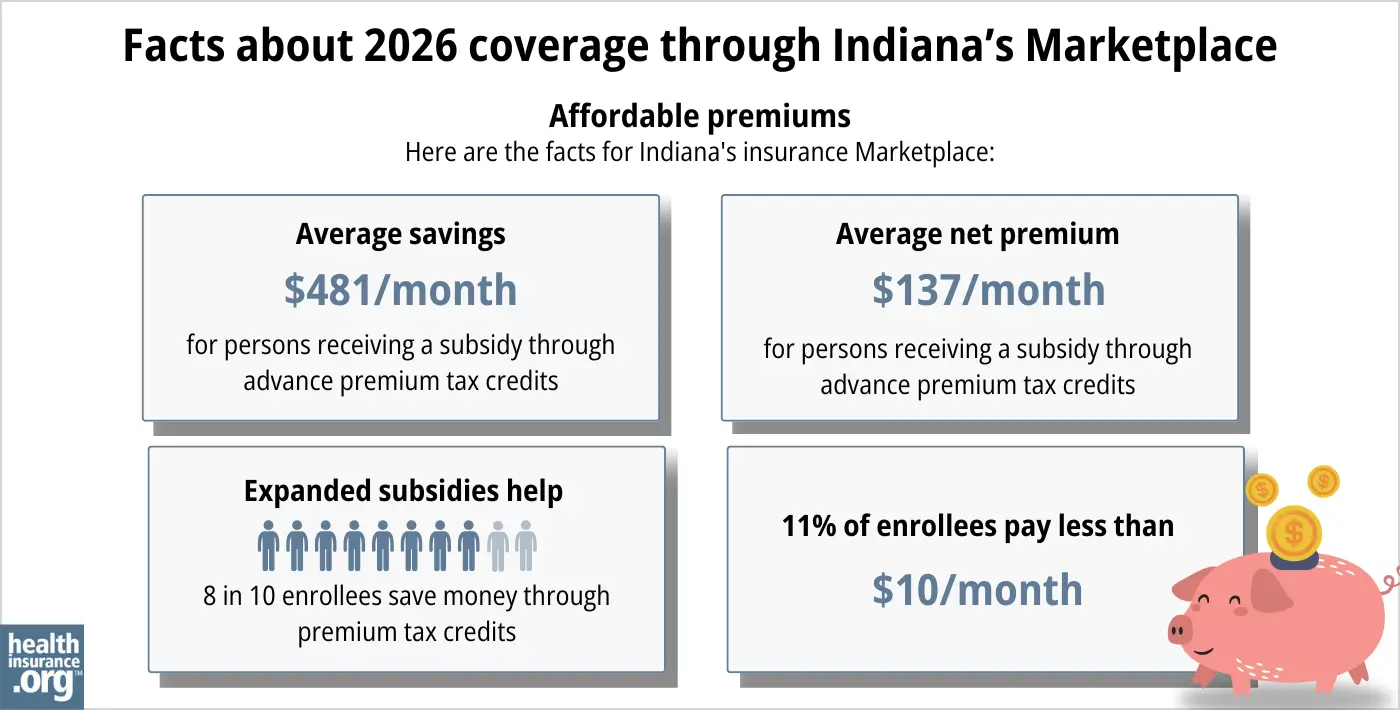
Source: CMS.gov1
Cost-sharing reductions (CSR) also reduce costs by helping lower your deductibles and out-of-pocket costs. CSR benefits are automatically built into all of the available Silver-level plans as long as your income isn’t more than 250% of the federal poverty level.14
The federal government used to reimburse insurers for the cost of providing CSR benefits, but that ended in 2017. Since then, insurers have been adding the cost of CSR to the premiums they charge. In most states, this cost is only added to Silver-plan rates, since CSR benefits are only available on Silver plans. But Indiana is one of only two states where insurers are required to spread the cost of CSR across premiums for plans at all metal levels (broad loading, as opposed to the silver loading approach taken in most states).15
Medicaid offers very affordable access to coverage and care for those who meet the eligibility criteria. Check out our guide on Medicaid in Indiana for more information.
Non-ACA-compliant short-term plans are also available if you don’t qualify for employer plans, Medicaid, Medicare, or subsidies from the exchange. Learn more about short-term health insurance in Indiana.
How many insurers offer Marketplace coverage in Indiana?
Five insurance companies offer coverage through Indiana’s Marketplace for 2026,16 down from six in 2025. Aetna exited the market at the end of 2025, as is the case in all states where Aetna offered Marketplace coverage in 2025.
There have been various insurer changes in Indiana’s Marketplace in recent years, including:
- Aenta joined the Indiana Marketplace as of the 2024 plan year.17 (These policies will terminate at the end of 2025.)
- UnitedHealthcare Insurance Company joined the Marketplace as of the 2025 plan year.18
- Celtic stopped offering on-exchange plans as of the 2025 plan year, and now only offers plans outside the exchange. Everyone with an on-exchange Celtic plan in 2024 was mapped to a Coordinated Care plan unless they picked a different plan (Coordinated Care and Celtic are both owned by the same parent company, Centene19)
- U.S. Health & Life exited the individual market in Indiana at the end of 2024.
Are Marketplace health insurance premiums increasing in Indiana?
For 2026, the following average rate changes were approved for the insurers that offer plans through Indiana’s Marketplace (before subsidies are applied).20
Indiana’s ACA Marketplace Plan 2026 APPROVED Rate Increases by Insurance Company |
|
|---|---|
| Issuer | Percent Increase |
| Anthem (Anthem BCBS) | 21.3% |
| Caresource | 27.7% |
| Coordinated Care | 30% |
| Cigna | 29.9% |
| Aetna Health | Exiting market |
| UnitedHealthcare Insurance Company | 30% |
Source: Indiana Department of Insurance and Indiana SERFF20
According to the filings in SERFF, the five carriers that will continue to offer Marketplace plans in 2026 have the following number of individual market enrollees in 2025:20
- Anthem: 97,312
- CareSource: 59,863
- Coordinate Care: 121,516
- Cigna: 8,614
- UnitedHealthcare: 1,225
Based on those enrollment numbers, the overall weighted average rate increase, before subsidies are applied, is about 26.5%.
Most Indiana residents who use the exchange receive financial assistance in the form of premium tax credits (premium subsidies), and thus do not pay full price.21
If you qualify for subsidies, the actual change in what you pay depends on how much your plan’s cost changes and how much financial assistance you receive from the government. For 2026, however, subsidies will cover a smaller portion of the total premium and will be available to fewer people, due to Congress’s failure to extend the subsidy enhancements that expired at the end of 2025. As a result, the average net (after-subsidy) premium that Marketplace enrollees pay will increase considerably.
For perspective, here’s an overview of how full-price premiums have changed over the years in Indiana’s individual/family health insurance market:
- 2015: Average increase of 5%.22
- 2016: Average increase of 0.7%.23
- 2017: Average increase of 18.9%.24
- 2018: Average increase of 24%.25
- 2019: Average increase of 2.6%.26
- 2020: Average increase of 13.5%.27
- 2021: Average increase of 10.5%.28
- 2022: Average decrease of 1.7%.29
- 2023: Average increase of 5.7%.30
- 2024: Average increase of 2.1%.31
- 2025: Average decrease of 1.3%.32
How many people are insured through Indiana’s Marketplace?
During the open enrollment period for 2026 coverage, 300,049 people enrolled in private individual market health plans through the Indiana Marketplace.1 (See chart below for historical enrollment numbers).
Enrollment has been growing since 2021, partly due to the subsidy enhancements created by the American Rescue Plan and Inflation Reduction Act.
The enrollment growth in 2024 and 2025 was also due to the “unwinding” of the pandemic-era Medicaid continuous coverage. As of June 2024, more than 479,000 Indiana residents had been disenrolled from Medicaid.33 And CMS reported that by April 2024, more than 125,000 of those people had transitioned to a Marketplace plan.34
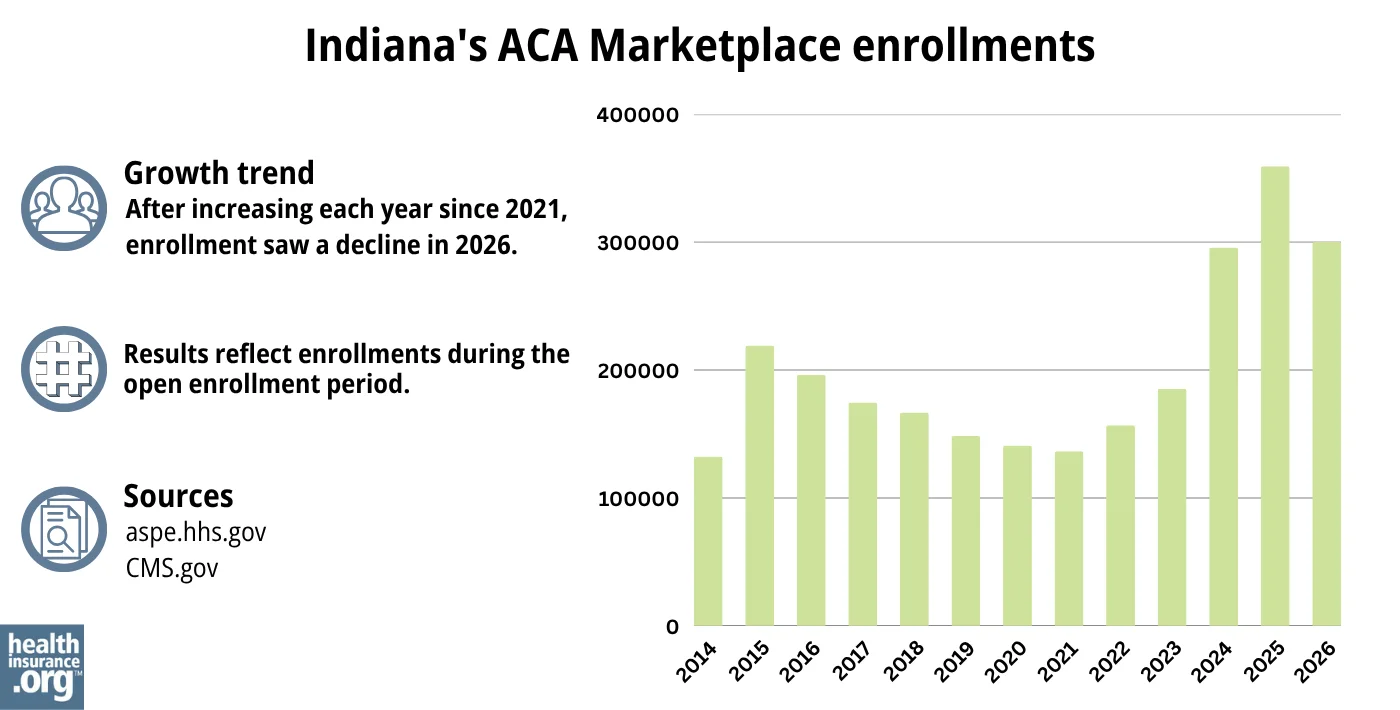
Source: 2014,35 2015,36 2016,37 2017,38 2018,39 2019,40 2020,41 2021,42 2022,43 2023,44 2024,45 20255 20261
What health insurance resources are available to Indiana residents?
HealthCare.gov
800-318-2596
Indiana Department of Insurance
Oversees and licenses health insurance companies, brokers, and agents who sell insurance plans. It can be a valuable source for Indiana residents with questions or complaints about their health coverage.
Affiliated Service Providers of Indiana, Inc. (ASPIN)
A Navigator organization funded by the federal government, serving Indiana. They can assist with questions and help people enroll in Medicaid or a private insurance plan through the exchange.
Indiana State Health Insurance Assistance Information Program (SHIP)
This local service offers guidance and information to Medicare beneficiaries and their caregivers.

Looking for more information about other options in your state?
Need help navigating health insurance options in Indiana?
Explore more resources for options in IN including short-term health insurance, dental, Medicaid and Medicare.
Speak to a sales agent at a licensed insurance agency.
Footnotes
- ”2026 Marketplace Open Enrollment Period Public Use Files” CMS.gov. April 2026 ⤶ ⤶ ⤶ ⤶ ⤶
- ”Indiana 2026 ACA Filings” Indiana Department of Insurance. Accessed Aug. 15, 2025 *The above is based on the most current data available. ⤶
- ”2026 Marketplace Open Enrollment Period Public Use Files” and “Marketplace 2025 Open Enrollment Period Report: National Snapshot” Centers for Medicare & Medicaid Services, April 2026 ⤶
- ”Indiana 2026 ACA Filings” Indiana Department of Insurance. Accessed Dec. 20, 2025 ⤶
- “2025 Marketplace Open Enrollment Period Public Use Files” CMS.gov, May 2025 ⤶ ⤶
- ”APTC and CSR Basics” Centers for Medicare and Medicaid Services. Oct. 2025 ⤶
- ”Health Reimbursement Arrangement Tax Credit” Indiana Department of Revenue. December 2024 ⤶
- “Are you eligible to use the Marketplace?” HealthCare.gov, 2023 ⤶
- Medicare and the Marketplace, Master FAQ. Centers for Medicare and Medicaid Services. Accessed Dec. 20, 2025 ⤶
- Premium Tax Credit — The Basics. Internal Revenue Service. Accessed Dec. 20, 2025 ⤶ ⤶
- Updates to frequently asked questions about the Premium Tax Credit. Internal Revenue Service. February 2024. ⤶
- “When can you get health insurance?” HealthCare.gov. Accessed Dec. 20, 2025 ⤶
- “Entities Approved to Use Enhanced Direct Enrollment” CMS.gov, Dec. 8, 2025 ⤶
- APTC and CSR Basics. Centers for Medicare and Medicaid Services. June 2023. ⤶
- ”SERFF Plan Management Instructions for Plan Year 2026” Indiana Department of Insurance. May 29, 2025 ⤶
- ”Indiana 2026 ACA Filings” Indiana Department of Insurance. Accessed Aug. 15, 2025 ⤶
- Aetna CVS Health to enter the Affordable Care Act (ACA) individual insurance exchange marketplace in Indiana for January 1, 2024. PR Newswire. October 2023. ⤶
- ”Indiana 2025 ACA Filings” Indiana Department of Insurance. Accessed Sep. 13, 2024 ⤶
- ”Report of Examination of Coordinate Care Corporation” Indiana Department of Insurance. May 13, 2020 ⤶
- ”Indiana 2026 ACA Filings” Indiana Department of Insurance. And Indiana SERFF Filings (Filing numbers are in the DOI rate filing summary). Accessed Aug. 15, 2025 ⤶ ⤶ ⤶
- “2025 Marketplace Open Enrollment Period Public Use Files” CMS.gov, Accessed Aug. 15, 2025 ⤶
- Analysis Finds No Nationwide Increase in Health Insurance Marketplace Premiums. The Commonwealth Fund. December 2014. ⤶
- Indiana: Approved 2016 Weighted Avg. Rates Confirmed As Only 0.7%. ACA Signups. September 2015. ⤶
- Avg. UNSUBSIDIZED Indy Mkt Rate Hikes: 25% (49 States + DC). ACA Signups. October 2016. ⤶
- UPDATE: Indiana Chooses The Worst Possible Way Of Spreading Their CSR Load. ACA Signups. October 2017. ⤶
- 2019 Rate Hikes. ACA Signups. October 2018. ⤶
- Indiana: *Final* Avg. 2020 #ACA Premium Rate Hikes: IN DOI Says 9.7%. The Math Says 13.5%. ACA Signups. October 2019. ⤶
- 2021 Rate Changes. ACA Signups. October 2020. ⤶
- Indiana 2022 ACA Filings. Indiana Department of Insurance. Accessed December 2023. ⤶
- Indiana: Final Avg. Unsubsidized 2023 #ACA Rate Changes: +5.7%. ACA Signups. October 2022. ⤶
- Indiana: *Final* Avg. Unsubsidized 2024 #ACA Rate Changes: +2.1%. ACA Signups. August 2023. ⤶
- ”Indiana 2025 ACA Filings” Indiana Department of Insurance. Accessed Nov. 14, 2024 ⤶
- ”Medicaid Enrollment and Unwinding Tracker” KFF. June 14, 2024. ⤶
- ”HealthCare.gov Marketplace Medicaid Unwinding Report” Centers for Medicare & Medicaid Services. Data through April 2024. ⤶
- “ASPE Issue Brief (2014)” ASPE, 2015 ⤶
- “Health Insurance Marketplaces 2015 Open Enrollment Period: March Enrollment Report”, HHS.gov, 2015 ⤶
- “HEALTH INSURANCE MARKETPLACES 2016 OPEN ENROLLMENT PERIOD: FINAL ENROLLMENT REPORT” HHS.gov, 2016 ⤶
- “2017 Marketplace Open Enrollment Period Public Use Files” CMS.gov, 2017 ⤶
- “2018 Marketplace Open Enrollment Period Public Use Files” CMS.gov, 2018 ⤶
- “2019 Marketplace Open Enrollment Period Public Use Files” CMS.gov, 2019 ⤶
- “2020 Marketplace Open Enrollment Period Public Use Files” CMS.gov, 2020 ⤶
- “2021 Marketplace Open Enrollment Period Public Use Files” CMS.gov, 2021 ⤶
- “2022 Marketplace Open Enrollment Period Public Use Files” CMS.gov, 2022 ⤶
- “Health Insurance Marketplaces 2023 Open Enrollment Report” CMS.gov, 2023 ⤶
- ”HEALTH INSURANCE MARKETPLACES 2024 OPEN ENROLLMENT REPORT” CMS.gov, 2024 ⤶