Medicare in Washington
Original Medicare, Medicare Advantage, Part D prescription drug, and Medigap coverage in Washington


Medicare enrollment in Washington
As of January 2026, there were 1,568,747 people with Original Medicare or Medicare Advantage plans in Washington.1
Most individuals become eligible for Medicare when they turn 65. But Medicare eligibility is also triggered for younger people if they’re disabled and have been receiving disability benefits for at least 24 months, or have end-stage renal disease (ESRD) or amyotrophic lateral sclerosis (ALS). Nationwide, about 9% of Medicare beneficiaries are under the age of 65.2 In Washington, about 8% of Medicare beneficiaries are eligible due to disability rather than age, and are under the age of 65.1
- Read about Medicare’s open enrollment period and other important enrollment deadlines.
- Learn how Washington’s Medicaid program can provide assistance to Medicare beneficiaries with limited income and assets.
Medicare Advantage plan availability and enrollment in Washington
Medicare Advantage plans are an alternative to Original Medicare, and are available in most areas of the United States, including all counties in Washington in 20263
In 2026, the average Medicare beneficiary in Washington can choose from among 31 Medicare Advantage plans.3
As of January 2026, 781,084 enrollees were in Washington Medicare Advantage plans.1 Nationwide, Medicare Advantage enrollment has been steadily increasing for nearly two decades,4 and that’s true in Washington as well.
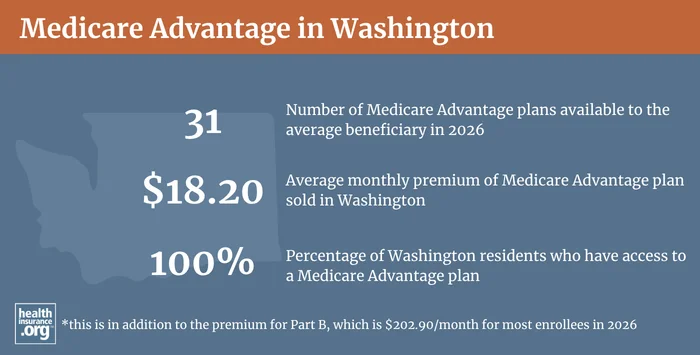
Sources: Medicare Advantage 2026 Spotlight: A First Look at Plan Offerings, KFF.org, Dec. 9, 2025; Fact Sheet: Medicare Open Enrollment for 2026, Centers for Medicare & Medicaid Services. Sep. 26, 2025
Learn more about Medicare Advantage, Medicare’s annual open enrollment period, and the Medicare Advantage open enrollment period.
Learn about Medicare plan options in Washington by contacting a licensed agent.



Medicare supplement (Medigap) plan availability in Washington
According to an AHIP analysis, there were 309,719 Washington residents with Medigap coverage as of 2023.5
There are 20 insurers that offer Medigap plans in Washington for 2026, although some of them have a service area that does not include the whole state.6
Washington is one of nine states where Medigap insurers are required to use community rating for enrollees age 65 and older (see Washington statute RCW 48.66.045).7 Premiums vary significantly from one insurer to another, but each specific plan has the same rates for all enrollees who are at least 65.6
In addition to community-rating requirements, Washington state law also gives Medigap enrollees the option to switch to a different Medigap plan at any time, guaranteed-issue (with some limitations, described below).8
Federal rules only grant a one-time six-month open enrollment period for Medigap, beginning when the enrollee is at least 65 and enrolled in both Medicare Part A and Part B. After that, unless a person experiences one of the limited circumstances that trigger a guaranteed-issue right, Medigap plans can be medically underwritten, unless states impose other rules.
But Washington is one of just a handful of states where state law prevents Medigap insurers from using medical underwriting if a person with Medigap wants to switch to a different policy after their initial enrollment window has ended. State law in Washington allows a person with Medigap Plan A to switch to any other Medigap Plan A. And a person with Medigap Plan B through N can switch to any other Plan B through N. This opportunity to switch plans on a guaranteed-issue basis applies year-round, as long as the person has been covered under a Medigap plan for at least 90 days.8
Washington has also enacted legislation to limit pre-existing condition waiting periods for Medigap enrollees. Federal rules allow Medigap insurers to impose pre-existing condition waiting periods of up to six months, but Washington law limits it to three months instead.9
People who aren’t yet 65 can enroll in a Medicare plan if they’re disabled and have been receiving disability benefits for at least two years (people with end-stage renal disease (ESRD) or amyotrophic lateral sclerosis (ALS) do not have to wait 24 months for Medicare eligibility), and about 8% of Washington Medicare beneficiaries are under age 65.10 But federal rules do not guarantee access to Medigap plans for people who are under 65.11
The majority of the states have implemented rules to ensure that disabled Medicare beneficiaries have at least some access to Medigap plans. But although Washington has gone beyond federal regulations in terms of rating requirements and allowing Medigap enrollees to switch plans on a guaranteed-issue basis, the state does not require Medigap insurers to offer coverage to people under the age of 65 who are enrolled in Medicare due to a disability.
As of 2026, only two of Washington’s Medigap insurers offer plans to people under the age of 65 (one offers Medigap Plan B for these enrollees, and the other offers Plan G). The premiums for these policies are higher than the rates that would apply to someone who is 65.6
But Washington has also maintained its pre-Affordable Care Act (ACA) high-risk pool (WSHIP, the Washington State Health Insurance Pool), and it serves as an option for disabled Medicare beneficiaries (WSHIP’s non-Medicare plans have been closed to new enrollees since 2014, as the ACA eliminated the need for a high-risk pool in the non-Medicare market).12
WSHIP’s Medicare Supplement Plan is available to people who are unable to obtain Medigap plans due to medical underwriting, and who live in an area where they don’t have “a reasonable choice of Medicare Advantage plans.” As of 2026, eleven counties (Clark, Cowlitz, Island, King, Kitsap, Pierce, Skagit, Snohomish, Spokane, Thurston, and Whatcom) have a “reasonable choice” of Medicare Advantage plans; residents of those counties are only eligible for WSHIP Medicare Supplement coverage if their medical provider is not in-network with at least one of the available Medicare Advantage plans.13
See 2026 premium rates for WSHIP’s Medicare supplement plans.
Disabled Medicare beneficiaries in Washington have access to the normal Medigap Open Enrollment Period when they turn 65. At that point, they can select from among any of the available Medigap plans, at the standard community-rated premiums that apply to people who are 65 or older.
Learn how Medigap plans are regulated and standardized.
Medicare Part D plan availability and enrollment in Washington
Medicare beneficiaries who do not have prescription drug coverage through Medicaid or an employer-sponsored plan may need to obtain Medicare Part D prescription drug coverage. Medicare Part D prescription drug coverage can be purchased as a stand-alone plan, or as part of a Medicare Advantage plan with integrated Part D coverage.
There were 10 stand-alone Medicare Part D prescription drug plans available in Washington in 2026, with monthly premiums starting at $0 per month.14
As of January 2026, there were 496,337 Medicare beneficiaries in Washington who had stand-alone Medicare Part D prescription drug plans. Another 744,872 had Medicare Part D prescription drug coverage integrated with their Medicare Advantage plans.1
Learn how Medicare Part D prescription drug coverage works, what it pays for, how and when to enroll.
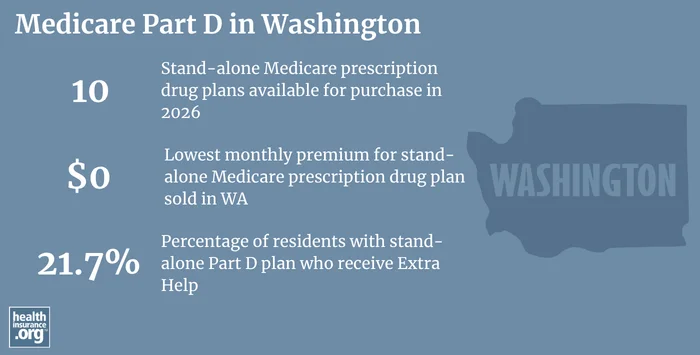
Source: Fact Sheet: Medicare Open Enrollment for 2026, Centers for Medicare & Medicaid Services. Sep. 26, 2025
Resources for Medicare beneficiaries in Washington
Have questions about Medicare enrollment or Medicare eligibility in Washington?
- You can also contact SHIBA, the Washington Statewide Health Insurance Benefits Advisors, with questions related to Medicare coverage in Washington.
- The Medicare Rights Center offers a comprehensive national website and a helpful call center that can provide a variety of assistance with Medicare-related questions.
- The Washington Office of the Insurance Commissioner regulates Medigap plans and also licenses and regulates the brokers and agents who help residents in the state secure various forms of private Medicare coverage (Part D, Medicare Advantage, and Medigap plans). The Washington Office of the Insurance Commissioner maintains an extensive collection of resources for Medicare beneficiaries in the state, as well as a page about how consumers can identify and report Medicare fraud and abuse.

Explore Marketplace, short-term, dental, and Medicaid options in Washington
See Washington coverage guidesNeed help? Speak to a licensed agency partner about Washington health insurance options
Call 888-383-5527Footnotes
- “Medicare Monthly Enrollment – Washington” Centers for Medicare & Medicaid Services Data. Accessed May 2026. ⤶ ⤶ ⤶ ⤶
- “Medicare Monthly Enrollment – US” Centers for Medicare & Medicaid Services Data. Accessed May 2026. ⤶
- “Medicare Advantage 2026 Spotlight: First Look” KFF.org Dec. 9, 2025. ⤶ ⤶
- “Medicare Advantage Enrollment Grew by About 1 Million People, Mainly Due to Special Needs Plans” KFF.org. Feb. 23, 2026 ⤶
- “The State of Medicare Supplement Coverage” AHIP. May 2024 ⤶
- “2026 Approved Medicare Supplement (Medigap) plans” Washington Office of the Insurance Commissioner. Accessed May 15, 2026 ⤶ ⤶ ⤶
- “Key Facts About Medigap Enrollment and Premiums for Medicare Beneficiaries” KFF.org. Oct. 18, 2024 ⤶
- “Medigap (Medicare Supplement) plan coverage and costs” Washington Office of the Insurance Commissioner. Accessed May 15, 2026 ⤶ ⤶
- “Preexisting condition limitations” Washington State Legislature. Accessed May 15, 2026 ⤶
- “Medicare Monthly Enrollment – Washington” Centers for Medicare & Medicaid Services Data. Accessed May 15, 2026 ⤶
- “Get Ready to Buy” Medicare.gov. Accessed May 15, 2026 ⤶
- “Non-Medicare Plans – Eligibility Requirements” Washington State High Risk Pool. Accessed May 15, 2026 ⤶
- “2026 Counties with Reasonable Choice of Medicare Advantage Plans” WSHIP. Accessed May 15, 2026 ⤶
- “Fact Sheet: Medicare Open Enrollment for 2026” Centers for Medicare & Medicaid Services. Sep. 26, 2025 ⤶