Can I have two health insurance plans?

In this article
- Does it make sense to have two health insurance policies?
- The real math: An example of how plans work together
- When does it NOT make sense to have two health plans?
- If I have two health plans, which one is primary?
- Will I have to pay two deductibles if I have two health plans?
- Will having two plans mean I’m reimbursed more than 100% of my medical bill?
- Can I choose which plan is primary?
- What happens if I don’t disclose my second plan?
- Can my child be covered by two health insurance plans?
- Does having two health plans affect my taxes?
Yes, you can have two health insurance plans at the same time, depending on the coverage options available to you. But you’ll need to figure out whether dual health insurance coverage makes sense for your situation – and that will depend on the policies being offered and how much you’ll have to pay in premiums.
Does it make sense to have two health insurance policies?
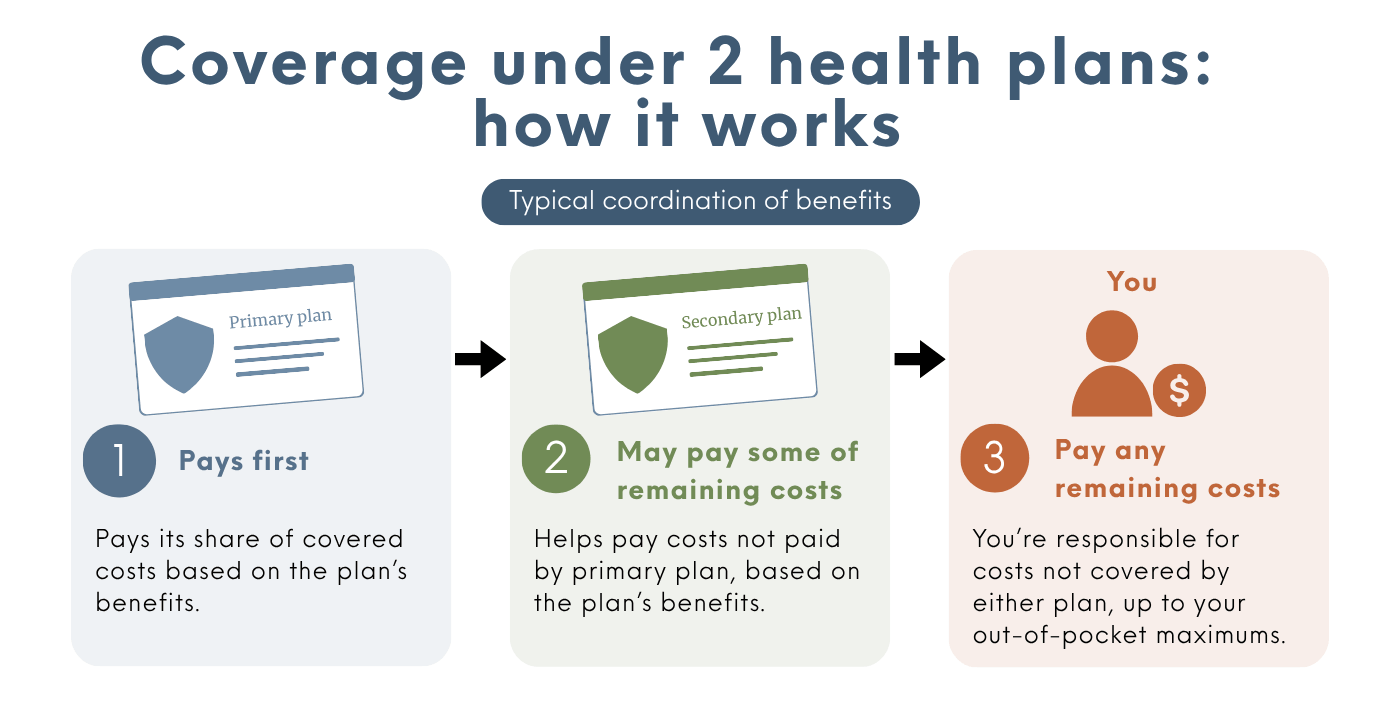
When you’re covered by two health insurance plans, one will be primary and the other will be secondary. But you don’t get to decide which plan is primary. The details of that, and the way the two policies work together, are determined through a process called coordination of benefits.1
Depending on the benefit details, having two health insurance policies can help to keep your out-of-pocket costs lower than they would otherwise be. But the specifics vary by plan, and you might find that your secondary policy doesn’t reduce your out-of-pocket costs as much as you expected.2 Depending on the coverage specifics and the cost of paying premiums for both policies, it might not be worth it.
As with most health insurance scenarios, there’s not a one-size-fits-all answer. But there are some situations where it can be clearly advantageous to have two health plans. For example:
- Spouses whose employers both offer family health benefits and subsidize a significant portion of the cost. Although it’s not common, some employers cover the full cost of their employees’ health coverage, including the cost to add family members to the plan.3 If both spouses are working for employers that provide very generous benefits, it might be an easy choice to maintain family coverage under both plans.
- Someone who needs extensive medical care might find that the additional premium costs are more than outweighed by the lower out-of-pocket costs that can potentially come with two health plans, depending on the policy details. This might be temporary – the year you’re having a baby, for example – or it might be ongoing if there’s a chronic medical condition that will require extensive care year after year.
- Most Original Medicare beneficiaries maintain some type of additional coverage (Medigap, Medicaid, or coverage from a current or former employer), because Original Medicare has no cap on out-of-pocket costs.4
- Paying for two plans might make sense if the secondary plan has more generous benefits than the primary plan, or provides coverage that the primary plan doesn’t, such as out-of-network care, or alternative therapies such as chiropractic care. Note: Be sure to check the secondary plan’s coordination of benefits contract to make sure that it doesn’t explicitly exclude coverage for services that the primary plan does not cover.
The real math: An example of how plans work together
An example can help here, but it’s important to understand that the math will be different for every set of policies, based on the coverage specifics and the coordination-of-benefits rules that apply.
With that said, here’s an example of how a claim might be processed when a person has two health plans. Let’s say Clarissa has two policies:
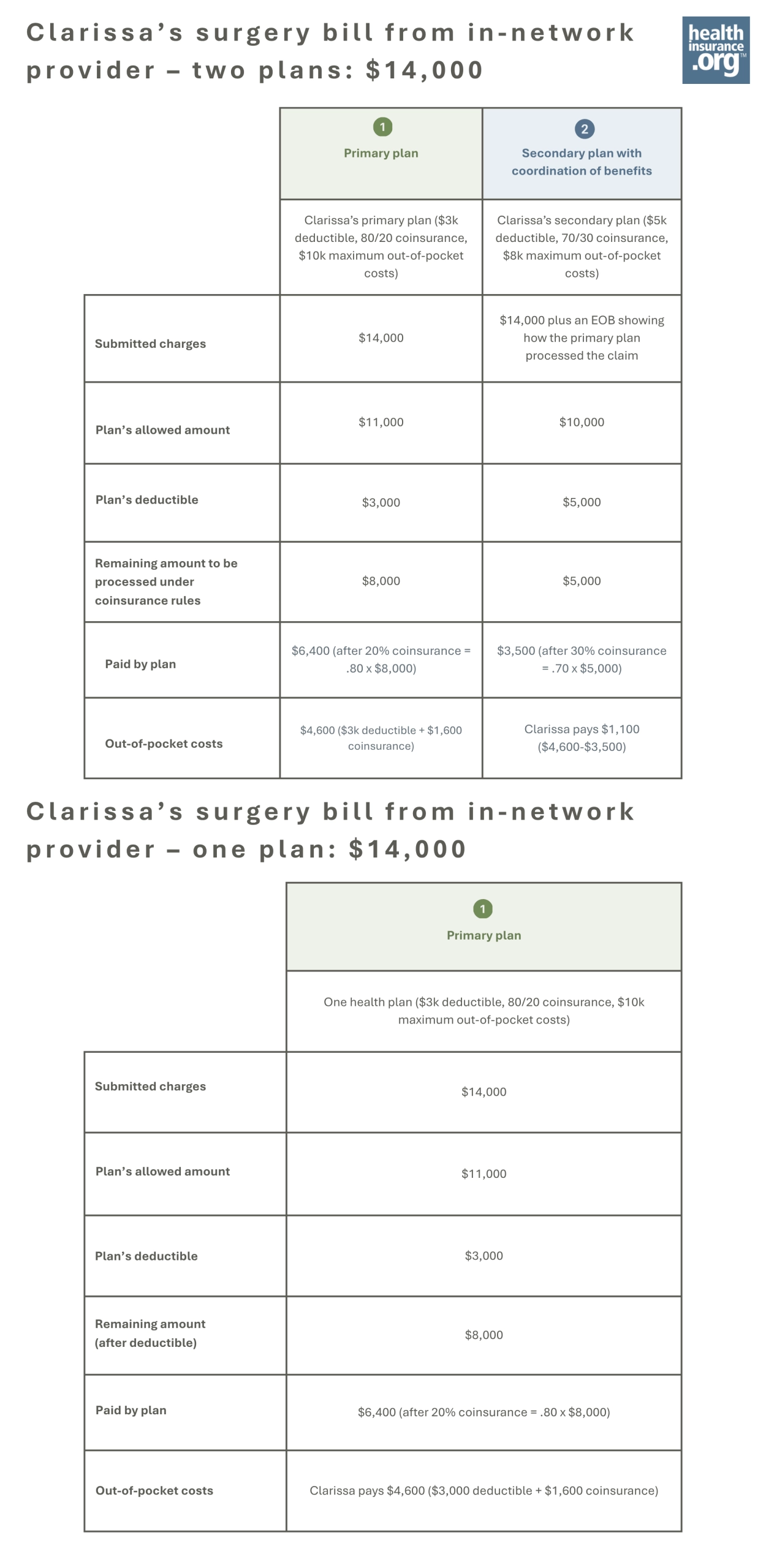
- Primary (policy is provided by Clarissa’s employer): $3,000 deductible, and 80/20 coinsurance up to a maximum out-of-pocket limit of $10,000.
- Secondary (Clarissa is covered as the spouse on the plan offered by her husband’s employer): $5,000 deductible, 70/30 coinsurance up to a maximum out-of-pocket limit of $8,000.
Clarissa has surgery, and the providers are in-network with both plans. The total bills submitted by the medical providers come to $14,000, although each plan has its own negotiated allowed amount for the care she received.
Primary plan:
- Allowed amount is $11,000
- Deductible = $3,000
- The plan will then pay 80% of the remaining $8,000, which is $6,400 (Clarissa’s share of the coinsurance is the other $1,600).
- So if Clarissa only had this policy, her out-of-pocket costs would be $4,600, including her $3,000 deductible and $1,600 in coinsurance.
Secondary plan:
- Begins by processing the claim as if the primary plan did not exist but will then adjust payout (if needed) based on the explanation of benefits from the primary plan.
- Allowed amount is $10,000 (differs from the primary plan)
- Deductible = $5,000 (Clarissa doesn’t have to pay this; it’s just used by the plan to determine how much the plan has to pay. If the allowed amount for this claim had been less than $5,000, the secondary policy wouldn’t pay anything.)
- Of the remaining $5,000, the plan will pay 70%, or $3,500
Clarissa owed $4,600 after her primary plan processed the claim, and the secondary plan is paying $3,500 of that. So her out-of-pocket cost, after both plans process the claim, is $1,100.
Note: If the secondary plan’s coverage had been more generous and had resulted in a payout of more than $4,600, the actual amount the secondary plan paid would have been reduced so that it wouldn’t exceed $4,600. One of the reasons coordination of benefits rules exist is to make sure that the total combined payments from both plans will not exceed the allowed amount. (If the two plans have different allowed amounts, as was the case in our example, the higher of the two allowed amounts is used for this calculation.)5
The example is based on the National Association of Insurance Commissioners’ (NAIC) coordination of benefits model law,6 but keep in mind that the NAIC model law only applies if a state has adopted it.7
States can modify it, or can explicitly delegate some of the decision-making to the health plans. (For example, Indiana’s coordination of benefits rule says that group plans can make certain changes to how coordination of benefits is handled.)8
And self-insured plans are not subject to state insurance laws, so these plans, which cover the majority of people with employer-sponsored coverage, are free to set their own coordination-of-benefits rules.9
When does it NOT make sense to have two health plans?
There are various circumstances when it might not make sense to have two health plans:
- The secondary plan wouldn’t actually pay much of the remaining out-of-pocket costs after the primary plan pays its share. In our example above, if Clarissa’s secondary plan had an $8,000 deductible, it would only have paid $1,400 (70% of $2,000), leaving her with $3,200 in out-of-pocket costs.
- Your health providers aren’t in-network with one of the plans. If that plan includes out-of-network coverage, it’s possible that you could still get a benefit by having both plans, but it would depend on the out-of-pocket costs for out-of-network care.
- Adding the second plan costs you more in premiums than it will save you in out-of-pocket costs. A few points to keep in mind here:
- Most of the time, you don’t know exactly what medical care you’ll need in the coming year, so most people are making rough guesses on this one. But you should account for worst-case scenarios where you end up needing to meet your plan’s out-of-pocket limit.
- If you and your spouse are both enrolling in each other’s employer-sponsored plan, be sure you understand whether the employers have spousal surcharges, and if so, what their rules are and how much they’ll add to the premium.10
- You have HSA-eligible coverage and want to contribute to an HSA.
- You can only contribute to a health savings account (HSA) if you’re only covered by an HSA-eligible high-deductible health plan (HDHP).11
- As long as both plans are HSA-eligible HDHPs, you can have both a primary and secondary plan and still make HSA contributions.12 But if either plan is not HSA-eligible, you wouldn’t be able to make HSA contributions if you’re covered under both plans.
- If you and your spouse are both covered by HDHPs (either one HDHP that covers both of you, separate HDHPs for each of you, or two HDHPs that each cover both of you) and no other coverage that would make you ineligible, you’re both eligible to contribute to an HSA. You can contribute the family amount to one HSA (in either spouse’s name), or you can each have your own HSA and divide the total family contribution across those two HSAs in any allocation you like.13 But the total contributions can’t exceed the maximum family contribution. (In 2026, that’s $8,750; rising to $9,000 in 2027).
- You don’t want to deal with the administrative headache of having two health plans. It’s your responsibility to follow up with your plans to ensure that claims are processed correctly and bills are paid – because ultimately, you’re responsible for bills that aren’t paid by your insurance. Having two plans might mean that you spend more time on the phone sorting out coverage details. It’s up to you to decide whether the dual coverage benefits are worth it.
If I have two health plans, which one is primary?
The answer here depends on the type of coverage you have, where you live (since states can have different coordination of benefits rules), and whether there are any court orders in place. (For example, if divorced parents each have coverage on their child, a court order can stipulate which one is primary.) Regardless of the details, there will be clear rules in place that determine which plan is primary and which is secondary, and you don’t get to choose this yourself. In general:
- A plan provided by your own employer will be primary, and if you also have coverage under a spouse’s or parent’s plan, it will be secondary.1
- If a child is covered under plans offered by both parents’ employers, the primary plan will be the one belonging to the parent whose birthday comes first in the year, although a court order can override this.1
- Medicaid is always secondary.14
- Medicare can be primary or secondary, depending on the circumstances. In general, Medicare will be secondary if you (or your spouse) are still working, covered by the employer’s plan, and the employer has 20 or more employees.15 Learn more about Medicare when you’re continuing to work.
Will I have to pay two deductibles if I have two health plans?
No, having two health plans doesn’t mean you pay your deductible separately under each plan. Instead, as illustrated in the example above, the secondary plan might pick up some of the out-of-pocket costs (including the deductible) that you would otherwise have to pay if you only had the primary plan.6
Depending on the benefits structure of the two plans, it’s possible that the secondary plan could pay all of your out-of-pocket costs under the primary plan, including the full deductible.
But again, the specifics vary considerably by plan. So while you won’t have to pay a separate deductible under each plan, you also shouldn’t assume that the second plan will leave you with no out-of-pocket costs at all. It might, but it might not.
In the example above about Clarissa, if the allowed amount for her claim had been less than $5,000, her secondary policy wouldn’t have paid anything, because it has a $5,000 deductible.
Will having two plans mean I’m reimbursed more than 100% of my medical bill?
No. One of the basic tenets of coordination of benefits is that the combined payments from both plans won’t exceed the total allowed amount of the claim (using whichever plan’s allowed amount is higher).16
Can I choose which plan is primary?
No. That will be determined based on coordination of benefits rules, and you have no say in the matter.17
What happens if I don’t disclose my second plan?
If you don’t disclose your secondary plan, nothing happens other than you will miss out on benefits that the secondary plan might have provided. Your primary insurance will process your claim the same way, regardless of whether you have secondary coverage or not.
But if you have two plans and you only disclose the secondary one – meaning you tell the medical office to send the bills directly to the secondary plan, without first billing the primary plan – the secondary plan can deny the claim. That’s because under coordination of benefits rules, the secondary insurer can’t properly determine how much it needs to pay without knowing how the primary policy handled the claim.18 If the claim was never submitted to the primary policy, there’s no way for that to have happened.
Can my child be covered by two health insurance plans?
Yes, your child can be covered by two health insurance plans. Unless there’s a court order stipulating which plan is primary, the primary plan will generally be the one that belongs to the parent whose birthday comes first in the calendar year.19 Note: If one plan is Medicaid, that coverage will always be secondary.
Does having two health plans affect my taxes?
Most people under age 65 get their health insurance from an employer, with the premiums paid on a pre-tax basis.20 If you and your spouse both opt to have family coverage under your respective employers’ health plans, the payroll deductions for the premiums will reduce the income taxes and payroll taxes that you pay throughout the year21 (assuming the employer isn’t paying the full premium on your behalf). You should factor that into your decision making when determining whether it’s worth paying the additional premium to have a second health insurance policy.
A note about Marketplace coverage: If you have a plan through the health insurance Marketplace and a subsidy is being paid on your behalf (which is true for most Marketplace enrollees),22 you cannot have any other minimum essential coverage at the same time. If you do, you’ll have to repay the full premium subsidy to the IRS when you file your taxes.23
Footnotes
- “Coordination of Benefits Model Regulation” NAIC Model Laws. Accessed Aug. 8, 2026 ⤶ ⤶ ⤶
- “Q: Will secondary insurance pay remaining 20% for acupuncture after primary covers 80%?” JUSTIA Ask a Lawyer. July 23, 2025. And “Primary vs Secondary Insurance in Medical Billing: A Complete Guide” Medix Revenue Group. Mar. 16, 2026 ⤶
- “2025 Employer Health Benefits Survey” (page 90; about 3% of employers pay the full family premium) KFF.org. Accessed Aug. 9, 2026 ⤶
- “A Snapshot of Sources of Coverage Among Medicare Beneficiaries” KFF.org. Dec. 19, 2025 ⤶
- “Coordination of Benefits Model Regulation” (Section 3(A)(5)(c)) NAIC Model Laws. Accessed Aug. 8, 2026 ⤶
- “Coordination of Benefits Model Regulation” (Section 7) NAIC Model Laws. Accessed Aug. 8, 2026 ⤶ ⤶
- “Insurance 101: Understanding NAIC Model Laws” AgentSync. Mar. 27, 2023 ⤶
- “760 IAC 1-38.1-11 - Model coordination of benefits provision; prohibited coordination; benefit design” Cornell Law School, Legal Information Institute. Accessed Aug. 9, 2026 ⤶
- “Coordination of Benefits” Paradigm Consulting. Oct. 1, 2022 ⤶
- “Spousal & Dependent Carve-Outs, Surcharges & Incentives” IMA Financial Group. Accessed Aug. 8, 2026 ⤶
- “Publication 969; Qualifying for an HSA Contribution” Internal Revenue Service. Accessed Aug. 9, 2026 ⤶
- “2026 Health Savings Account (HSA) Questions & Answers (Q&As)” Michigan.gov. Accessed Aug. 9, 2026 ⤶
- “Rules for Married People” Internal Revenue Service. Accessed Aug. 9, 2026 ⤶
- “Coordination of Benefits & Third Party Liability” Medicaid.gov. Accessed Aug. 8, 2026 ⤶
- “How Medicare works with other insurance” Medicare.gov. Accessed Aug. 8, 2026 ⤶
- “Coordination of Benefits Model Regulation” (Section 7 and Section 3(A)(5)(c)) NAIC Model Laws. Accessed Aug. 9, 2026 ⤶
- “Primary vs. Secondary Insurance: What’s the Difference?” UPMC Health Beat. July 7, 2022 ⤶
- “Coordination of Benefits Model Regulation” (Section 7) NAIC Model Laws. Accessed Aug. 9, 2026 ⤶
- “Coordination of Benefits Model Regulation” (Dependent Child Covered Under More Than One Plan) NAIC Model Laws. Accessed Aug. 9, 2026 ⤶
- “Employer-Sponsored Health Insurance 101” KFF.org. Apr. 15, 2026 ⤶
- “How does the tax exclusion for employer-sponsored health insurance work?” Tax Policy Center, Urban Institute & Brookings Institute. Accessed Aug. 9, 2026 ⤶
- “Health Insurance Exchanges 2026 Open Enrollment Report” (Page 14). Centers for Medicare & Medicaid Services. Accessed Aug. 9, 2026 ⤶
- “Questions and answers on the Premium Tax Credit” (Question 19). Internal Revenue Service. Accessed Aug. 9, 2026 ⤶