What is the employer shared-responsibility provision?
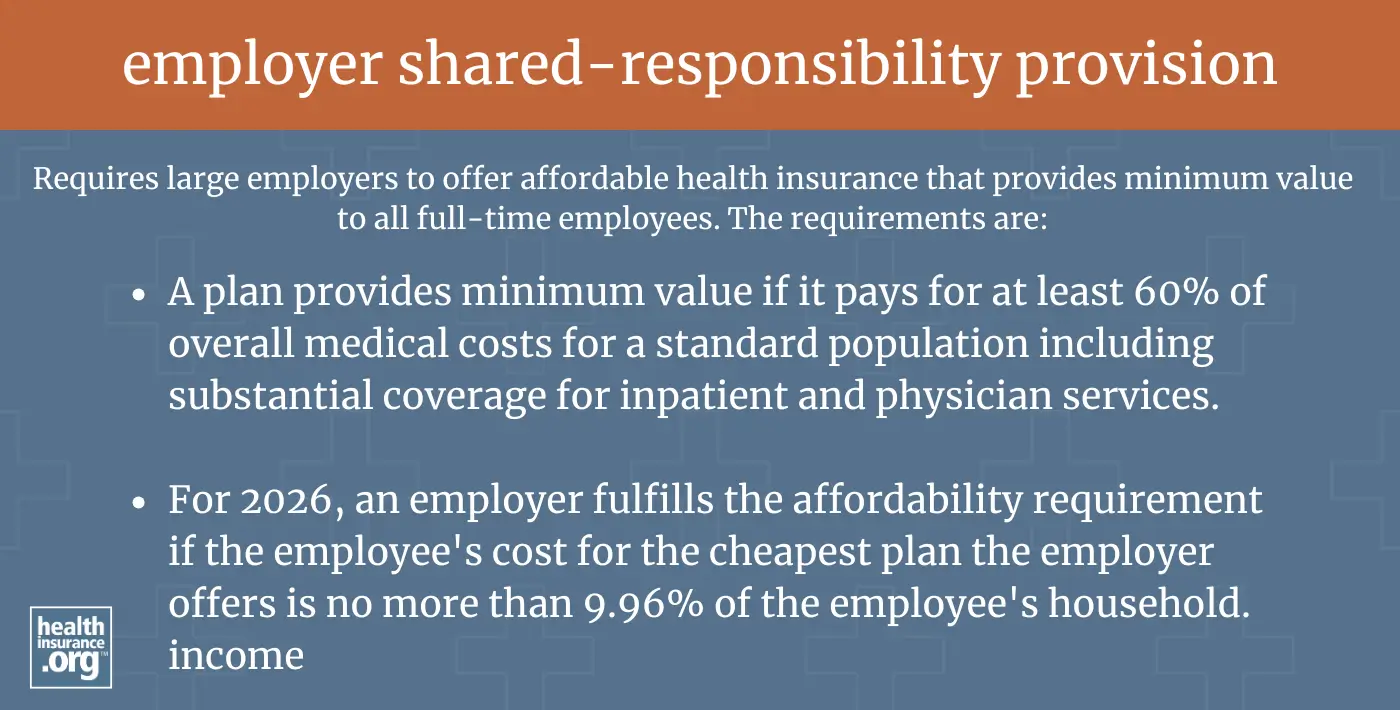
The employer shared responsibility provision of the Affordable Care Act (ACA) requires large employers to offer affordable health insurance that provides minimum value to all full-time employees (working at least 30 hours per week).
If they do not, and if at least one of the employees receives a subsidy to purchase health insurance in the health insurance Marketplace, the employer will be assessed a penalty.1 The employer shared responsibility provision, also known as the employer mandate, took effect in 2015 and applies ONLY to employers with at least 50 full-time equivalent employees.2
Affordability and minimum value
The IRS sets standards in terms of the requirements the health coverage has to fulfill to be considered affordable and provide minimum value.3
- A plan provides minimum value if it pays for at least 60% of overall medical costs for a standard population and also provides "substantial" coverage for inpatient and physician services.
- The specifics for affordability vary from one year to the next, as they are indexed. For 2026, an employer fulfills the affordability requirement if the employee's cost (ie, the part that's payroll deducted) for the cheapest plan the employer offers (that also provides minimum value) is no more than 9.96% of household income.4
Note that the cost to add a spouse and/or dependents to the plan is not taken into consideration when determining whether an employer is complying with the requirement to offer affordable coverage. That is still the case even now that the family glitch fix is in effect; even if family members end up being eligible for subsidies as a result of the family glitch fix, the employer has fulfilled their obligations as long as just the employee's coverage is considered affordable.
Penalty amount differs for employers who don't offer coverage, versus those who offer coverage that doesn't meet minimum requirements
The ACA provides for two different employer mandate penalty calculations: One applies if the employer simply doesn't offer coverage to at least 95% of full-time (30+ hours per week) workers.
The other applies if the employer does offer coverage, but it's either not considered affordable or it doesn't provide minimum value.
Details about both penalty calculations are provided by the IRS.5 The amount of the penalty is indexed each year.6
How much is the employer mandate penalty?
As of 2026, the penalty for not offering coverage to at least 95% of full-time employees is $3,340 per full-time employee, after subtracting the first 30 full-time employees.7
And the penalty for an employer that offers coverage that isn't affordable and/or doesn't provide minimum value is $5,010 per full-time employee who obtains a premium tax credit in the Marketplace.7
In both cases, the penalty is only triggered if at least one full-time employee obtains a premium tax credit in the Marketplace. And the penalty for offering sub-standard coverage can't be larger than the penalty for not offering coverage at all, so the lesser of the two penalty amounts is used in this case.
Footnotes
- "Questions and answers on employer shared responsibility provisions under the Affordable Care Act" Internal Revenue Service. Accessed Nov. 20, 2024 ⤶
- "Employer shared responsibility provisions" Internal Revenue Service. Accessed Dec. 5, 2025 ⤶
- "Minimum value and affordability" Internal Revenue Service. Accessed Dec. 5, 2025 ⤶
- “Revenue Procedure 2025-25”. Internal Revenue Service. Accessed Sep. 26, 2025 ⤶
- "Types of employer payments and how they're calculated" Internal Revenue Service. Accessed Dec. 5, 2025 ⤶
- "Questions and answers on employer shared responsibility provisions under the Affordable Care Act, Question 55" Internal Revenue Service. Accessed Dec. 5, 2025 ⤶
- "Revenue Procedure 2025-26" Internal Revenue Service. Accessed Dec. 5, 2025 ⤶ ⤶