In some state-run exchanges, pregnancy is a qualifying life event

In this article
In most states, pregnancy does not trigger a special enrollment period to sign up for health insurance outside of the annual open enrollment period. HHS considered that possibility, but clarified in 2015 that it had opted not to include pregnancy as a qualifying life event. (The birth of the baby is a qualifying life event in every state, but that special enrollment period doesn't begin until the baby is born, meaning that the new health plan will not cover costs related to the pregnancy.)
However, state-run exchanges (there are 21 of them as of 2026, growing to 22 as of 2027) have some flexibility to set their own rules for qualifying life events and special enrollment periods. And more than half of the state-run exchanges have chosen to allow a special enrollment period triggered by pregnancy.
This makes the pregnant person eligible to enroll in health coverage and have better access to prenatal care as well as coverage for labor and delivery costs. (In most cases, this special enrollment period applies to people who don't already have coverage, as opposed to an opportunity to change plans, but the specific rules vary from one state to another.)
In which state Marketplaces is pregnancy a qualifying life event?
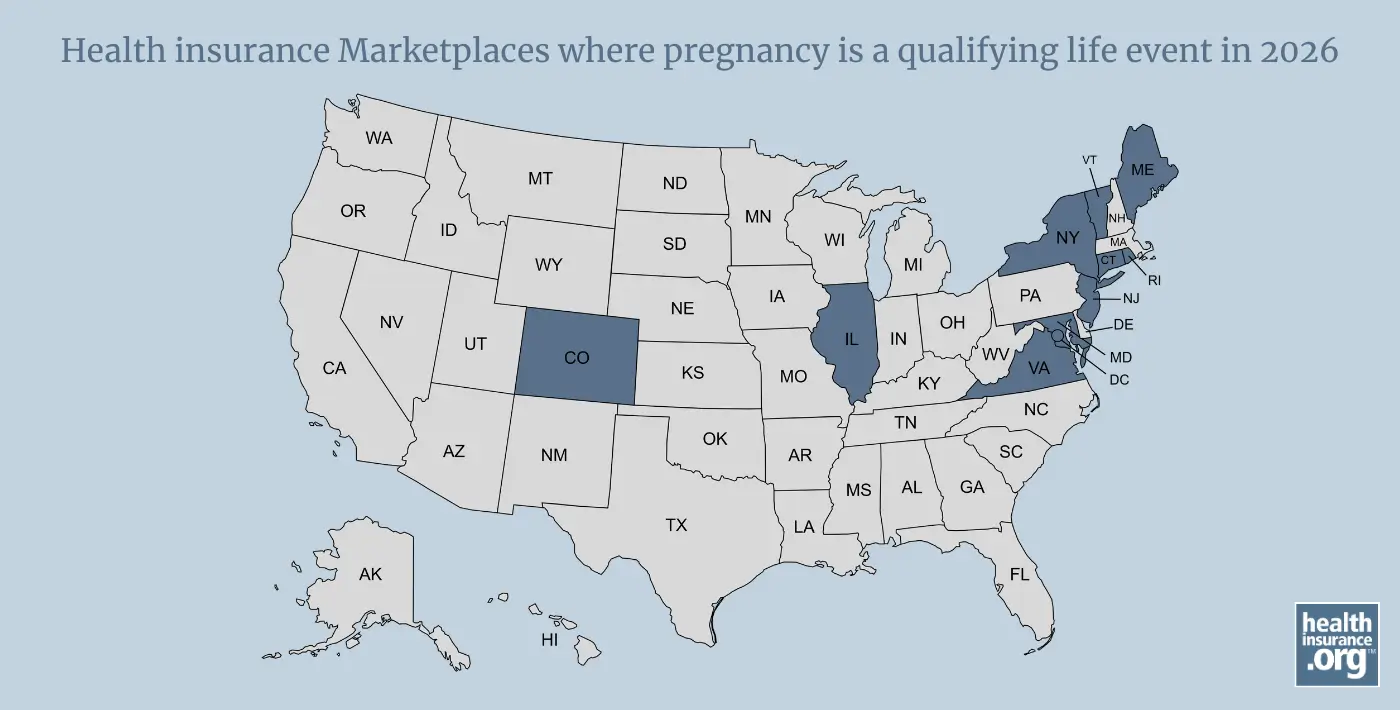
Pregnancy is a qualifying life event in these state-run exchanges as of 2026:
- Colorado1
- Connecticut2
- District of Columbia3
- Illinois4
- Maine5
- Maryland6
- New Jersey7
- New York8
- Rhode Island9
- Vermont10
- Virginia11
Illinois12 and Virginia13 were added to this list in 2026, due to legislation that each state enacted in 2025.
Which states are considering legislation to create a pregnancy SEP?
California: Legislation to add pregnancy as a qualifying life event that would trigger a special enrollment period was introduced in February 2026.14
Massachusetts: Legislation to create a special enrollment period due to pregnancy was introduced in 2025 and was still under consideration as of 2026. The bill calls for the SEP to apply to plans available through Massachusetts Health Connector (the state-run exchange). A pregnant woman would have a 30-day window to sign up for coverage, with an effective date of the first of the month in which the pregnancy is certified by a medical provider.15
Iowa: Legislation introduced in 2025 and again in 2026 would create a special enrollment period due to pregnancy, in both the individual and group markets.16 Notably, however, Iowa uses HealthCare.gov as its Marketplace and thus does not have the authority to set special enrollment periods for individual-market plans purchased through the Marketplace.
States that have unsuccessfully considered legislation to create a pregnancy SEP
California's legislature passed a bill in 2025 that would have made pregnancy a qualifying life event starting in 2026,17 but Governor Newsom vetoed it. His reasons for the veto included increased costs as well as a “dangerous precedent for condition-specific special enrollment periods,” noting that it could destabilize the individual market if the door were to be opened to allowing people to enroll in coverage due to a new need for medical care.18
Similarly, legislation to create a special enrollment period due to pregnancy (including for state-regulated employer-sponsored plans) passed in Nevada in 2025, but was vetoed by the governor.19 (The Nevada bill also included new coverage mandates for IVF, the cost of which was the focus of Gov. Lombardo's veto.)20
Legislation introduced in New Mexico in 2025 and 2026 would have created a pregnancy SEP for uninsured individuals, in both the individual and group market. But the measures did not advance.21
Legislation introduced in Wisconsin in 2026 would have created a special enrollment period due to pregnancy, but the measures did not advance out of committee.22 And Wisconsin does not run its own Marketplace and thus cannot create state-specific special enrollment periods for Marketplace coverage.
Several pieces of legislation were introduced in 2024 in Kentucky that would have created a special enrollment period triggered by pregnancy, but none of them were successful.23
In 2023, the state legislatures in Kentucky (H.B.286) and in Massachusetts (H.1052) considered creating special enrollment periods triggered by pregnancy, but neither bill was successful during the 2023 legislative session.
Footnotes
- “Connect for Health Colorado, Legislative Oversight Committee Report” Aug. 1, 2024 ⤶
- “Special Enrollment Periods” Access Health CT. Accessed Feb. 4, 2026 ⤶
- “Individual & Family Special Enrollment Periods” DC Health Benefit Exchange. Accessed Feb. 4, 2026 ⤶
- “Life changes and special enrollment” Get Covered Illinois. Accessed Feb. 4, 2026 ⤶
- “Special Enrollment Periods” CoverME. Accessed Feb. 4, 2026 ⤶
- “Are you pregnant? Enroll in a health plan with Maryland Health Connection!” Maryland Health Connection. Accessed Feb. 4, 2026 ⤶
- “Special Enrollment Period (SEP) Overview” GetCoveredNJ. Accessed Feb. 4, 2026 ⤶
- “Special Enrollment Periods” NY State of Health. Accessed Feb. 4, 2026 ⤶
- “HealthSource RI Policy Manual” (Page 12). Health Source RI. Accessed Feb. 4, 2026 ⤶
- “Life Events Chart” Vermont Health Connect. Accessed Feb. 4, 2026 ⤶
- “Qualifying Life Events and Special Enrollment Periods” Virginia Health Insurance Marketplace. Accessed Feb. 4, 2026 ⤶
- “Illinois SB3130” BillTrack50. Enacted Aug. 2, 2024 ⤶
- “Virginia HB2083” BillTrack50. Passed House Jan. 28, 2025 ⤶
- "California AB2066" BillTrack50. Introduced Feb. 18, 2026 ⤶
- “Massachusetts H1204” BillTrack50. In committee Feb. 27, 2025 ⤶
- “Iowa HF606” and "Iowa HF2415" BillTrack50. Introduced Feb. 26, 2025 and Feb. 11, 2026 ⤶
- “California SB257” BillTrack50. Vetoed Oct. 13, 2025 ⤶
- “Veto of California SB257” Governor Gavin Newsom. Oct. 13, 2025 ⤶
- “Nevada SB217” BillTrack50. Vetoed June 12, 2025 ⤶
- “Governor Lombardo breaks veto record, axes health bill to improve IVF access” KOLO8. June 16, 2025 ⤶
- “New Mexico SB508” and “New Mexico SB189” BillTrack50. Accessed Feb. 26, 2026 ⤶
- "Wisconsin SB1103" and "Wisconsin AB1087" BillTrack50. Introduced Feb./Mar. 2026 ⤶
- “Kentucky SB34, Kentucky HB10, Kentucky HB734, Kentucky HB380, and Kentucky HB700” BillTrack50. Accessed February 27, 2024 ⤶