Why did the federal government cancel ACA Marketplace coverage for 760,000 people?

In this article
- Why did the government cancel these ACA enrollments?
- Does this affect people enrolled through state-run Marketplaces?
- Could some enrollees have been improperly canceled?
- Could more Marketplace enrollees have their coverage canceled?
- Can I get my Marketplace coverage reinstated if it was canceled by mistake?
- What happens if I received medical care after CMS canceled my coverage?
- If I do not want to appeal my cancellation, can I still re-enroll in the Marketplace?
- If my plan was canceled, do I have to repay my subsidy?
- Are there changes to how enrollment will work going forward to prevent fraud?
- Is the CMS focus on ACA enrollment fraud new?
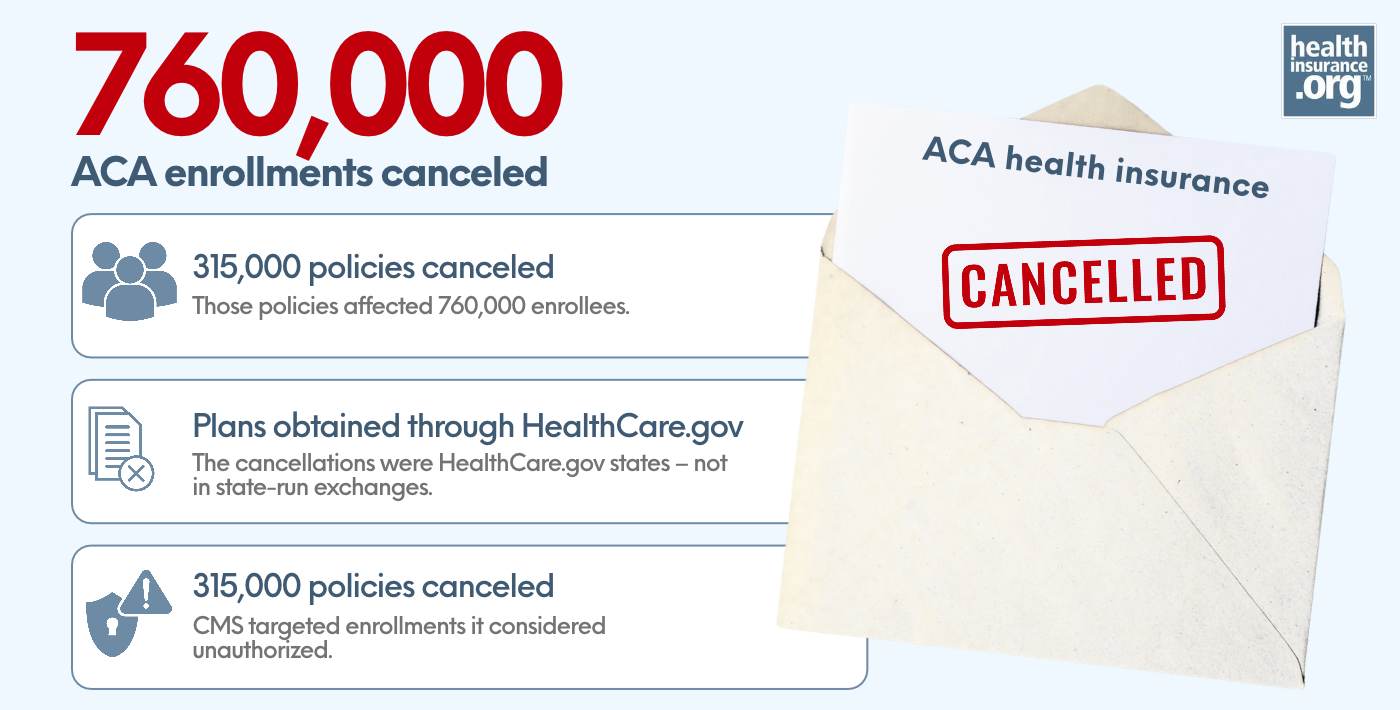
In September 2026, the Centers for Medicare & Medicaid Services (CMS) announced that on August 31, 2026, it terminated 315,000 Marketplace policies. CMS explained that the cancellation of those policies – which covered 760,000 enrollees – was expected to save about $2.2 billion in premium tax credits.1
Why did the government cancel these ACA enrollments?
CMS considers the 760,000 enrollments to be fraudulent or unauthorized, generally meaning that the person was enrolled without their knowledge or consent.1
The agency is working with insurers to recoup $2.2 billion in advance premium tax credits that were paid to the insurers that provided the policies.2
CMS worked with insurers to identify the unauthorized policies and determined policies should be canceled if they followed a “pattern of unauthorized enrollment.”3 Policies identified as fitting the pattern had applications submitted with assistance from an agent or broker and without verified citizenship or immigration documentation (for example, without Social Security Numbers). Additionally, insurers issuing the policies were “unable to identify claims or establish consumer contact.”
Does this affect people enrolled through state-run Marketplaces?
No. The issue of unauthorized enrollments was largely confined to the federally run Marketplace.4 The 760,000 enrollees whose plans were canceled in August 2026 were all in states that enroll through HealthCare.gov, as opposed to states that run their own Marketplace enrollment platforms.1
Could some enrollees have been improperly canceled?
Yes, although CMS has characterized the canceled enrollments as unauthorized and fraudulent, some legitimately enrolled consumers also lost coverage. By mid-October, CMS had reinstated coverage for “a small number” of people who had been legitimately enrolled.5
CMS has provided only limited information in terms of how the 760,000 enrollees were identified and what steps CMS took to ensure that the policies were the result of brokers enrolling people without their consent, or enrolling people who don’t exist.
One health policy analyst pointed out that the “pattern” used by CMS might leave room for error in determining fraud.6
Another health policy analyst has also pointed out that not having any claims is not necessarily proof that a person doesn’t exist or isn’t aware of their enrollment.7 Healthy enrollees, as well as enrollees who can’t afford out-of-pocket costs, might simply not need or use their coverage, and might choose to not take advantage of the zero-cost preventive care provided by Marketplace plans.6 This is particularly true in the individual market, where the average enrollee keeps their coverage for less than a full year.7
Could more Marketplace enrollees have their coverage canceled?
When CMS announced in September that 760,000 enrollments had been canceled, the agency was referring to policies that had been terminated a few weeks earlier, at the end of August. But officials noted that “CMS will continue working with health insurance companies to identify and investigate potentially unauthorized enrollments” and cancel any that they confirm are unauthorized.2
In addition to the 760,000 canceled enrollments, CMS is reviewing another 419,000 enrollments to determine whether they were unauthorized.8 If you have been notified you are enrolled in one of those policies – either by HealthCare.gov or your insurer – you’ll want to respond immediately to confirm whether your enrollment was legitimate or not.
Depending on the results of the investigation CMS is doing into those additional 419,000 enrollments, there could be another round of policy cancellations.
Can I get my Marketplace coverage reinstated if it was canceled by mistake?
People who believe their Marketplace coverage was improperly canceled by CMS in August should immediately contact the HealthCare.gov call center at 1-800-318-2596. These individuals will need to explain their situation and ask that their coverage be reinstated.
Depending on the circumstances, they may need to provide additional documentation, such as a Social Security Number, proof of immigration status, or proof of income. Exact details of an enrollee appeal have not been addressed by CMS in its press release, fact sheet, or interim final rule published in September 2026, although there does appear to be “an expedited review process” for people whose coverage was improperly terminated.5
(The interim final rule contains instructions on how people should proceed if they’ve been enrolled in a HealthCare.gov plan without their consent. But as of mid-October, CMS had not publicly issued steps someone should take if they had a legitimate enrollment that was canceled.)
What happens if I received medical care after CMS canceled my coverage?
CMS noted that no claims had been filed in 2026 for any of the policies that were canceled. But as noted above, some policies were canceled despite being legitimate, and it’s possible that an enrollee might have had their first medical care of the year in September, soon after the policies were canceled.
If that happened to you, immediately contact HealthCare.gov and the insurer that provided your plan. Explain that your enrollment was legitimate and provide any documentation necessary to prove that. You’ll want to request that your coverage be reinstated without any lapse, so that you’ll have uninterrupted coverage and your new claim can be processed.
If I do not want to appeal my cancellation, can I still re-enroll in the Marketplace?
Yes. Anyone who is eligible to use the Marketplace can enroll during open enrollment (November 1 to January 15 in most states) regardless of prior coverage.
If you were disenrolled in 2026 because CMS determined your enrollment was unauthorized or fraudulent, you may need to provide additional documentation or go through new identity proofing to enroll in 2027 coverage.9
If my plan was canceled, do I have to repay my subsidy?
For the canceled policies, CMS is working to recoup subsidies directly from the insurance companies.2
CMS sends Marketplace premium subsidies to insurers on behalf of enrollees, and enrollees later reconcile the subsidy (which is a tax credit) on their tax return. But in the case of the 760,000 unauthorized enrollments that CMS has canceled, the agency believes that the people either do not exist or were enrolled without their knowledge. So CMS is recouping the tax credits directly from the insurers, rather than through the normal tax reconciliation pathway with the individuals.
Are there changes to how enrollment will work going forward to prevent fraud?
Yes. CMS has taken several additional steps to prevent fraudulent enrollments during the ACA open enrollment period for 2027 coverage:2
- Agents and brokers who weren’t already certified by the federally facilitated Marketplace for Plan Year 2026 are not allowed to register with the Marketplace for Plan Year 2027 until February 1, 2027 – after open enrollment for the 2027 plan year has ended.10 CMS made this change because the federal agency noticed a disproportionate number of unauthorized enrollments among agents and brokers who were new to the Marketplace for 2026.
- Existing agents and brokers (who were already registered with the Marketplace for Plan Year 2026) must prove their identity using Login.gov or ID.me.
- Agents and brokers must obtain electronic authorization from a consumer before they can be involved with the consumer’s application or enrollment.
- All Marketplace applications completed with the help of an agent or broker must include Social Security numbers (for anyone over the age of 90 days) or verified immigration document information.11
- Some enrollees will have to complete additional identity proofing, particularly those who are new to the Marketplace, or who are working with a different agent or broker than they used in the past, or who have an after-subsidy premium under $30/month.9
Is the CMS focus on ACA enrollment fraud new?
No. Since 2024, CMS has been working to address unauthorized HealthCare.gov enrollments attributed to “rogue agents” – agents and brokers who fraudulently enrolled people, or changed their plan, without their knowledge.12
From June to October 2024, CMS suspended Marketplace registration for 850 agents and brokers suspected of submitting unauthorized enrollments or unauthorized plan switches.13 The Trump administration reinstated them in 2025,14 but has since terminated or issued intent-to-terminate notices to hundreds of agents and brokers who had repeatedly submitted applications suspected of being fraudulent.15
In April 2024, CMS announced that the agency was “taking swift actions to protect consumers from unauthorized activity by agents and brokers.”16 And during the first eight months of 2024, CMS resolved more than 183,000 complaints from people who had been enrolled in coverage through HealthCare.gov without their consent.13
In 2025, CMS canceled about 250,000 unauthorized enrollments and restored coverage for another 200,000 people whose plans had been switched without their knowledge.17
So while the termination of 760,000 unauthorized enrollments made headlines in the fall of 2026, this was part of an ongoing effort to mitigate fraudulent enrollments on the federally run Marketplace platform.
Footnotes
- “CMS Cracks Down on Fraud, Waste, and Abuse in the Federal Health Insurance Marketplace” Centers for Medicare & Medicaid Services. Sep. 22, 2026 ⤶ ⤶ ⤶
- “Federal Marketplace (FFE and SBE-FP) Anti-Fraud Actions” Centers for Medicare & Medicaid Services. Sep. 22, 2026 ⤶ ⤶ ⤶ ⤶
- “Patient Protection and Affordable Care Act; Temporary Moratoria on Certain Agent and Broker Registration To Participate in the Exchanges” Centers for Medicare & Medicaid Services. Sep. 23, 2026 ⤶
- “Unauthorized Plan Switching and Enrollment in ACA Health Plans” American College of Physician Advisors. Accessed Oct. 13, 2026 ⤶
- “After booting 760K off ACA health plans, the Trump administration adds some people back” NPR. Oct. 15, 2026 ⤶ ⤶
- “The Troubling Termination Of 760,000 ACA Marketplace Members” Health Affairs. Oct. 2, 2026 ⤶ ⤶
- “Matt Fiedler (Brookings Institution) X thread” X.com. Aug. 21, 2025 ⤶ ⤶
- “Vice President Vance Holds News Conference on Fraud” C-SPAN. Sep. 22, 2026 ⤶
- “EDE Change Request (CR) 109: Identity Proofing and Agent/Broker Authorization” Centers for Medicare & Medicaid Services. Aug. 3, 2026 ⤶ ⤶
- “Patient Protection and Affordable Care Act; Temporary Moratoria on Certain Agent and Broker Registration To Participate in the Exchanges” Centers for Medicare & Medicaid Services. Sep. 23, 2026 ⤶
- “Enforcing Existing Requirement to Provide a Verified SSN/Immigration Document(s)” HealthCare.gov. Accessed Oct. 13, 2026 ⤶
- “Unauthorized ACA plan switches drive call for action against rogue agents” NPR Shots. April 8, 2024 ⤶
- “CMS Update on Actions to Prevent Unauthorized Agent and Broker Marketplace Activity” Centers for Medicare & Medicaid Services. Oct. 17, 2024 ⤶ ⤶
- “Trump Team Claims Successes Against ACA Fraud While Pushing for More Controls” KFF Health News. Mar. 27, 2026 ⤶
- “Patient Protection and Affordable Care Act; Temporary Moratoria on Certain Agent and Broker Registration To Participate in the Exchanges” Centers for Medicare & Medicaid Services. Sep. 23, 2026 ⤶
- “CMS Statement on Agent and Broker Marketplace Activity” CMS Newsroom. April 12, 2024 ⤶
- “CMS Actions to Protect Consumers and Strengthen Exchange Program Integrity” Centers for Medicare & Medicaid Services. Jan. 28, 2025 ⤶