2027 ACA open enrollment: What’s changing
ACA open enrollment started Nov. 1. Here’s what you need to know about insurer exits, premiums, subsidies – and more.


In this article
- Insurers are entering and exiting the Marketplace in many states
- Premiums will be higher on average
- Out-of-pocket limits are increasing
- Fewer immigrants will qualify for Marketplace subsidies
- Oregon will utilize a state-run Marketplace platform
- Virginia and Rhode Island introduce state-funded subsidies
- HSA contribution limits will increase
- Catastrophic plan eligibility will be further limited
- Brokers who weren't registered with HealthCare.gov for 2026 cannot assist with 2027 enrollments
The ACA (Affordable Care Act) open enrollment period for plan year 2027 began November 1, 2026, in most states – and for people who buy their own health coverage, this year’s enrollment period comes with a number of important changes.
Insurers are leaving the Marketplace in nearly half of the states, unsubsidized premiums are rising substantially in many areas, and federal rules have changed who will qualify for subsidies and how much consumers will pay out of pocket. There are also changes to Marketplace platforms, state-funded subsidies, HSA contribution limits, and Catastrophic plan eligibility.
Whether you already have Marketplace coverage or are shopping for a plan for the first time, you’ll want to carefully compare your 2027 options during open enrollment. Here’s a look at the key changes to know before you enroll.
Insurers are entering and exiting the Marketplace
As is always the case, insurers are joining the Marketplace in some areas, and others are exiting the Marketplace. For 2027, there are far more exits than entries.
- Who’s affected? Hundreds of thousands of Marketplace enrollees have plans that will be terminated at the end of 2026 because of carrier exits. But in some states, many enrollees will have access to new plans due to a carrier entry.
- What can you do? Carefully compare the plan options available to you during open enrollment. Don’t rely on auto-renewal. If your Marketplace plan is ending, the auto-renewal process in most states will use an algorithm to pick a new plan for you, and it’s in your best interest to pick your own replacement plan. If new plans will be available in your area, comparison shopping during open enrollment will help you know whether any of those plans (or any other available plan) might be the best option for you.
What you need to know if your insurer is exiting the market.
Premiums will be higher on average and subsidies will also be larger
Nationwide, the median proposed rate increase (the midpoint of insurers’ proposed increases) for individual-market policies is about 15% for 2027.1 This means that roughly half of Marketplace insurers have proposed increases above 15% and the other half have proposed increases of less than 15%. The weighted average increase (which accounts for how many people are enrolled in each insurer’s plans) ranges from under 7% in Vermont, Iowa, New York, and Utah to nearly 28% in Arizona.
But those increases are for full-price premiums, and most individual-market enrollees do not pay full price. The majority of people with individual-market coverage buy it through the Marketplace (as opposed to off-exchange).2 And 87% of Marketplace enrollees were receiving premium subsidies at the start of 2026.3

Need help exploring your options?
A licensed agent can help you:
- Answer coverage questions
- Understand your options
- Explore costs and eligibility
- Enroll when you're ready
Subsidy amounts are based on the cost of the second-lowest-cost Silver (benchmark) plan. When the benchmark plan’s premium increases, subsidies also increase. Many enrollees will be fully or partially insulated from the rising premiums, due to increases in their subsidy amounts. But the benchmark plan’s premium change won’t be the same as other plans’ premium changes, and people who don’t get a subsidy (including everyone who buys coverage outside the exchange) will bear the full brunt of the rate increases.
- Who’s affected? More than 19 million people had Marketplace coverage as of early 2026,4 and the proposed rate increases also apply to off-exchange plans (where there are no subsidies available to offset the rate increases).
- What can you do? Pay close attention to the renewal notices you get from your insurer and the Marketplace. The notices will tell you your plan’s premium, and if applicable, your after-subsidy premium. Then you can comparison shop during open enrollment to see if a different plan might be a better value.
Out-of-pocket limits are increasing
For 2027 coverage, the maximum allowable out-of-pocket cap is $12,000 – up from $10,600 in 2026.
The Department of Health and Human Services set the $12,000 maximum in January 2026 using a formula created by the ACA and by HHS rules. (In the spring of 2026, HHS finalized a rule that would have allowed some Bronze plans to have out-of-pocket limits as high as $15,600.5 But that was stayed by a court in July,6 so the highest out-of-pocket limit you’ll see for a single person in 2027 is $12,000.)
- Who’s affected? The limit on out-of-pocket costs applies to all non-grandfathered (and non-grandmothered) individual and group health plans. Combined, these plans cover more than half of the population.7 Many plans have out-of-pocket caps that are well below the federal limits, but any individual or group plan can increase its out-of-pocket limit for 2027 as long as it doesn’t go over the federal limits.
- What can you do? Pay close attention to any communications you get from your health plan, to see if there will be any changes in your deductible and total out-of-pocket exposure for the coming year.
Fewer immigrants will qualify for Marketplace subsidies
Starting with plan year 2027, the only immigrants who qualify for Marketplace subsidies will be:
- Lawful Permanent Residents (LPR)
- Cuban-Haitian Entrants (CHE)8
- Compact of Free Association (COFA) migrants.9
All other immigrants will no longer qualify for Marketplace subsidies.10
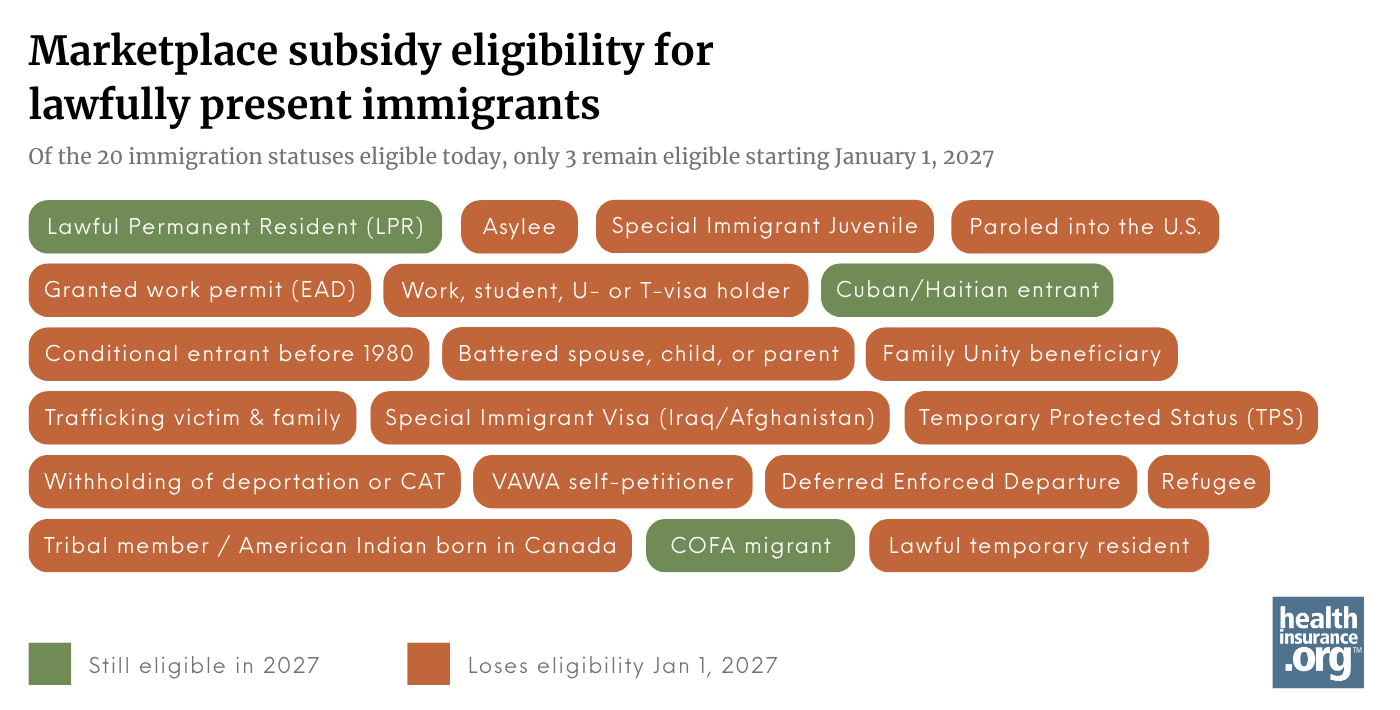
- Who’s affected? Any non-citizens who aren’t in one of the three categories listed above. Immigrants who will no longer qualify for Marketplace subsidies include asylees, refugees, people with Temporary Protected Status (TPS), and people with various types of temporary visas, such as work visas, student visas, U-visas (for victims of certain crimes) and T-visas (for victims of trafficking). An estimated one million people are expected to become uninsured by 2035 as a result of this change.11
- What can you do? If you’re not a U.S. citizen and you currently have subsidized Marketplace coverage, be sure you understand whether your immigration status makes you eligible for ongoing subsidies in 2027. If not, you’ll want to understand how much full-price coverage will cost, and consider whether any of the lower-priced Marketplace plans in your area (a Bronze plan, for example) might be a better fit for your budget.
Oregon will utilize a state-run Marketplace platform
Starting this fall, Oregon residents will use the state-run Explore Health platform to obtain their coverage for 2027, instead of HealthCare.gov.12 Oregon is the latest state to switch from HealthCare.gov to a state-run Marketplace enrollment platform.
- Who’s affected? Nearly 106,000 Oregon residents had Marketplace coverage as of early 2026,13 All of them will transition to Explore Health for 2027 if they wish to keep Marketplace coverage.
- What can you do? If you’re in Oregon and have Marketplace coverage in 2026, pay close attention to any communications you get from HealthCare.gov and Explore Health (the Oregon Health Insurance Marketplace). Your account should be automatically migrated to the new platform, and you should have received details in early October about how to activate your new account using an access code or your Social Security Number. Window shopping began on the new platform on October 15, and open enrollment began November 1.14
Virginia and Rhode Island introduce state-funded subsidies
For the 2027 plan year, Virginia and Rhode Island are joining the list of states that offer state-funded health insurance subsidies in addition to the ACA’s federal subsidies.
The Virginia Premium Savings program and the Rhode Island Marketplace Affordability Program (RIMAP) became available starting November 1, 2026, when consumers are enrolling in coverage for 2027.15
Virginia
- Who’s affected? People in Virginia who buy their own health insurance and have household incomes between 138% and 250% of the federal poverty level (FPL). For 2027 coverage, that amounts to:16
- Above $22,025 but not more than $39,900 for an individual.
- Above $45,540 but not more than $82,500 for a family of four.
- What can you do? If you’re in Virginia and your income makes you eligible for the new Virginia Premium Savings program, the subsidy will be automatically applied to any metal-level plan you select in the Virginia Marketplace. You won’t get the subsidy if you buy coverage outside the Marketplace, or if you buy a Catastrophic plan in the Marketplace.16
Rhode Island
- Who’s affected? About 20,000 Rhode Island residents will receive the new state-funded subsidies.17 This includes people who buy their own health insurance via HealthSource RI and have household incomes between 138% and 200% of FPL, as well as roughly 1,000 to 1,400 enrollees with household income a little above 400% FPL (who aren’t eligible for any federal subsidies) and who would otherwise pay more than 18% of their income for health insurance.18 For 2027 coverage, that amounts to:
- For an individual: Above $22,025 but not more than $31,920. AND some individuals with income a little above $63,840.
- For a family of four: Above $45,540 but not more than $66,000. AND some four-person families with income a little above $132,000.
- What can you do? If you’re in Rhode Island and your income makes you eligible for RIMAP, the subsidy will be automatically applied to any metal-level plan you select in HealthSource RI. You won’t get the subsidy if you buy coverage outside the Marketplace.
HSA contribution limits will increase
As is the case each year, the IRS has indexed health savings account (HSA) contribution limits.19 If you have HSA-eligible health coverage in 2027, here’s how much you can contribute to an HSA:
- Up to $4,500 if your HDHP covers just yourself.
- Up to $9,000 if your HDHP also covers at least one additional family member.
In 2026, the contribution limits were $4,400 and $8,750, respectively.20
Note: HSA contributions will lower your household income under the ACA’s rules for how modified adjusted gross income is calculated. This could make you eligible for a larger premium subsidy, or make you eligible for a subsidy when you would otherwise be over the “subsidy cliff.” It’s important to check with a tax advisor for any tax-related questions you might have.
- Who’s affected? Anyone with an HSA-eligible high-deductible health plan (HDHP) who wants to contribute to an HSA in 2027. As was the case in 2026, all Marketplace Bronze and Catastrophic plans will continue to be HSA-eligible in 2027.
- What can you do? If you’ll have an HSA-eligible HDHP in 2027, consider whether you’d like to make HSA contributions. You can make the contributions at any point during the year, or even up until the tax filing deadline in April 2028. The money you put into the HSA is pre-tax, and there’s no use-it-or-lose-it rule for HSAs. So if you don’t need to withdraw HSA funds to pay for medical expenses, they will remain in the account (along with any interest, dividends, or investment growth) and you can use the funds to pay medical bills in the future.
Learn more about how HSAs work.
Catastrophic plan eligibility expansion has been reversed
Catastrophic plans are once again only available to people aged 30 or older who obtain a hardship or affordability exemption certificate (and who are in an area where Catastrophic plans are sold).
In September 2025, a Trump administration rule expanded access to Catastrophic plans, making them automatically available in most states to enrollees who didn’t qualify for Marketplace subsidies (regardless of age).21 That rule was expanded in 2026 to apply nationwide.22
But in July 2026, a judge stayed the new rule.23 That means eligibility for Catastrophic plans is once again limited to the pre-September 2025 rules: a person who is 30 or older must obtain a hardship or affordability exemption certificate to purchase a Catastrophic plan.24
- Who’s affected? During the open enrollment period for 2026 coverage, 67,489 people enrolled in Catastrophic plans through the Marketplaces nationwide, amounting to about 0.3% of Marketplace enrollees.25 And more than 20,000 of these enrollees had been eligible to purchase Catastrophic coverage simply because they were not eligible for Marketplace subsidies, due to the expanded eligibility rule that had been issued in September 2025.26 Any enrollees who are 30 or older will only be able to keep Catastrophic coverage for 2027 if they qualify for and obtain a hardship exemption.
- What can you do? If you’re 30 or older and you want to enroll in a Catastrophic plan for 2027, you’ll need to obtain a hardship or affordability exemption certificate. That process isn’t immediate; it requires paperwork that has to be processed after you complete it, so you’ll want to start early.
Learn more about Catastrophic health plans.
Brokers who weren’t registered with HealthCare.gov for 2026 cannot assist with 2027 enrollments
As part of ongoing efforts to prevent fraud, CMS announced in September 2026 that brokers who weren’t already registered with the federally run Marketplace (HealthCare.gov) in 2026 would not be able to register for the 2027 plan year until February 2027. So for the duration of the open enrollment period that runs from November 1, 2026 through January 15, 2027, the only brokers able to assist consumers with HealthCare.gov enrollments will be those who were already registered for the 2026 plan year.27
- Who’s affected? Any consumers working with a broker who can’t register with the Marketplace due to the moratorium, or working with a brokerage or insurer that potentially experiences staffing shortages due to the moratorium.
- What can you do? If you’re in a state that uses HealthCare.gov and you want to enroll in a Marketplace plan with help from a broker, make sure the broker you’re working with can assist you with that process. If you want to make an appointment with a brokerage or call an insurer’s enrollment call center, don’t wait until the last minute. Some brokerages and insurers may be short-staffed this fall due to the moratorium, which could potentially make it harder to secure appointments or lead to longer hold times.28
Footnotes
- “How Much and Why ACA Marketplace Premiums Are Going Up in 2027” KFF.org. Aug. 3, 2026. ⤶
- “How Individual Market Enrollment Changed with the Enhanced Premium Tax Credits” KFF.org. June 12, 2025. ⤶
- “2026 Marketplace Open Enrollment Period Public Use Files” (Columns H and AO). Centers for Medicare & Medicaid Services. Accessed Aug. 19, 2026. ⤶
- “Health Insurance Exchanges Monthly Effectuated Enrollment (February 2026 data)” Centers for Medicare & Medicaid Services. Accessed Aug. 19, 2026. ⤶
- “Patient Protection and Affordable Care Act, HHS Notice of Benefit and Payment Parameters for 2027; and Basic Health Program” Centers for Medicare & Medicaid Services. May 15, 2026. ⤶
- “Updated Statement Regarding the City of Columbus v. Kennedy, No. 1:26-cv-02215” Centers for Medicare & Medicaid Services. Aug. 4, 2026. ⤶
- “Health Insurance Coverage of the Total Population” KFF.org. Accessed Aug. 20, 2026. ⤶
- “Information for SAVE Users: Cuban-Haitian Entrants” U.S. Citizenship and Immigration Services. Accessed Aug. 19, 2026. ⤶
- “Status of Citizens of the Freely Associated States of the Federated States of Micronesia and the Republic of the Marshall Islands Fact Sheet” U.S. Citizenship and Immigration Services. Accessed Aug. 19, 2026. ⤶
- “New Immigrant Eligibility Restrictions Coming to Federally-Funded Health Coverage” Georgetown University Center for Children and Families. Oct. 1, 2025. And “1.4 Million Lawfully Present Immigrants are Expected to Lose Health Coverage due to the 2025 Tax and Budget Law” KFF.org. Sep. 25, 2025. ⤶
- “1.4 Million Lawfully Present Immigrants are Expected to Lose Health Coverage due to the 2025 Tax and Budget Law” KFF.org. Sep. 25, 2025. ⤶
- “State-based Marketplace Project” Oregon.gov. Accessed Aug. 19, 2026. And “Conditional approval letter from CMS,” Aug. 13, 2026. ⤶
- “Health Insurance Exchanges Monthly Effectuated Enrollment (February 2026 data)” Centers for Medicare & Medicaid Services. Accessed Aug. 19, 2026. ⤶
- “State-based Marketplace Project Partner Listening Sessions” (What is a soft launch?). Oregon Health Authority. Accessed Aug. 19, 2026. ⤶
- “Virginia Premium Savings” Virginia Health Insurance Marketplace. Accessed Oct. 26, 2026. And “HealthSource RI, partners mark upcoming Open Enrollment season, new health coverage affordability options through RIMAP” HealthSource RI. Oct. 21, 2026. ⤶
- “Virginia Premium Savings” Virginia Health Insurance Marketplace. Accessed Aug. 19, 2026. ⤶ ⤶
- “HealthSource RI, partners mark upcoming Open Enrollment season, new health coverage affordability options through RIMAP” HealthSource RI. Oct. 21, 2026. ⤶
- “Rhode Island Marketplace Affordability Program (RIMAP) Annual Program Parameters for Plan Year 2027” HealthSource RI. Accessed Oct. 26, 2026. ⤶
- “Revenue Procedure 2026-24” Internal Revenue Service. Accessed Aug. 19, 2026. ⤶
- “Revenue Procedure 2025-19” Internal Revenue Service. Accessed Aug. 21, 2026. ⤶
- “Expanding Access to Health Insurance: Consumers to Gain Access to ‘Catastrophic’ Health Insurance Plans in 2026 Plan Year” Centers for Medicare & Medicaid Services. Sep. 4, 2025. ⤶
- “Patient Protection and Affordable Care Act, HHS Notice of Benefit and Payment Parameters for 2027; and Basic Health Program” Centers for Medicare & Medicaid Services. May 15, 2026. ⤶
- “City of Columbus et al. v. Kennedy et al. (Columbus II)” Georgetown Law Health Care Litigation Tracker. Stay issued July 16, 2026. And “Updated Statement Regarding the City of Columbus v. Kennedy, No. 1:26-cv-02215” Centers for Medicare & Medicaid Services. Aug. 4, 2026. ⤶
- “How to pick a health insurance plan: Catastrophic health plans” HealthCare.gov. Accessed Aug. 20, 2026. ⤶
- “2026 Marketplace Open Enrollment Period Public Use Files” (Columns H and BV). Centers for Medicare & Medicaid Services. Mar. 27, 2026. ⤶
- “City of Columbus et al. v. Kennedy et al. (Columbus II), Memorandum Opinion” Georgetown Law Health Care Litigation Tracker. Issued July 16, 2026. ⤶
- “Patient Protection and Affordable Care Act; Temporary Moratoria on Certain Agent and Broker Registration To Participate in the Exchanges” U.S. Department of Health & Human Services. Sep. 23, 2026. ⤶
- “NAIC letter to CMS” NAIC. Oct. 14, 2026. ⤶