Health insurance premium increases for 2027: Proposed rates by state and what consumers should know
Another round of double-digit premium increases feels like déjà vu. Here’s why it’s not.
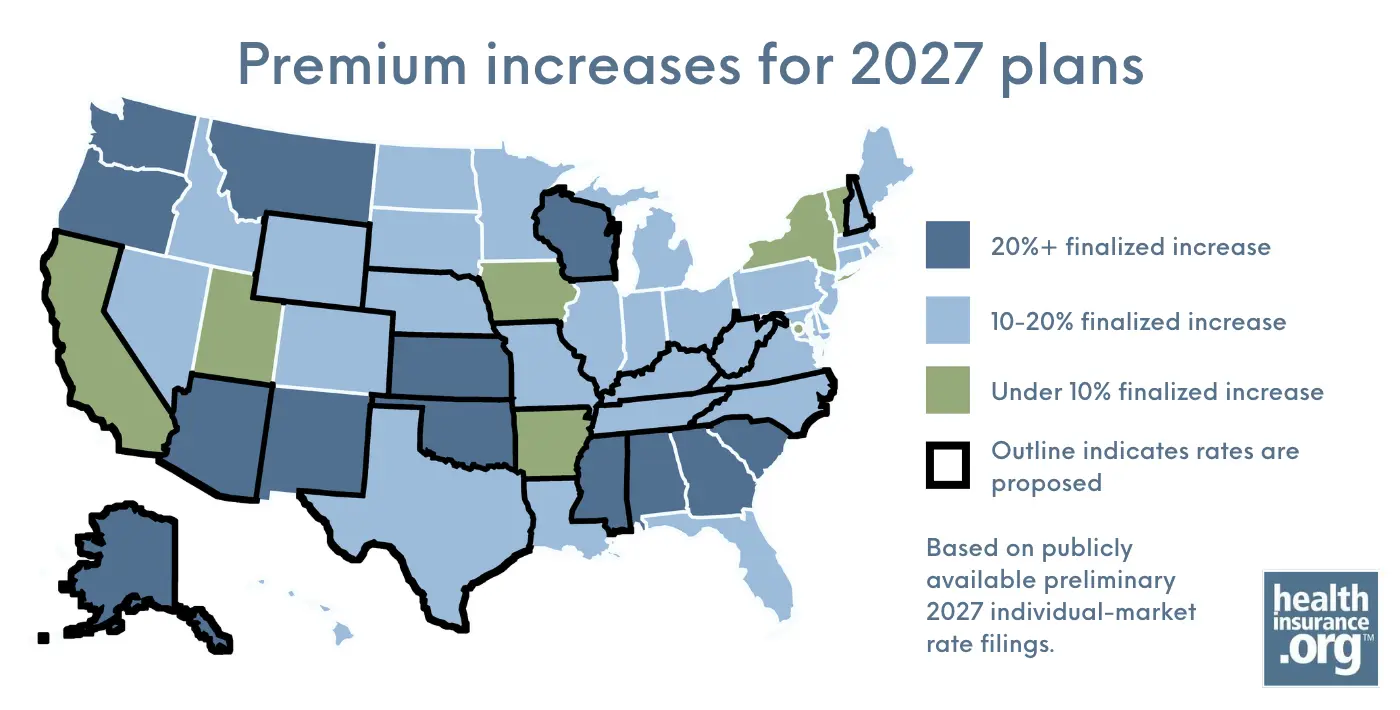

Healthinsurance.org is reviewing proposed — and as they become available, approved — individual market premium increases for 2027 (see chart below; rates have been finalized in about two-thirds of the states as of mid-October 2026). The median proposed increase for 2027 was about 15%, before any subsidies are applied.1 And including final rates for about half of the states, the weighted average rate increase is also sitting at about 15%.2
After last year’s increases, another round of double-digit rate increases may sound alarming. But these rate increases do not necessarily reflect what Marketplace enrollees will ultimately pay, and several key factors make the outlook for 2027 very different than what we saw for 2026.
Here are the proposed (and final, as available) weighted average health insurance rate increases by state:
Proposed 2027 individual market rate increases by state |
|
|---|---|
| State | Weighted average proposed increase |
| Vermont (rate increases finalized) | 3%3 |
| Iowa (rate increases finalized) | 5.7%4 |
| New York (rate increases finalized) | 6%5 |
| Utah (rate increases finalized) | 6.7%6 |
| Arkansas* | 7.6%7 |
| Washington, DC (rate increases finalized) | 9.9%8 |
| California | 9.9%9 |
| Colorado (rate increases finalized) | 10%10 |
| Florida (rate increases finalized) | 10.4%11 |
| South Dakota (rate increases finalized) | 10.4%12 |
| Massachusetts (rate increases finalized) | 10.8%13 |
| Connecticut (rate increases finalized) | 11.2%14 |
| Wyoming | 11.3%15 |
| Idaho (rate increases finalized) | 12%16 |
| Rhode Island (rate increases finalized) | 12.4%17 |
| Missouri | 12.5%18 |
| Hawaii (rate increases finalized) | 12.7%19 |
| Tennessee* | 12.7%20 |
| Texas* | 13.1%21 |
| Nebraska | 13.3%22 |
| North Carolina* (rate increases finalized) | 14%23 |
| Illinois (rate increases finalized) | 14.1%24 |
| Michigan (rate increases finalized) | 14.5%25 |
| Maryland (rate increases finalized) | 14.6%26 |
| Maine (rate increases finalized) | 14.8%27 |
| Virginia (rate increases finalized) | 15.8%28 |
| Pennsylvania (rate increases finalized) | 16%29 |
| Ohio (rate increases finalized) | 16.3%30 |
| Delaware* (rate increases finalized) | 16.5%31 |
| North Dakota (rate increases finalized) | 17.1%32 |
| Indiana (rate increases finalized) | 17.5%33 |
| Minnesota (rate increases finalized) | 17.7%34 |
| Louisiana (rate increases finalized) | 18.1%35 |
| West Virginia | 18.3%36 |
| New Hampshire | 18.4%37 |
| Kentucky (rate increases finalized) | 18.7%38 |
| Nevada* (rate increases finalized) | 18.8%39 |
| New Jersey (rate increases finalized) | 19.8%40 |
| Oklahoma* | 20.2%41 |
| Georgia (rate increases finalized) | 20.7%42 |
| Wisconsin* | 21.1%43 |
| Oregon (rate increases finalized) | 21.6%44 |
| Mississippi | 21.8%45 |
| South Carolina* (rate increases finalized) | 22.1%46 |
| Washington (rate increases finalized) | 22.2%47 |
| Montana (rate increases finalized) | 22.6%48 |
| Alaska | 22.9%49 |
| Kansas | 24.2%50 |
| New Mexico (rate increases finalized) | 24.4%51 |
| Alabama (rate increases finalized) | 25%52 |
| Arizona (rate increases finalized) | 27.9%53 |

Need help exploring your options?
A licensed agent can help you:
- Answer coverage questions
- Understand your options
- Explore costs and eligibility
- Enroll when you're ready
Federal subsidy enhancements expired last year, driving up the average net (after-subsidy) Marketplace premiums by 58% in 2026,54 even though many people downgraded to lower-priced Bronze plans.
Had the subsidy enhancements been extended, premium subsidies would have been larger, offsetting much of the underlying premium growth – which was significantly larger than we had seen for the last several years.55
(Premium subsidies are actually larger in 2026 than they were in 2025. In 2026, the average premium subsidy is $650/month, up from $550/month in 2025. But the average full-price premium grew by even more: It was $619/month in 2025, and increased to $741/month in 2026, despite all the people who downgraded their coverage.)56
Here’s why 2027 will be different, despite the double-digit rate increases in most states:
- Most Marketplace enrollees still get premium subsidies, even after the subsidy enhancements expired. During the open enrollment period for 2026 coverage, 87% of enrollees qualified for premium subsidies.57
- The subsidies are designed to keep pace with the cost of the benchmark (second-lowest-cost) Silver plan in each area. So as premiums rise, so should subsidies. The reason people are paying much higher premiums this year, even if they’re still getting a subsidy, is because the expiration of the subsidy enhancements resulted in a significant increase in the percentage of income that people have to pay for their coverage.
- For 2027, the percentage of income that people have to pay themselves will be indexed just the way it was each year from 2015 to 2021, but it won’t be the sort of drastic change that we saw for 2026.
The short story: For most Marketplace enrollees, larger subsidies will likely offset some or all of the premium increases for 2027. The full brunt of the premium increases will mostly impact Marketplace enrollees who aren’t eligible for a subsidy, plus anyone who buys individual market coverage outside the Marketplace, where subsidies aren’t available.
Why Marketplace premiums are increasing
The factors driving full-price premiums higher for 2027 include some usual culprits and some that stem from recent federal changes. As is typically the case, the largest driver of higher premiums is the ever-increasing cost of healthcare. This encompasses a variety of factors, such as higher hospital and drug costs (including the cost of GLP-1 medications), higher labor costs, and increased utilization of medical services.60
Insurers also point to general economic inflation as a factor that has pushed prices higher across the board in recent years, including the price of healthcare.
Insurers also note that the expiration of the federal subsidy enhancements is expected to result in continued deterioration of the health of the overall risk pool in 2027, as healthier enrollees drop their coverage, leaving a sicker risk pool that costs more to insure on a per-person basis. Insurers also highlight some other recent federal rule changes that are projected to result in lower enrollment (and thus a sicker risk pool), including the 2025 Marketplace Integrity rule, the “One Big Beautiful Bill,” and the 2027 Notice of Benefit and Payment Parameters.60
(Note: Several of the key changes included in the 2025 Marketplace Integrity Rule and the 2027 Notice of Benefit and Payment Parameters have been blocked by court rulings and are not taking effect in the fall of 2026.)61
Will I qualify for a subsidy in 2027 if I don’t qualify in 2026?
Because the subsidy enhancements were allowed to expire, the “subsidy cliff” returned in 2026. This means subsidy eligibility ends abruptly if household income goes above 400% of the federal poverty level (FPL), regardless of how much the household has to spend on health insurance.
During the open enrollment period for 2025 coverage, 92% of Marketplace enrollees qualified for a subsidy, but that dropped to 87% in 2026,62 largely because of the return of the subsidy cliff.
The subsidy cliff will still exist in 2027, so subsidies will not be available if household income is more than 400% FPL. But because of annual increases in the FPL, the income level at which subsidy eligibility ends will be a little higher in 2027:63
- A single person in the continental U.S. will qualify for a subsidy with an income as high as $63,840, up from $62,600 in 2026.
- A household of four in the continental U.S. will qualify for a subsidy with a household income as high as $132,000, up from $128,600 in 2026.
Make sure you understand how household income is calculated under the ACA, as it’s a unique version of MAGI. And keep in mind that contributions to a health savings account or pre-tax retirement account will reduce your ACA-specific MAGI.
If I get a premium subsidy, will my subsidy increase in 2027?
If the cost of the benchmark plan in your area increases, your subsidy amount will generally increase too, assuming your income remains fairly steady.
But the benchmark plan is just one plan, and there are dozens of plans available in most areas. So it’s important to understand that the size of your subsidy is tied to the price of the benchmark plan, not the price of your specific plan.
Depending on the discrepancy between how much your plan’s premium changes and how much the benchmark plan’s premium changes, you may find that your subsidy doesn’t keep pace with your premium. But it’s also possible for the subsidy amount to increase by more than the premium increase for your plan, making your plan more affordable in the coming year.
Either way, it’s always a good idea to carefully comparison shop during open enrollment, which starts on November 1 in most states.
Should I switch to a different Marketplace plan for 2027?
Renewing your current plan for 2027 – if it’s still available – might be the best option, or you might be better served by switching to a different plan. You won’t know until you compare the plans available in your area during open enrollment.
Pay close attention to any notifications you get from your health plan and the Marketplace as we get closer to the start of open enrollment. If your net health insurance premium is increasing for 2027, you might prefer a different plan. But choosing a health insurance policy involves a lot more than just premiums, so be sure you consider all aspects of the various plans before picking the one you want for 2027.
Note: Several hundred thousand people will need to select new plans for 2027 because of carriers exiting the Marketplace at the end of 2026. If your carrier is leaving the Marketplace and you pick a new plan by December 31, it will take effect on January 1, ensuring that you have seamless coverage.
Final rates could differ from proposed rates
The rate increases listed above are still proposals in some states, so they could change before they’re finalized (in states where the rates have already been approved, it's noted in the chart and on the map). In nearly all states, the rate review process is done by the state,64 and there’s significant variation in terms of how much approved rates tend to differ from the rates that the insurers initially file.
For example, New York regulators approved an overall average rate increase of 6% for 2027 individual market plans, which was significantly smaller than the 20.6% average rate increase the insurers had proposed.65
But in New Mexico, the approved 2027 health insurance rates are nearly identical to the insurers’ proposals, with an overall weighted average increase of 24.4%, versus the 25.6% overall average the insurers had initially proposed.66
Footnotes
- “ACA Marketplace Insurers Are Proposing a Median Premium Increase of About 15% in 2027” KFF.org. Aug. 4, 2026 ⤶
- “NATIONALLY, unsubsidized ACA premiums to jump *ANOTHER* ~15% next year (UPDATED)” ACA Signups. Sep. 25, 2026 ⤶
- “Insurance rates on Vermont marketplace to grow up to 6%” Valley News. Aug. 20, 2026. Weighted average calculated from enrollment totals in the filings (17,429 for BCBSVT, and 16,542 for MVP) Aug. 23, 2026 ⤶
- “Health Insurance Rate Increase Data” Iowa Insurance Division. Accessed July 2, 2026. And “2027 Rate Changes - Iowa +5.7% for unsubsidized indy market enrollees; Medica is out” ACA Signups. Oct. 12, 2026 ⤶
- “Summary of Requested & Approved 2027 Rate Actions” New York State Department of Financial Services. Accessed Sep. 4, 2026 ⤶
- “Latest Rate Changes” Utah Health Insurance Transparency. Accessed Sep. 18, 2026. Weighted average calculated based on enrollment numbers in the carrier filings: 123 for BridgeSpan, 16,747 for Regence, 293,150 for Select Health, 21,699 for UUHP, 832 for Molina, and 6,491 for Imperial. ⤶
- “Arkansas Rate Review Submissions” RateReview.HealthCare.gov. Accessed Aug. 6, 2026. Weighted average calculated based on total effectuated Arkansas Marketplace enrollment as of early 2026 (129,699), an assumption that off-exchange enrollment brings this total to about 135,000, and USAble Mutual's filing indicating that they have 107,724 enrollees. We've assigned the rest of the enrollees equally across the remaining carriers to calculate a semi-weighted average increase. ⤶
- “DISB Announces Approved 2027 Health Insurance Rates; Rigorous Review Protects DC Consumers and Small Businesses” DC Department of Insurance, Securities, and Banking. Sep. 18, 2026 ⤶
- “Covered California Rates and Plans for 2027: California Continues Fight for Health Insurance Affordability and Access” July 21, 2026 ⤶
- “Press Release: Division of Insurance Announces Final ACA Health Insurance Premium Increases for Plan Year 2027" Colorado Division of Insurance. Sep. 22, 2026 ⤶
- “Individual PPACA Market Monthly Premiums for Plan Year 2027” FLOIR. Oct. 16, 2026 ⤶
- “South Dakota SERFF Filings” (Filing numbers AVER-134967602, SANF-134880465, and WMIA-134959395) Accessed Sep. 15, 2026. Weighted average based on effectuated Marketplace enrollment in SD (45,888 in early 2026), an assumption that off-exchange brings the total to about 47,000, and the details in the filings: 21,516 enrollees for Avera, and 17,910 enrollees for Sanford (WellMark redacted, but calculated at about 7,574 with the assumption that total market is about 47,000) ⤶
- “Final Merged Market Rates Effective for 2027” Massachusetts Division of Insurance. Accessed Sep. 2, 2026 ⤶
- “Health Insurance Rates for 2027 (Final Rate Chart)” Connecticut Insurance Department. Accessed Sep. 4, 2026 ⤶
- “Wyoming Rate Review Submissions” RateReview.HealthCare.gov. Accessed Aug. 2, 2026. Weighted average calculated based on enrollment number in UHC's filing (4,332), total WY Marketplace effectuated enrollment as of February 2026 (34,514), and an assumption that total enrollment including off-exchange is likely about 35,000. ⤶
- “Idaho Rate Review Individual” Idaho Department of Insurance. Accessed Oct. 1, 2026 ⤶
- “2027 Commercial Health Insurance Rates Approved with Modifications” Rhode Island Office of the Health Insurance Commissioner. Sep. 29, 2026 ⤶
- “Missouri 2027 Single Risk Pool” Missouri Department of Commerce and Insurance. July 31, 2026. Weighted average calculated based on enrollment numbers provided in the SERFF filings: 5,416 for BCBSKC; 151,880 for Ambetter/Celtic; 39,872 for Anthem BCBS; 12,843 for Medica; 18,672 for Oscar; and an estimated 27,000 for United HealthCare ⤶
- “Hawaii SERFF Filings” (Tracking numbers KAHA-134973969 and HMSA-134976042) Approved Sep. 2, 2026. And “2027 Rate Changes - Hawaii: +12.7% indy mkt; enrollment down 9% y/y (FINAL)” ACA Signups. Sep. 17, 2026 ⤶
- “Tennessee Rate Review submissions” RateReview.HealthCare.gov. Accessed Aug. 5, 2026. Semi-weighted average based on enrollment numbers in filings: BCBSTN (92,000), Oscar (89,993), United HealthCare (66,697), and Alliant (4,373). Total effectuated TN Marketplace enrollment was 441,515 in early 2026. We've split the remaining enrollees equally across Cigna (exiting) and Celtic. ⤶
- “Texas Rate Review Submissions” RateReview.HealthCare.gov. Accessed Aug. 6, 2026. Weighted average based on enrollment numbers in filings: 959,956 for BCBSTX; 677,777 for CHRISTUS; 11,999 for Community First; 6,750 for Community Health Choice; 1,314 for Moda; 527,578 for Oscar; 37,847 for Sendero; 545,502 for UnitedHealthcare; 116,197 for Wellpoint. For the remaining carriers, we used total TX Marketplace enrollment (3,277,198), rounded up to 3,330,000 to account for off-exchange, and assigned the remaining enrollees equally across the remaining carriers. ⤶
- “Nebraska Rate Review Submissions" RateReview.HealthCare.gov. Accessed Aug. 4, 2026. Weighted average calculated based on enrollment numbers in filings: 29,600 for BCBSNE; 7,989 for Medica; 3,659 for Oscar; 2,831 for UnitedHealthCare. For the remaining carrier (Celtic) we used the total NE Marketplace enrollment in early 2026 (100,622), added a small off-exchange total, and allocated the rest of the enrollees to Celtic. ⤶
- “2027 Rate Changes - North Carolina: +14.9% indy market; +19.8% sm. group market” ACA Signups. Aug. 10, 2026. Rate increases updated with final rates from SERFF for all insurers other than AmeriHealth Caritas (North Carolina SERFF filings: CECO-134955583; BCNC-134942959; OHIN-134935957; UHLC-134935080) Accessed Oct. 22, 2026. Estimated market share supported by 2025 NC market share data. ⤶
- “Affordable Care Act (ACA) - Illinois Rate Filings” (weighted average is based on enrollment totals pulled from the filings on that page: HCSC has 240,252 enrollees, Celtic has 16,493, Mercy Care has 2,070, Molina has 118, Oscar has 22,291, and United Healthcare has 59,068). Illinois Department of Insurance. Accessed Oct. 19, 2026 ⤶
- “2027 Michigan Health Insurance Rate Change Requests” Michigan Department of Insurance and Financial Services (DIFS). July 14, 2026. And “2027 Rate Changes - Michigan: +14.5% indy market; +10.0% sm. group market (FINAL)” ACA Signups. Sep. 30, 2026 ⤶
- “Maryland Insurance Administration Approves 2027 Affordable Care Act Premium Rates” And “Exhibit 1, 2027 Maryland Individual Market ACA Rate Filings Summary” Maryland Insurance Administration. Sep. 25, 2026 ⤶
- “Maine Bureau of Insurance Releases 2027 Health Insurance Premiums for Individual and Small Group Market” Maine Bureau of Insurance. Aug. 14, 2026 ⤶
- “2027 ACA Individual Market Rate Summary” Virginia Bureau of Insurance. Accessed Oct. 2, 2026. Weighted average based on enrollment totals provided in the rate summary, for plans available on-exchange. ⤶
- “Rate Decision, 2027” (“The statewide average rate change request across all insurers
was originally 17.1% and was revised to 16%”) Pennsylvania Insurance Department. Accessed Sep. 18, 2026 ⤶ - “2027 Rate Changes - Ohio: +16.3% indy market; +22.0% sm. group market (FINAL)” ACA Signups. Oct. 15, 2026. And Ohio SERFF ⤶
- “Health Insurance Rate Filings” Delaware Department of Insurance. Accessed Sep. 11, 2026. Semi-weighted average based on Highmark's 26,000 members (noted in filing documents), and a total individual market of 36,282 in Delaware in early 2026. We rounded that up to 40,000 to account for off-exchange enrollees, and split the remaining enrollees between Celtic (leaving the market) and AmeriHealth, assigning them both about 7,000 enrollees. ⤶
- “Godfread announces 2027 health insurance rate changes” North Dakota Insurance & Securities. Oct. 12, 2027. And “North Dakota Rate Review Submissions” RateReview.HealthCare.gov. Accessed Aug. 5, 2026. Enrollment share from filings for BCBSND (32,000) and Medica (2,363), and inferred for Sanford based on total effectuated ND Marketplace enrollment (37,472) plus a small margin for off-exchange enrollment ⤶
- “Indiana 2027 ACA Filings” Indiana Department of Insurance. Accessed Sep. 4, 2026. Enrollment numbers are in SERFF filings: Anthem: AWLP-134814956 (105,770 enrollees); Coordinate Care: CECO-134977902 (63,592 enrollees); United HealthCare: UHLC-134932652 (507 enrollees). Accessed June 19, 2026 ⤶
- “Individual Market Final Average Rate Changes for Plan Year 2027” Minnesota Commerce Department. Accessed Oct. 1, 2026. And “2027 Rate Changes - Minnesota: +17.7% indy, +14.7% sm. group (FINAL)” ACA Signups. Oct. 1, 2026 ⤶
- “Health Rate Filing Search for Individual and Small Group Markets” Louisiana Department of Insurance. Accessed Sep. 15, 2026 ⤶
- “West Virginia Rate Review Submissions” RateReview.HealthCare.gov. Accessed Aug. 3, 2026 ⤶
- “New Hampshire Rate Review Submissions” RateReview.HealthCare.gov. Accessed Aug. 4, 2026. Weighted average based on enrollment totals reported in each carrier's filing: 1,924 for Harvard Pilgrim; 38,800 for Matthew Thornton; 7,608 for Boston Medical Center/Wellsense ⤶
- “Rate Filing Summary, WellCare Health Plans of Kentucky” And “Rate Filing Summary, Anthem Health Plans of Kentucky” (And “Rate Filing Summary, Molina Healthcare of Kentucky” but Molina won't be in the KY Marketplace for 2027) Kentucky Department of Insurance. Approved July 31, 2026. And “2027 Rate Changes - Kentucky: +18.7% indy mkt, +10.7% sm. group” ACA Signups. July 30, 2026 ⤶
- “Nevada Rate Review Submissions” RateReview.HealthCare.gov. And “Health Insurance Rate Change Search Results” Nevada Division of Insurance. Accessed Aug. 5, 2026. Weighted average based on enrollment totals reported in each carrier's filing: 799 for CareSource; 5,100 for Community Care; 44,110 for Health Plan of NV; 7,773 for Select Health; 23,813 for Silver Summit; an estimated 7,500 for Hometown Health (based on 5,909 policyholders). For the remaining three carriers (HMO NV, Imperial, and Molina), we used effectuated NV Marketplace enrollment (99,663), added a small amount for off-exchange, and split the rest of the enrollment across the three remaining carriers. ⤶
- “NJ Department of Banking and Insurance Releases Final Health Insurance Rates for the Individual Market, Including Get Covered New Jersey, for Plan Year 2027” New Jersey Department of Banking and Insurance. Oct. 15, 2026. ⤶
- “Oklahoma Rate Review Submissions" RateReview.HealthCare.gov. Accessed Aug. 6, 2026. Weighted average based on enrollment details in filings: 60,034 for BCBSOK; 10,146 for UnitedHealthcare; 71,620 for Celtic, and total Marketplace enrollment in Oklahoma (179,600 in early 2026), rounded up slightly to account for off-exchange enrollments. We subtracted 11,000 for the two exiting insurers (Medica and Mending), and divided the remaining 30,000 enrollees equally between Oscar and Community Care, both of which redacted their enrollment numbers. ⤶
- “2027 Rate Changes - Georgia +20.7% for unsubsidized indy market enrollees (FINAL)” ACA Signups. Sep. 25, 2026 ⤶
- “Wisconsin Rate Review Submissions” RateReview.HealthCare.gov. Accessed Aug. 5, 2026. Weighted average calculated based on enrollment numbers in filings: Aspirus (15,196), Common Ground (25,735), CompCare (43,950), Dean (43,412), Health Partners (10,300), Medica (15,266), Network (39,901), Quartz (15,155), United HealthCare (23,922). For the other three carriers that didn't disclose enrollment in their filings (Group Health Coop, MercyCare, and Security), we used the effectuated enrollment total for the Marketplace (245,753), added a small margin to account for off-exchange enrollment, and split the remaining enrollment across those three carriers. ⤶
- “ACA Compliant Plan, 2027 Health Insurance Rates” Oregon Division of Financial Regulation. Accessed Aug. 21, 2026. And “Division of Financial Regulation finalizes 2027 health insurance rates, acts to preserve coverage choices statewide” Oregon Division of Financial Regulation. Aug. 18, 2026 ⤶
- “Mississippi Rate Review Submissions” RateReview.HealthCare.gov. Accessed Aug. 5, 2026. Weighted average calculated based on enrollment numbers in filings for the three carriers that will continue to offer plans: Oscar (24,093), Ambetter/Magnolia (103,134), and United HealthCare (17,185) ⤶
- “South Carolina SERFF” And “2027 Rate Changes - South Carolina: +22.1% indy market; +8.9% small group market (FINAL)” ACA Signups. Oct. 19, 2026. Three of the six carriers' filings have enrollment numbers redacted, but BCBSSC notes that they have about 300,000 enrollees; Instil Health has about 2,500, and Ambetter/Absolute Total Care has 67,070. There were a total of 387,145 Marketplace enrollees in SC in early 2026, so roughly three-quarters have BCBSSC. ⤶
- “Average 22.2% rate increase approved for Washington’s 2027 Exchange health insurance market” Washington State Office of the Insurance Commissioner. Sep. 9, 2026 ⤶
- “Montana SERFF” (Filing numbers MHEC-134980752 and BSMT-134954611). Accessed Sep. 16, 2026. Weighted average based on enrollment totals in filings: 36,484 for BCBSMT, and 7,739 for MT Health CO-OP ⤶
- “Alaska Rate Review Submissions” RateReview.HealthCare.gov. Accessed Aug. 2, 2026. Weighted average based on enrollment totals in filings: 5,106 for Moda, and 18,561 for Premera ⤶
- “Kansas Rate Review Submissions” RateReview.HealthCare.gov. Accessed Aug. 6, 2026. Weighted average based on enrollment totals in filings: 2,685 for BCBSKC; 19,157 for BCBSK; 13,410 for Oscar, and 22,178 for UnitedHealthcare ⤶
- “New Mexico Announces Rates for 2027 ACA Plans, State Premium Support Will Continue to Help Enrollees with Costs” New Mexico Office of the Superintendent of Insurance. Sep. 1, 2026. Weighted average based on enrollment totals in filings: 40,188 for BCBSNM; 18,174 for Molina; 18,699 for Presbyterian; 9,219 for United HealthCare ⤶
- “2027 Proposed ACA Rate changes for Alabama policies in the individual market" Alabama Department of Insurance. Sep. 3, 2026. Weighted average based on enrollment details in filings: 184,000 for BCBSAL (19.9% increase); 66,674 for Celtic (11.4% increase); 873 for Oscar (33.8% increase). UHC's enrollment total was redacted, but we used total AL Marketplace enrollment (324,504 in early 2026), rounded up slightly to account for off-exchange enrollments, and assigned the remaining 89,000 enrollees to UHC (27.5% increase). ⤶
- “2027 Rate Changes - Arizona: +27.9% indy market, +19.7% sm. group (FINAL)” ACA Signups. Oct. 22, 2026 ⤶
- “2026 Marketplace Open Enrollment Period Public Use Files” (State-level PUF, Column AB) And “2026 Marketplace Open Enrollment Period Public Use Files” (State-level PUF, Column AG) Centers for Medicare & Medicaid Services. Accessed July 10, 2026 ⤶
- “Marketplace Average Monthly Benchmark Premiums (2014-2026, U.S. trend graph)” KFF.org. Accessed July 13, 2026 ⤶
- “2026 Marketplace Open Enrollment Period Public Use Files” (State-level PUF, Column AA and AK) And “2026 Marketplace Open Enrollment Period Public Use Files” (State-level PUF, Columns AF and AP). Centers for Medicare & Medicaid Services. Accessed July 10, 2026 ⤶
- “2026 Marketplace Open Enrollment Period Public Use Files” (State-level PUF, Columns H and AO) Centers for Medicare & Medicaid Services. Accessed July 10, 2026 ⤶
- “Revenue Procedure 2025-25” Internal Revenue Service. Accessed Aug. 4, 2026 ⤶
- “Revenue Procedure 2026-26” Internal Revenue Service. Accessed Aug. 4, 2026 ⤶
- “How much and why ACA Marketplace premiums are going up in 2027” Peterson-KFF Health System Tracker. July 8, 2026 ⤶ ⤶
- “City of Columbus et al. v. Kennedy et al. (Columbus I)” And “City of Columbus et al. v. Kennedy et al. (Columbus II)” Georgetown Law, Health Care Litigation Tracker. Accessed Sep. 8, 2026. And “Updated Statement Regarding the City of Columbus v. Kennedy, No. 1:26-cv-02215” Centers for Medicare & Medicaid Services. Aug. 4, 2026 ⤶
- “2026 Marketplace Open Enrollment Period Public Use Files” (State-level PUF, Columns H and AJ) And “2026 Marketplace Open Enrollment Period Public Use Files” (State-level PUF, Columns H and AO) Centers for Medicare & Medicaid Services. Accessed July 10, 2026 ⤶
- “2025 Poverty Guidelines” and “2026 Poverty Guidelines” U.S. Department of Health & Human Services. Accessed July 10, 2026 ⤶
- “State Effective Rate Review Programs” Centers for Medicare & Medicaid Services. Accessed July 10, 2026 ⤶
- “Summary of Requested & Approved 2027 Rate Actions” New York Department of Financial Services. Sep. 4, 2026 ⤶
- “2027 Rate Changes - New Mexico: +24.4% indy mkt (FINAL), +20.2% sm. group (prelim)” ACA Signups. Sep. 4, 2026 ⤶