One Big Beautiful Bill Act brings sweeping changes to health coverage
The One Big Beautiful Bill Act is reshaping Medicaid, ACA Marketplace subsidies, and HSA rules. See which changes are already in effect and what’s coming.

In this article
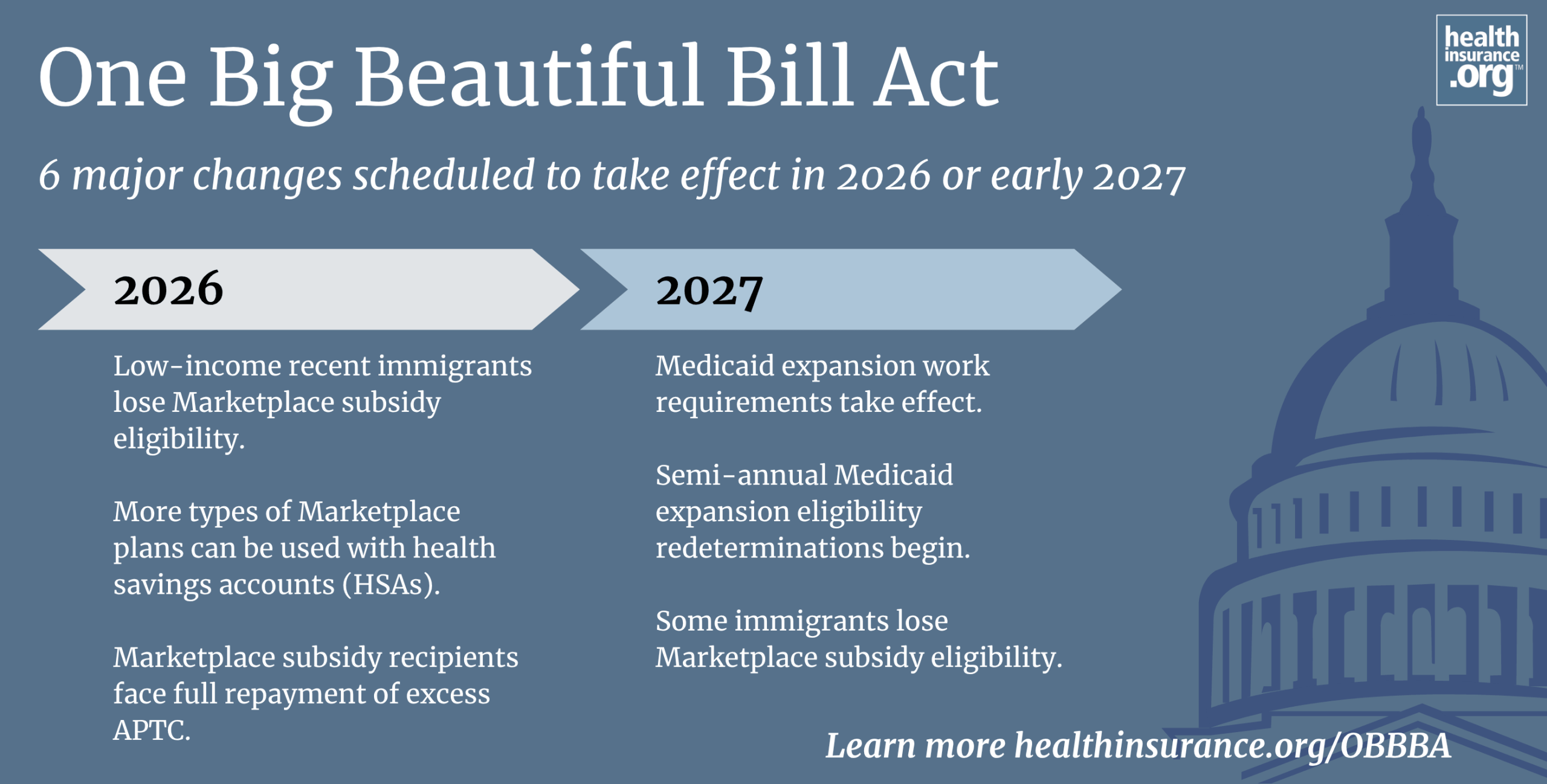
The One Big Beautiful Bill Act (OBBBA) – or H.R. 11 – set the stage for sweeping changes to Medicaid and Marketplace health coverage. Some of the changes took effect in 2025 and 2026, while others take effect in 2027 or 2028.
In this article, we look at some of the most important provisions of the OBBBA and how they’re affecting coverage access.
What is the OBBBA?
The OBBBA is federal budget legislation signed into law by President Donald Trump in July 2025. Millions of people are expected to lose health coverage as a result of the OBBBA, due in large part to the Medicaid changes that will be implemented in 2027 and future years.2
And this is in addition to the millions of people who lost health coverage due to the sunsetting of the Marketplace subsidy enhancements at the end of 2025. Altogether, the number of uninsured people in the United States is expected to increase by about 17 million people in the next decade or so, due to the OBBBA, the expiration of the subsidy enhancements, and various new Marketplace rules.3 (The new Marketplace rules have been blocked by the courts in 2025 and again in 2026, so it’s unclear if and when they’ll take effect).4

Need help exploring your options?
A licensed agent can help you:
- Answer coverage questions
- Understand your options
- Explore costs and eligibility
- Enroll when you're ready
Here’s what consumers need to know about the OBBBA, and how their health coverage options could be affected:
1. Medicaid expansion enrollees face work requirements, more frequent renewals, and in some cases, new out-of-pocket costs
- In a nutshell: Medicaid expansion enrollees will face a work requirement and semi-annual eligibility redeterminations – and some enrollees will have to pay higher out-of-pocket costs.
- Who’s affected? Medicaid expansion enrollees, plus partial expansion enrollees in Georgia and Wisconsin, and certain low-income parents in Tennessee.
- Effective date: January 1, 2027 for work requirements (in most states) and semi-annual eligibility redeterminations; October 2028 for new out-of-pocket costs.
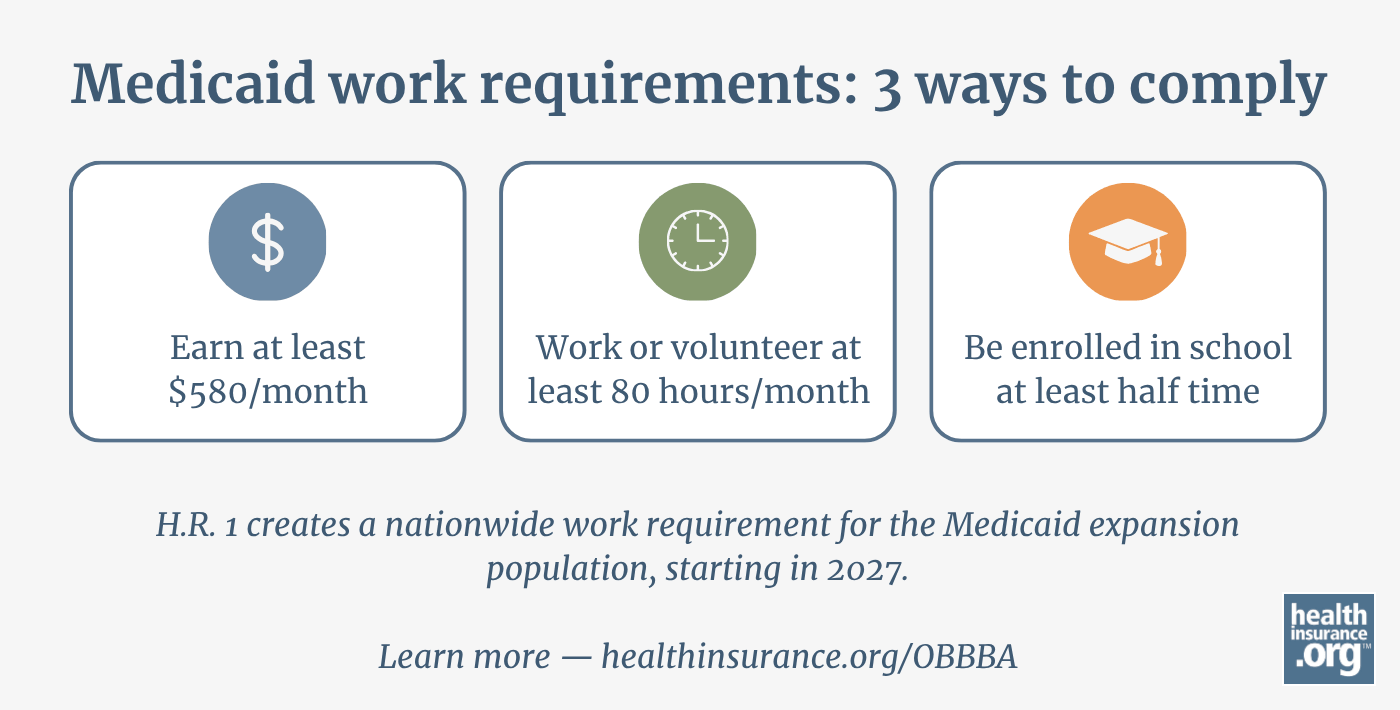
Work requirement: Under the OBBBA, adults covered through the ACA’s Medicaid expansion (a provision that covers adults with income up to 138% of the federal poverty level) will be subject to a work requirement starting in 2027.
Unless these enrollees qualify for an exemption, the work requirement will apply to Medicaid expansion enrollees in Washington, D.C., and the 40 states that have expanded Medicaid under the ACA, and it will also apply to adults with income up to the federal poverty level in Wisconsin and Georgia, as well as parents with income up to the federal poverty level in Tennessee.5
Learn more about the Medicaid work requirement, and what’s necessary for compliance.
Semi-annual eligibility redetermination: The OBBBA also requires Medicaid expansion enrollees (except for American Indians and Alaska Natives) to have their eligibility redetermined every six months starting in 2027, instead of just once per year.6
Learn more about Medicaid eligibility redeterminations.
New out-of-pocket costs: Starting in October 2028, Medicaid expansion enrollees with income of at least the federal poverty level will pay more in out-of-pocket costs when they receive care. The OBBBA requires states to impose cost sharing of up to $35 per service for this population, although some services are exempt and there will continue to be an aggregate spending cap equal to 5% of household income for all family members’ total premiums and out-of-pocket costs.7
2. Additional Medicaid changes that reduce federal spending but also reduce coverage and benefits
- In a nutshell: Retroactive Medicaid coverage will be more limited, and most states will see a reduction in federal Medicaid funding.
- Who's affected? People applying for Medicaid with unpaid medical bills for recent months, as well as anyone with Medicaid who might experience benefit cuts or reduced access to providers.
- Effective date: January 2027 for retroactive Medicaid limitations. For potential coverage reductions and provider changes, it will vary by state and could phase in over the next few years.
In addition to the significant changes for Medicaid expansion enrollees, the OBBBA includes various other Medicaid provisions that will affect access to coverage, how much federal Medicaid funding states receive, and the benefits that states provide. They include:
- Starting in January 2027, retroactive Medicaid coverage (meaning coverage of bills incurred before an individual applied for Medicaid) will be more limited. For Medicaid expansion enrollees, it will be capped at one month, and for traditional enrollees, it will be capped at two months. Most states have historically allowed up to three months of retroactive Medicaid coverage (assuming the person would have met the eligibility requirements during those months).8
- Starting in October 2027, new OBBBA rules will reduce federal Medicaid funding to most states.9 The impacts will vary by state, but could include reduced reimbursements for providers (and thus fewer providers accepting Medicaid) as well as state reductions to Medicaid coverage for optional benefits.10 (Coverage of many services is optional for Medicaid, meaning states can choose whether to cover them. These include Home and Community-Based Services,11 prescription drugs, physical, occupational, and speech therapy, and dental and vision care for adults.)12
- In 2023 and 2024, the Biden administration finalized a two-part rule designed to simplify and streamline the application and renewal process for Medicaid (including Medicare Savings Programs that help to pay Medicare premiums and out-of-pocket costs for beneficiaries with low incomes and asset levels), the Children’s Health Insurance Program (CHIP), and Basic Health Programs.13 The Biden administration’s rule included provisions such as eliminating in-person eligibility interviews for people with disabilities and individuals 65 or older, changes to ensure that fewer people would lose coverage due to undeliverable mail, and a ban on lock-out periods for children disenrolled from CHIP for failure to pay premiums. The OBBBA prohibits HHS from implementing, administering, or enforcing those rules, at least through September 2034.14
What people affected by these changes can do:
- Be aware that retroactive Medicaid coverage will be more limited starting in 2027. If you think you might be eligible to enroll in Medicaid, apply as soon as possible, rather than waiting until you need medical care to submit an application.
- Pay close attention to any communications from your doctor, hospital, or Medicaid program, regarding provider access or benefit changes.
- You may need to complete additional paperwork or comply with other new rules to enroll or renew your coverage. If you’re enrolled in Medicaid (including a Medicare Savings Program) or CHIP, it’s essential to make sure that the state Medicaid agency has your correct contact information, and that you quickly respond to any administrative requests related to your eligibility or coverage renewal.
3. Some immigrants lose subsidy eligibility
- In a nutshell: Recently arrived low-income immigrants no longer qualify for subsidies to buy Marketplace health insurance. And starting in 2027, fewer immigration statuses will be subsidy-eligible.
- Who’s affected? Lawfully present immigrants in their first five years in the United States with household incomes below the federal poverty level. In 2027, most non-permanent immigration statuses will not be subsidy-eligible.
- Effective dates: January 1, 2026 (for low-income immigrants), and January 1, 2027 (for non-permanent immigration statuses)
Low-income recent immigrants: In general, Marketplace subsidies are not available to anyone with a household income under the federal poverty level (FPL).15 But there has always been an exception for recent immigrants who are lawfully present in the U.S. if they are in the five-year waiting period before they can qualify for Medicaid.16
Learn more about Marketplace subsidies.
To avoid creating a coverage gap for low-income lawfully present immigrants during their first five years in the U.S., the Affordable Care Act (ACA) included a provision to allow them to qualify for Marketplace subsidies so they could meaningfully access the Marketplace.17
But the OBBBA ended this provision, starting January 1, 2026. Immigrants with household income under the poverty level who have been in the U.S. for less than five years no longer qualify for subsidies in the Marketplace.18
According to the Congressional Budget Office, about 300,000 people were expected to lose their health coverage by 2034 as a result of the termination of subsidy eligibility for recent immigrants with income below the FPL.19
Reduction in the subsidy-eligible immigration statuses: Since 2014, a long list of immigration statuses have made people eligible to use the health insurance Marketplace and qualify for income-based subsidies.20
But starting in 2027, subsidy eligibility for immigrants will be reduced to only lawful permanent residents (LPRs, also known as “green card” holders), Cuban-Haitian entrants, and people living in the U.S. under Compacts of Free Association (COFA). All other immigrants, including those with work or student visas, refugees, asylees, and people with temporary protected status (TPS) will no longer be eligible for Marketplace subsidies.21
According to CBO projections, approximately 900,000 to 1 million people are expected to become uninsured by 2035 as a result of the reduction in the number of immigration statuses that make a person eligible for Marketplace subsidies.22
Learn more about immigrant health coverage eligibility rules
What people affected by the change can do: To qualify for Marketplace subsidies, immigrants who have been in the U.S. for under five years must have a household income that is at least equal to the prior year’s FPL. For 2027 coverage (in all but Alaska and Hawaii, where the FPL is higher), that’s $15,960 for a single person and $33,000 for a household of four.23
And immigrants who aren’t LPRs, COFA migrants, or Haitian or Cuban entrants will not be able to qualify for Marketplace subsidies in 2027. Lawfully present immigrants will still be able to use the Marketplace, but without subsidies. In some cases, switching to a lower-cost Marketplace plan might be a viable solution.
4. Subsidy recipients face full repayment of excess APTC
- In a nutshell: Starting with 2026 coverage, there’s no limit on how much excess APTC a Marketplace enrollee might have to repay if their income ends up higher than expected.
- Who’s affected? Marketplace enrollees who receive advance premium tax credits (APTC) – especially those with income fluctuations.
- Takes effect: The 2026 plan year. Enrollees will start to see this on the 2026 tax returns they file in 2027.
Most Marketplace enrollees – 87% in 2026 – qualify for advance premium tax credits (APTC).24 APTC is based on an applicant’s projected income for the relevant calendar year. The federal government advances the estimated premium tax credit on the applicant’s behalf, to their health insurer, throughout the year.
But the following year, that APTC has to be reconciled when the enrollee files their tax return for the year. Learn more about how APTC reconciliation works.
Before 2026, there was a cap on how much excess APTC people have to repay, as long as their household income was less than 400% of FPL. The specific amounts were indexed each year by the IRS, but the most a person would have to repay in excess APTC for 2025 was $3,250, if their household income was as high as 399% of FPL.25
But the One Big Beautiful Bill Act eliminates those caps. Starting with the 2026 plan year, if your income ends up being higher than you projected, there will no longer be a limit on how much excess APTC you have to repay.26 Instead, you will have to repay all of the excess, regardless of how much that is.
(To clarify, the repayment caps for 2025 ranged from $375 for a single filer whose household income was under 200% of FPL, to $3,250 for a family with a household income of 399% FPL. The details are shown in Table 5 of the IRS instructions for Form 8962, which is used to reconcile Marketplace premium tax credits.)27
What people affected by the change can do: When people enroll in Marketplace coverage for 2026, it will be essential to project income as accurately as possible. The Marketplace will ask for proof of income if the projection you provide doesn’t match the information the Marketplace receives from data sources like the IRS.
It will also be a good idea to double-check your income projection mid-way through 2026, to see if you’re on track to earn roughly the amount you projected when you enrolled. If not, you can update your income in your Marketplace account, and it will adjust your subsidy in real time. This could help to avoid having to repay excess APTC when you file your 2026 tax return, which will be particularly important once there’s no longer a cap on how much excess APTC has to be repaid.
5. More Marketplace plans can be used with health savings accounts (HSAs)
- In a nutshell: Millions more people with high-deductible Marketplace plans will become eligible to contribute to health savings accounts.
- Who’s affected? Marketplace enrollees with Bronze or Catastrophic plans and consumers using direct primary care (DPC)
- Takes effect: January 2026 (for 2026 plan year)
Starting with the 2026 plan year, Marketplace enrollees with Bronze or Catastrophic plans are eligible to contribute to a health savings account (HSA). Through the end of 2025, HSA contributions could only be made by someone who has an HSA-qualified high-deductible health plan (HDHP), as defined by the IRS.28 But starting with the 2026 plan year, the HDHP definition expanded to include all Marketplace Bronze and Catastrophic plans.29
Prior to 2026, most Bronze plans were not HDHPs, since most Bronze plans did not meet the IRS HDHP requirements. For example, in Chicago, there were 31 Bronze Marketplace plans available in 2025, but zero HDHPs. In Houston, there were 28 Bronze Marketplace plans available, and only one HDHP (which was one of the Bronze plans).30
Through the end of 2025, Catastrophic plans could never be HDHPs, since their out-of-pocket limits were too high and covered up to three primary care visits pre-deductible. But very few people enroll in Catastrophic plans,31 largely because Marketplace premium subsidies cannot be applied to Catastrophic plans, and people age 30 and older can only enroll in a Catastrophic plan if they obtain a hardship exemption from the Marketplace.15
But millions of people have Bronze Marketplace plans. During the open enrollment period for 2026 coverage, about 40% of all Marketplace enrollees selected Bronze plans.32
In addition to the revised HDHP definition, H.R. 1 also relaxed the rules around HSAs and direct primary care (DPC) arrangements.33 Starting in January 2026, having a DPC membership (in addition to an HDHP) no longer disqualifies an individual from contributing to an HSA.34 In addition, the DPC membership fee is considered a qualified medical expense, meaning it can be paid for with pre-tax HSA funds.33
Why does HSA access matter?
Contributions to an HSA are pre-tax, and investment gains or interest earned in the account are also not taxed. Withdrawals are also tax-free as long as the money is used for a qualified medical expense.35
In addition, HSA contributions reduce a person’s ACA-specific modified adjusted gross income (MAGI), which can affect whether the person qualifies for Marketplace subsidies. This is particularly important for people to understand starting with the 2026 plan year, as the “subsidy cliff” returned in 2026 when federal subsidy enhancements expired at the end of 2025.36
So a person who would otherwise not qualify for a subsidy might find that by contributing to an HSA, they can bring their MAGI into the subsidy-eligible range. Marketplace enrollees should discuss this issue with a financial planner or accountant before selecting a plan. If contributing to an HSA makes financial sense for them, it will be important to select an HDHP during the open enrollment period, keeping in mind that Bronze and Catastrophic plans are now considered HDHPs.
Footnotes
- “H.R. 1 - One Big Beautiful Bill Act” Congress.gov Enacted July 4, 2025 ⤶
- “New CBO Health Coverage Estimates of Budget Reconciliation Law” Georgetown University Center for Children and Families. Aug. 15, 2025. And “5 Groups at Highest Risk of Losing Medicaid Coverage Under OBBBA” AJMC. March 27, 2026 ⤶
- “About 17 Million More People Could be Uninsured due to the Big Beautiful Bill and other Policy Changes” KFF.org. July 1, 2025 ⤶
- “City of Columbus et al. v. Kennedy et al. (Columbus I)” and “City of Columbus et al. v. Kennedy et al. (Columbus II)” Georgetown Law Health Care Litigation Tracker. Accessed Aug. 14, 2026 ⤶
- “Tracking Implementation of the 2025 Reconciliation Law: Medicaid Work Requirements” KFF.org. Aug. 3, 2026 ⤶
- “H.R. 1” (Sections 71107). Congress.gov. Enacted July 4, 2025 ⤶
- “Understanding Medicaid Cost Sharing and Policy Changes from the 2025 Reconciliation Law” KFF.org. May 21, 2026 ⤶
- “H.R. 1 Reduces Medicaid Retroactive Eligibility Starting in 2027” Justice in Aging. April 9, 2026 ⤶
- “CMS Releases Provider Tax Proposed Rule” State Health & Value Strategies. July 31, 2026. And “State-Level Impacts of OBBBA Provisions: A Data Dashboard” Milbank.org. Accessed Aug. 18, 2026 ⤶
- “5 Key Facts About Medicaid and Provider Taxes” KFF.org. Dec. 1, 2025 ⤶
- “What is Medicaid Home Care (HCBS)?” KFF.org. Feb. 18, 2025 ⤶
- “Mandatory & Optional Medicaid Benefits” Medicaid.gov. Accessed Aug. 14, 2026 ⤶
- “Setting the Record Straight on the Medicaid Eligibility and Enrollment Rules” Center on Budget and Policy Priorities. Jan. 21, 2025 ⤶
- “H.R. 1” (Sections 71101 and 71102). Congress.gov. Enacted July 4, 2025 ⤶
- “Explaining Health Care Reform: Questions About Health Insurance Subsidies” KFF.org. Oct. 25, 2024 ⤶ ⤶
- “Coverage for lawfully present immigrants” HealthCare.gov. Accessed July 10, 2025 ⤶
- “ACA Section 1401(c)(1)(B) – page 113 of the text of the ACA” Office of the Legislative Counsel. Enacted March 23, 2010 ⤶
- “H.R. 1 - One Big Beautiful Bill Act” (Sections 71302). Congress.gov. Enacted July 4, 2025 ⤶
- “Estimated Effects on the Number of Uninsured People in 2034 Resulting From Policies Incorporated Within CBO’s Baseline Projections and H.R. 1, the One Big Beautiful Bill Act” Congressional Budget Office. June 4, 2025 ⤶
- “Immigration status to qualify for the Marketplace” HealthCare.gov. Accessed Aug. 14, 2026 ⤶
- ”New Immigrant Eligibility Restrictions Coming to Federally-Funded Health Coverage” Georgetown University Center for Children and Families. Oct. 1, 2025. And “1.4 Million Lawfully Present Immigrants are Expected to Lose Health Coverage due to the 2025 Tax and Budget Law” KFF.org. Sep. 25, 2025 ⤶
- ”The Estimated Effects of Enacting Selected Health Coverage Policies on the Federal Budget and on the Number of People With Health Insurance” Congressional Budget Office. Sep. 18, 2025 ⤶
- “2026 Poverty Guidelines” U.S. Department of Health & Human Services. Accessed Aug. 14, 2026 ⤶
- “2026 Marketplace Open Enrollment Period Public Use Files” (Columns H and AO). Centers for Medicare & Medicaid Services. Accessed Aug. 14, 2026 ⤶
- “Instructions for Form 8962” (Table 5, Page 18). Internal Revenue Service. Accessed Aug. 26,2026 ⤶
- “H.R. 1 - One Big Beautiful Bill Act” (Section 71305). Congress.gov. Enacted July 4, 2025 ⤶
- “Instructions for Form 8962” (Page 18). Internal Revenue Service. Accessed Aug. 26, 2026 ⤶
- “Publication 969 — High deductible health plan (HDHP)” Internal Revenue Service. Accessed July 10, 2025 ⤶
- “H.R. 1 - One Big Beautiful Bill Act” (Section 71307). Congress.gov. Enacted July 4, 2025 ⤶
- “See Plans & Prices” (zip codes 60647 and 77001) HealthCare.gov. Accessed July 16, 2025 ⤶
- “2025 Marketplace Open Enrollment Period Public Use Files” (State-level public use files, Columns BQ). Centers for Medicare & Medicaid Services. Accessed July 9, 2025 ⤶
- “2026 Marketplace Open Enrollment Period Public Use Files” (State-level public use files, Columns BW and H). Centers for Medicare & Medicaid Services. Accessed Aug. 26, 2026 ⤶
- “H.R.1 - One Big Beautiful Bill Act” (Section 71308). Congress.gov. Enacted July 4, 2025 ⤶ ⤶
- This is true as long as the DPC membership has fees of no more than $150 for a single person or $300 for a family (unchanged for 2027), and doesn’t provide a member with access to prescriptions (other than vaccines), services that require general anesthesia, or laboratory services that aren’t typically provided in an ambulatory primary care setting. ⤶
- “Publication 969 – Health Savings Accounts and Other Tax-Favored Health Plans” Internal Revenue Service. Accessed July 10, 2025 ⤶
- Before the American Rescue Plan (ARP) temporarily changed the rules in 2021, Marketplace enrollees were not eligible for subsidies if their household income was over 400% of the federal poverty level. This was true regardless of the percentage of household income they would have to pay for their health insurance. Through the end of 2025, these applicants qualified for Marketplace subsidies if the cost of the second-lowest-cost Silver plan was more than 8.5% of their household income. But starting in 2026, subsidies are once again unavailable to applicants with household income over 400% FPL because Congress did not extend the ARP’s subsidy enhancements. ⤶