Can you switch Marketplace plans due to an inaccurate provider directory?
An inaccurate provider listing doesn’t guarantee you can switch health plans, but you may have options for protecting your care and costs.

In this article
- Can I switch plans if my plan’s provider directory was wrong?
- When might an inaccurate provider directory qualify you for a special enrollment period?
- What should you do if you enrolled in a Marketplace plan based on an inaccurate provider directory?
- What should you do if you received out-of-network care because of a provider directory error?
- How can a provider directory error disrupt your care?
- How can you confirm a provider’s network status before enrolling?
If you enrolled in a Marketplace plan because its provider directory showed that your provider was in-network – only to find out that the listing was wrong – you may have a limited opportunity to switch plans. But even if you can’t change your coverage, you may be able to continue with your care on your current plan thanks to other protections.
Here’s what you need to know:
Can I switch plans if my plan’s provider directory was wrong?
If you discover after enrolling in a plan that its provider directory was inaccurate, your options for switching to another plan will depend on several factors:
During open enrollment, you can change to another available Marketplace plan before the applicable enrollment deadline.1
After open enrollment ends, switching plans requires a special enrollment period (SEP), generally triggered by a qualifying life event.2
As discussed below, if you’re in a state that uses HealthCare.gov for enrollment, you may be eligible for a special enrollment period in rare cases when “grossly inaccurate” provider-network information influenced your plan choice.3
When might an inaccurate provider directory qualify you for a special enrollment period?
You may be eligible for an SEP when certain Marketplace enrollment errors occur or certain plan material inaccuracies – including benefit or cost-sharing information – were displayed by the Marketplace when you enrolled.4 However, federal guidance says provider-network inaccuracies typically don’t qualify under the SEP rules for Marketplace errors or plan-display errors.5
But in states that use HealthCare.gov, an exceptional-circumstances SEP may be available in rare situations in which an unintentional network error or correction occurred and a consumer selected a plan based on grossly inaccurate information.6
The guidance gives an example of multiple providers or hospitals being incorrectly listed as in-network. It doesn’t specify that one inaccurate provider-network listing will qualify, and each request is reviewed case by case.6
If you’re in a state that runs its own exchange, the procedures for an exceptional-circumstances SEP will vary by state. You’ll need to contact your state’s exchange to discuss the situation and see if an SEP is available.
What should you do if you enrolled in a Marketplace plan based on an inaccurate provider directory?
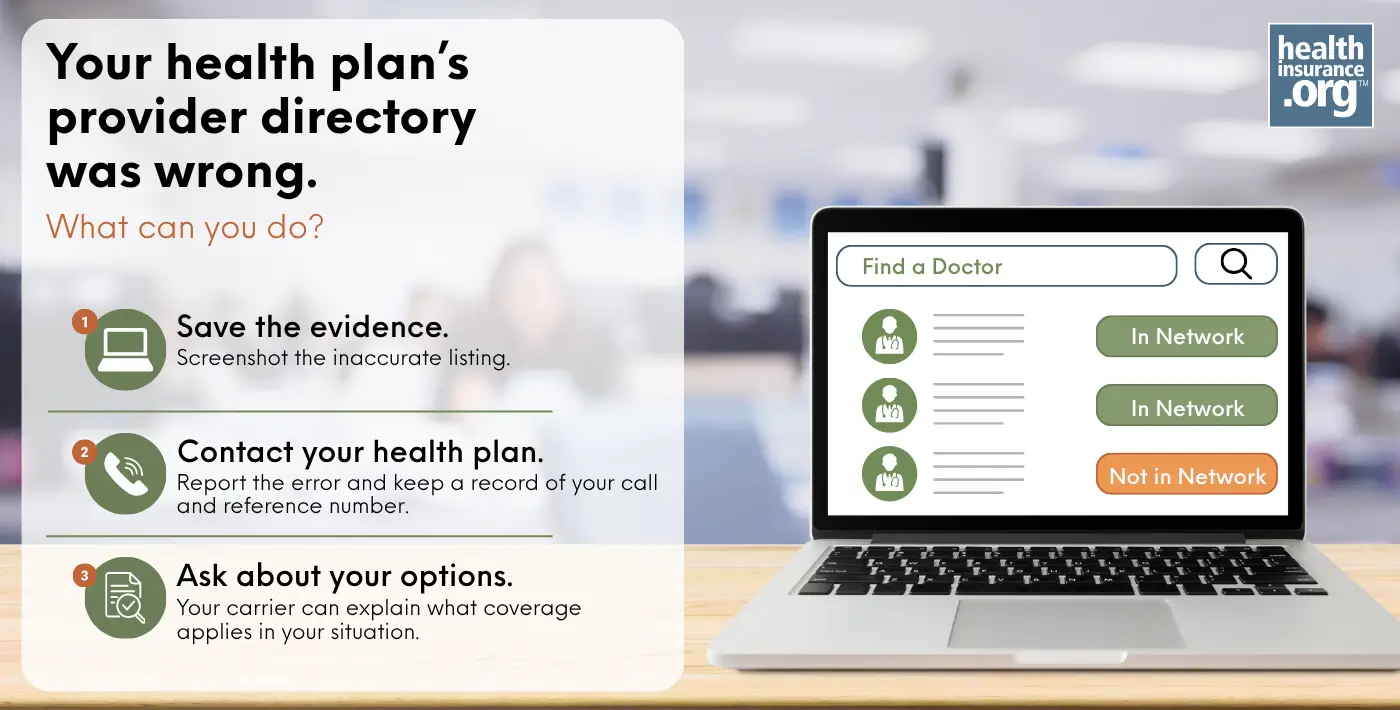
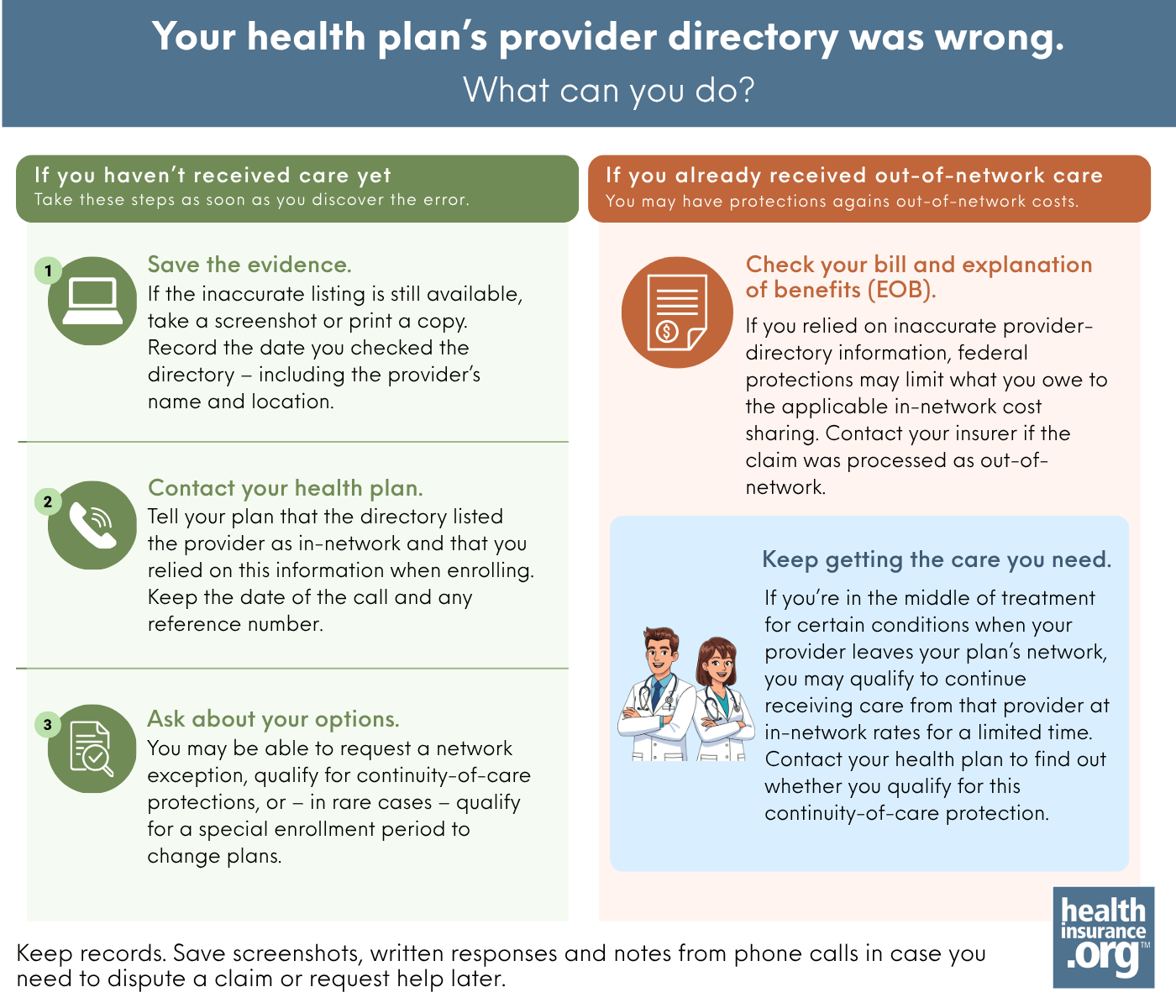
Take these steps as soon as you discover the error:
1. Save the information you relied on
If the original inaccurate listing is still available, save a screenshot or print a copy as documentation.7 Record the date you checked the directory – including the provider’s name and location.
2. Notify your health plan of the error
Contact your plan to explain that the directory listed the provider as in-network and that you relied on this information when enrolling. Retain the date of the call along with any reference number.
3. Apply for a network exception
A network exception is a request for your insurer to apply in-network cost sharing to specified covered services from an out-of-network provider.8 This would apply if you want to keep your current plan or can’t change plans until the next open enrollment period. Approval may be limited to certain services or a specific period.8
You’ll generally submit a request in writing – your insurer can provide submission instructions. If approved, obtain written confirmation and confirm that the provider has agreed to accept the insurer’s reimbursement as payment in full to avoid receiving a balance bill.
4. Determine whether continuity-of-care protections apply
A directory may be inaccurate because a provider recently stopped participating in the plan’s network. In this case, you may qualify for continuity-of-care protections if you were receiving a qualifying type of care when the provider’s network agreement ended.9
These protections allow you to continue treatment temporarily under the coverage terms and in-network cost sharing that applied while the provider was in-network.9 Those protections end when you no longer qualify as a continuing care patient or 90 days after the plan notifies you of the change, whichever comes first.9
Unlike a network exception, continuity-of-care protections apply only when the provider was previously in-network.
5. Consider an SEP
Requesting an SEP may be useful if your insurer denies or limits a network exception, or you want or need to change plans. But a denied or limited network exception does not, by itself, make you eligible for an SEP. You typically need a qualifying life event to be eligible for an SEP.4 In states that use HealthCare.gov, an SEP based on inaccurate provider-network information is considered only in rare circumstances, and is reviewed on a case-by-case basis.3
The Marketplace – not the insurer – determines SEP eligibility. Call HealthCare.gov at 1-800-318-2596 to start the process.4 (If you’re in a state that runs its own exchange, you’ll need to contact your state’s exchange rather than HealthCare.gov.)
If the SEP is approved, the Marketplace will help you enroll in a new plan.4 Confirm the new plan’s effective date and pay its first premium for coverage to begin.4
Note: If you switch plans, your out-of-pocket costs will reset to zero under the new plan. So this should be considered when you’re deciding whether to seek an SEP, if you’ve already incurred any out-of-pocket costs in the current calendar year.
6. Get help if the problem remains unresolved
Contact your state insurance department if you can’t resolve the problem with your insurer. Each state’s department accepts consumer complaints and can investigate whether an insurer followed applicable insurance laws and the terms of your policy.10
Some states have a Consumer Assistance Program that can help you understand your coverage rights and file a complaint or appeal involving your insurer.11
What should you do if you received out-of-network care because of a provider directory error?
The No Surprises Act limits your cost sharing when you receive an otherwise covered service after relying on inaccurate network information in your plan’s provider directory.12 You should not owe more than the applicable in-network deductible, copayment, or coinsurance. That amount must also count toward your in-network deductible and out-of-pocket maximum.12
Review your explanation of benefits. If the insurer applied out-of-network cost sharing, contact the plan and explain that you relied on its directory.12 Provide any documentation you saved and request that the plan recalculate your responsibility using in-network benefits.
The provider must refund any amount you paid above the applicable in-network cost sharing, plus interest, when these protections apply.12
Before receiving additional non-emergency care from the provider, contact your insurer about a network exception. Don’t assume that future services will receive in-network treatment without confirmation from the plan.
You can file an internal appeal if the insurer refuses to correct the claim.13 An external review by an independent third party may be available if the insurer upholds its decision, although not every dispute qualifies.14
You can also contact the No Surprises Help Desk at 1-800-985-3059, if you’ve received a surprise out-of-network bill after relying on an inaccurate provider network directory.
How might a provider directory error disrupt your care?
An inaccurate listing can delay your care while the insurer confirms the provider’s status or you search for another in-network option.15
Provider directory errors can remain for months.15 Researchers reviewed 5,170 inaccurate provider listings in Pennsylvania’s ACA Marketplace.16 When they checked the listings again four to nine months later, nearly 45% still contained at least one error.16
The study authors noted that persistent directory errors can make navigating care more difficult, delay access, increase out-of-pocket costs, and prevent people from seeing their preferred providers.16 Only one state’s ACA Marketplace was included in the study, so the findings may not reflect provider-directory accuracy elsewhere.
Financial impact is another factor. You may be required to pay out-of-network costs before receiving care while waiting for a claim to be reprocessed or a decision from an appeal. Internal appeals for care already received can take up to 60 days, and, if needed, an external review can take up to another 45 days.1317 Even when federal protections ultimately reduce the amount you owe, correcting the claim and recovering overpayment can take time.
How can you confirm a provider’s network status before enrolling?
Checking with both the insurer and the provider may help you identify outdated or incomplete directory information before enrolling and before scheduling any non-emergency medical care. Consider taking these steps:188
- Search the insurer’s directory using the plan’s exact name and network. Insurers often offer multiple plans with different provider networks.
- Contact the insurer to confirm that the provider and preferred office location participate in the plan’s network. Provide the provider’s National Provider Identifier (NPI), if available, to help the insurer verify the correct healthcare professional. Contact the provider’s office to obtain their NPI.
- Contact the provider’s office with the complete plan name to confirm network participation. Ask if the provider is accepting new patients and whether the office knows of any upcoming network changes.
Keep a record of your research, including dated screenshots, phone call documentation, and written responses. These records can provide supportive documentation if a dispute arises later.
Footnotes
- “Renew, change, update, or cancel your plan” HealthCare.gov. Accessed Aug. 27, 2026 ⤶
- “Changing plans after you’re enrolled” HealthCare.gov. Accessed Aug. 27, 2026 ⤶
- “Federally-facilitated Exchange (FFE) Enrollment Manual” page 81. CMS.gov. Accessed August 27, 2026 ⤶ ⤶
- “Special Enrollment Periods for complex issues” HealthCare.gov. Accessed Aug. 27, 2026 ⤶ ⤶ ⤶ ⤶ ⤶
- “Federally-facilitated Exchange (FFE) Enrollment Manual” pages 81 and 85. CMS.gov. Accessed Aug. 27, 2026 ⤶
- “Federally-facilitated Exchange (FFE) Enrollment Manual” page 81. CMS.gov. Accessed Aug. 27, 2026 ⤶ ⤶
- “No Surprises Act Toolkit for Consumer Advocates” page 110. CMS.gov. Accessed Aug. 27, 2026 ⤶
- “What You Should Know About Provider Networks” page 3. CMS.gov. Accessed Aug. 27, 2026 ⤶ ⤶ ⤶
- “No Surprises Act Overview of Key Consumer Protections” page 26. CMS.gov. Accessed Aug. 27, 2026 ⤶ ⤶ ⤶
- “How to File a Complaint” Content.naic.org. Accessed Aug. 27, 2026 ⤶
- “Consumer Assistance Program” CMS.gov. Accessed Aug. 27, 2026 ⤶
- “No Surprises Act Overview of Key Consumer Protections” CMS.gov. Accessed Aug. 27, 2026 ⤶ ⤶ ⤶ ⤶
- “Appealing a health plan decision - Internal appeals” HealthCare.gov. Accessed Aug. 27, 2026 ⤶ ⤶
- “No Surprises Act Toolkit for Consumer Advocates” page 23. CMS.gov. Accessed Aug. 27, 2026 ⤶
- “Persistence of Provider Directory Inaccuracies After the No Surprises Act” The American Journal of Managed Care. Accessed Aug. 27, 2026 ⤶ ⤶
- “Inaccuracies in provider directories persist for long periods of time” Health Affairs Scholar. Accessed Aug. 27, 2026 ⤶ ⤶ ⤶
- “Appealing a health plan decision - External review” HealthCare.gov. Accessed Aug. 27, 2026 ⤶
- “No Surprises Act Toolkit for Consumer Advocates” page 25. CMS.gov. Accessed Aug. 27, 2026 ⤶