Will I lose my Medicaid?
In this article
- Will the new Medicaid rules cause me to lose coverage?
- How can I keep my coverage if I’m a Medicaid expansion enrollee?
- Common reasons people lose their Medicaid coverage
- Don’t lose your Medicaid because you missed your renewal
- What should I do if I think I might lose Medicaid?
- What happens if I do lose Medicaid?
- What is Medicaid renewal (redetermination)?
- Can I get Marketplace insurance if I lose Medicaid?
- Will I lose my Medicaid if I get Medicare?
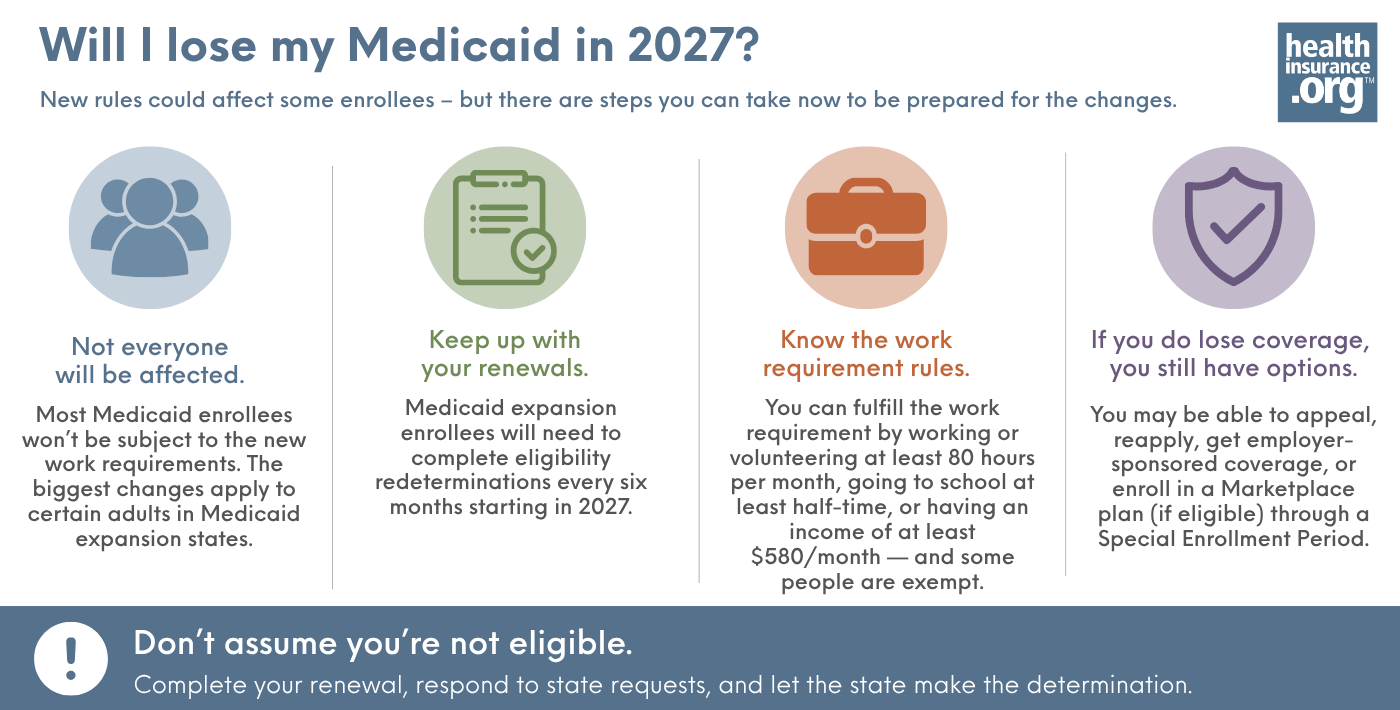
If you’re enrolled in Medicaid, you won’t necessarily lose your coverage under new Medicaid rules taking effect in 2027.1 But millions of people are expected to lose Medicaid coverage in the coming years – some because they no longer qualify, some because they don’t meet new work requirements, and some simply because they miss a renewal notice or don’t submit required paperwork.
Whether your coverage is at risk depends on why you qualify for Medicaid, your income and household circumstances, and, in some cases, whether you meet or are exempt from the new work requirements. Here’s how to determine whether you could lose Medicaid – and what to do if your coverage is at risk.
Will the new Medicaid rules cause me to lose coverage?
Medicaid changes imposed by the One Big Beautiful Bill Act (OBBBA) are expected to result in significant coverage losses. According to a Robert Wood Johnson Foundation analysis, between 5 and 10 million Medicaid expansion enrollees (roughly a quarter to a half of all expansion enrollees)2 could lose coverage due to the work requirement and more frequent eligibility redeterminations. And the Congressional Budget Office has projected that total Medicaid enrollment could drop by more than 13 million by 2035 as a result of the OBBBA.3
It’s important to understand that only about three out of ten Medicaid enrollees will be subject to the work requirements and semi-annual eligibility redeterminations.4
How can I keep my coverage if I’m a Medicaid expansion enrollee?
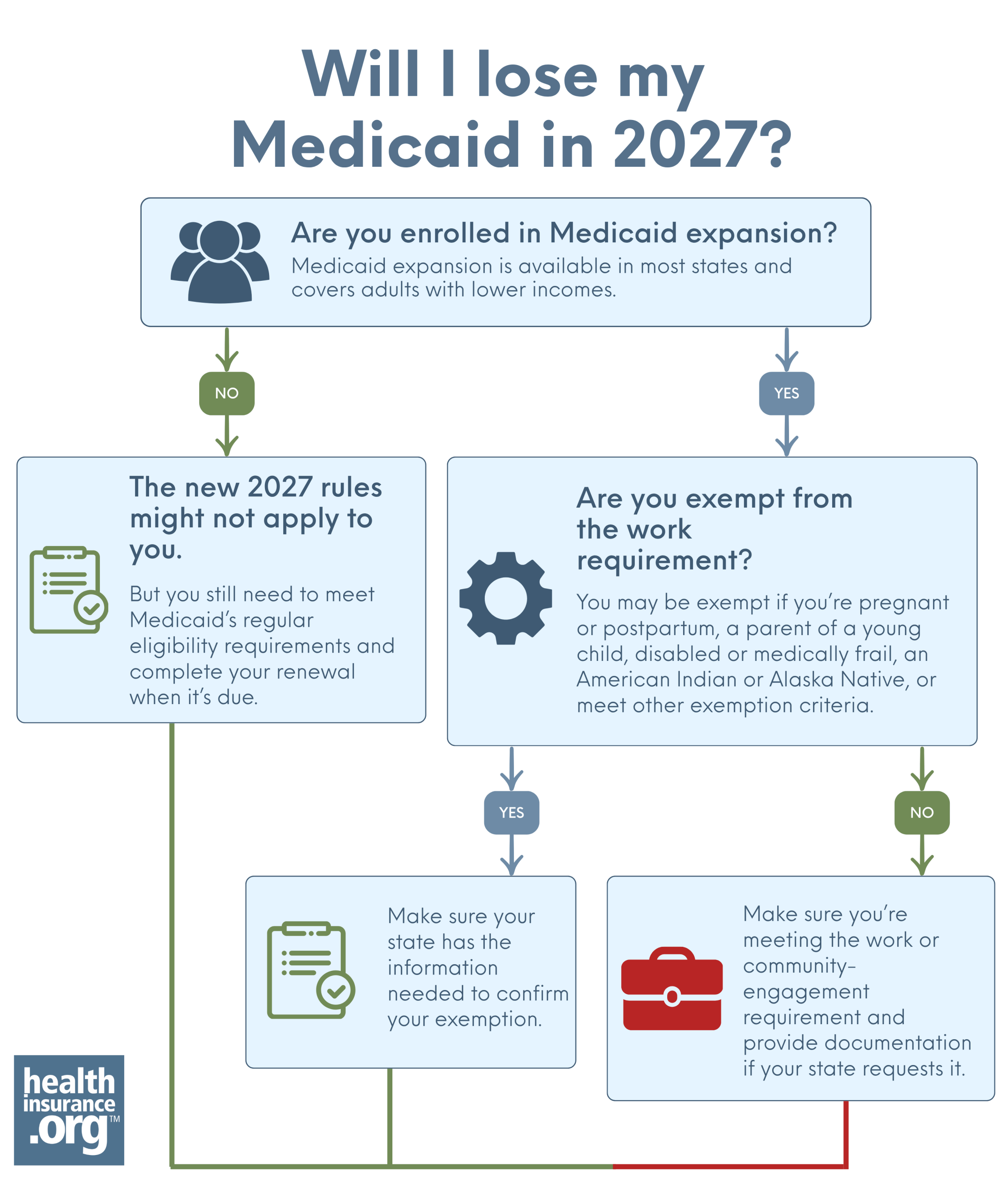
If you’re a Medicaid expansion enrollee, here’s what you need to know about your Medicaid coverage in 2027 and future years:
- You may find that you’re in compliance with the work requirement even if you’re not working at least 80 hours per month.5 Learn more about how you can comply with the Medicaid work requirement.
- You might be exempt from the work requirement even if you’re enrolled in expanded Medicaid. Some examples of exempt populations include parents of children under 14 years old, women who are pregnant or postpartum, American Indians and Alaska Natives, and people who are disabled or medically frail and thus unable to work. You can check with your state to see whether you qualify for an exemption and if so, what documentation you need to provide.5
- There will be state-to-state variation in terms of how the work requirement is implemented. Some states will have stricter rules than others, and states will also vary in terms of how much they automate the process.6 If your compliance can be confirmed automatically by your state, you may not have to submit any documentation at all. But you’ll want to pay close attention to any communications you get from your state Medicaid office and provide any documentation that’s requested.
- You’ll need to be prepared to renew your coverage every six months. The specifics of how this works will vary from state to state. But starting with your first renewal date in 2027, you might want to set a semi-annual automated reminder in your digital calendar so that you remember to keep an eye out for Medicaid renewal notices.
Common reasons people lose their Medicaid coverage
There are several reasons you might lose Medicaid, including:
- Changes in your income or household size. Medicaid eligibility depends on household income, and the limits are higher when there are more people in the household.7 So if your income has increased or the number of people in your household has decreased, you might no longer qualify for Medicaid.
- You no longer meet other eligibility requirements. Examples include turning 19 (income limits are higher up to age 18),8 being more than a year postpartum,9 or turning 65. (After age 64, you’ll no longer be eligible under Medicaid expansion and once you’re age 65, your eligibility for Medicaid depends on both income and assets.)10
- You moved out of state. Medicaid is state-specific, so you’ll lose your Medicaid if you move out of state. You can reapply in your new state, but eligibility rules vary from one state to another.8
- You didn’t complete your renewal paperwork. Each year (or twice a year, for Medicaid expansion enrollees starting in 2027),11 your Medicaid coverage has to be renewed. Your state might be able to do this automatically based on information that’s already on file, but if not, they’ll send a renewal packet to you. If you don’t complete the paperwork and provide the required documentation, you’ll lose your Medicaid.
- Medicaid expansion work requirement. As noted above, about 20 million adults with Medicaid expansion coverage will be subject to a work requirement starting in 2027 (or earlier in a few states), and will lose Medicaid if they aren’t in compliance or exempt.2 But most Medicaid enrollees, including children, pregnant women, certain low-income parents, and people who are disabled or at least 65, are not part of the expansion population and thus not subject to the work requirement.12
Don’t lose your Medicaid because you missed your renewal
Starting in 2023, after a pandemic-related three-year pause, states had to redetermine eligibility for everyone enrolled in Medicaid. (Learn more about Medicaid redetermination – also called Medicaid renewal.)
By the following year, Medicaid coverage had been renewed for about 56 million enrollees, but about 25 million people had been disenrolled. And among those who lost their Medicaid, more than two-thirds were disenrolled because they didn’t complete the paperwork needed to renew their coverage.13 In other words, states simply didn’t have enough information to determine whether those people were still eligible. So they lost their Medicaid.
The takeaway point for enrollees: Failure to complete your renewal paperwork will result in a loss of coverage, regardless of whether you still meet the eligibility guidelines.
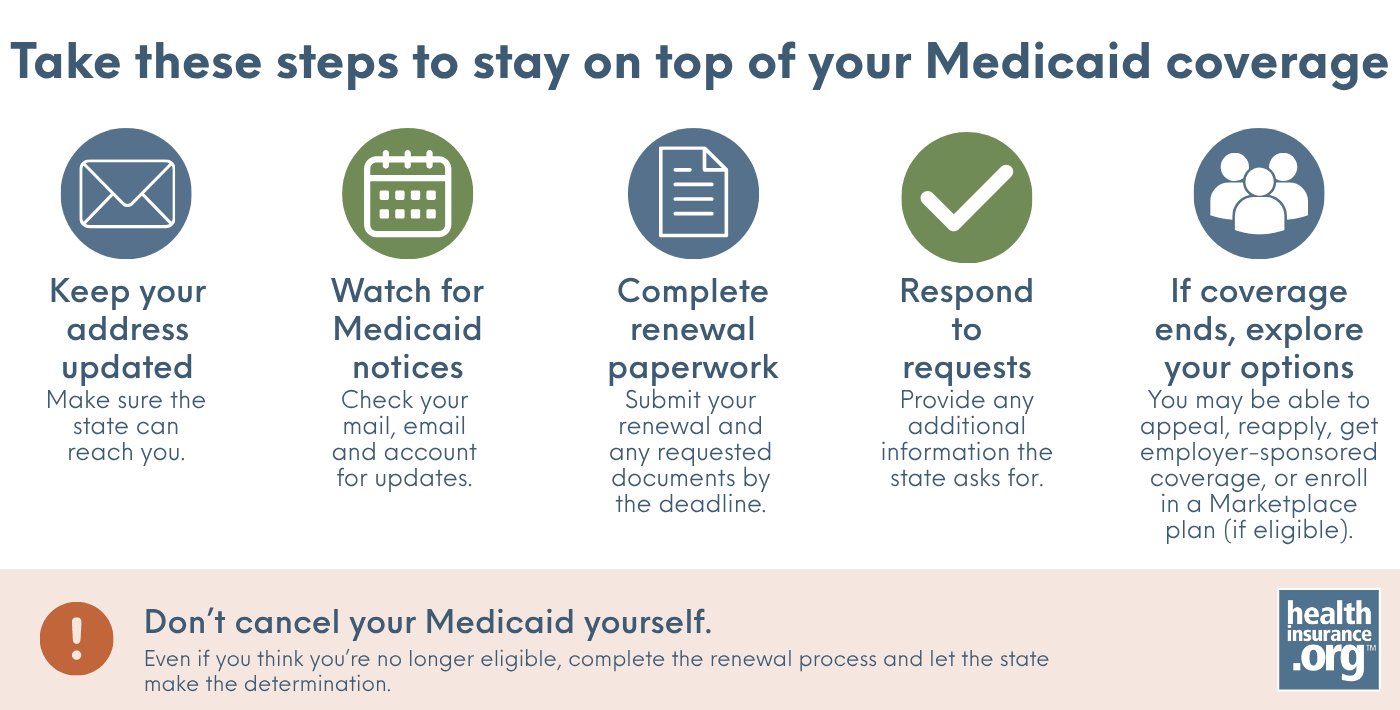
Here’s what you need to know to make sure this doesn’t happen to you:
- Confirm that your state Medicaid agency has your current address on file.
- You may also be able to sign up for email, text, or mobile app alerts when documents are due. But watch out for scams: If you get an online alert from Medicaid, it will direct you to log into the regular portal or watch for postal mail. Be wary of any message that asks you to respond by text, click a link, or call a phone number that isn’t the regular Medicaid phone number in your state. Messages like that are often a scam.14 If in doubt about a message you receive, do not click on any links or provide any information. Instead, contact your state’s Medicaid office or your Medicaid health plan directly, using the phone number on your ID card, to confirm whether the message was legitimate.
- Pay close attention to the deadline noted with the renewal paperwork you receive. Your coverage will terminate if you don’t submit any necessary information by that date.
- Fully complete the renewal paperwork, including any documentation that the state is asking you to provide. If you don’t understand what’s being asked, call your state Medicaid agency for help. Ignoring the situation guarantees that you’ll lose your Medicaid.
Your state might be able to process your renewal automatically, without needing you to submit any additional information.15 But if they need more information and you don’t provide it, you’ll lose your Medicaid.
What should I do if I think I might lose Medicaid?
If you think you’re no longer eligible for Medicaid and might lose your coverage, there are a few things to keep in mind:
- Don’t assume you’re not eligible. It’s in your best interest to complete your renewal paperwork and submit all of the documentation that the state requests. You might find that you’re eligible after all.
- Contact your state Medicaid agency to be sure you understand the eligibility rules, when your coverage renews, and what you need to do to keep your Medicaid if you’re still eligible.
- Start planning ahead:
- If you know you need certain medical care in the near future, you can try to schedule it for before your Medicaid ends. You could also consider refilling any prescriptions that are eligible for a refill.
- Learn more about what your coverage options will be if your Medicaid does end. Will you have access to an employer’s plan? Will you qualify for a Marketplace subsidy to purchase new coverage?
What happens if I do lose Medicaid?
If you find out that your Medicaid is ending, the first step is to make sure that you truly no longer qualify for Medicaid. If you are eligible – and just haven’t submitted the necessary documentation – you should be able to submit the paperwork and get your coverage reinstated (if it hasn’t been more than 90 days since it ended), or reapply for Medicaid, since Medicaid enrollment is open year-round. And if you believe that you’re still eligible but the state says you aren’t, you can file an appeal.16
If you’re no longer eligible for Medicaid, you may find that you can get affordable coverage from an employer or from the Marketplace in your state.
Learn more: I Lost My Medicaid Coverage. What Now?
What is Medicaid renewal (redetermination)?
Medicaid renewal, also called Medicaid redetermination, is the review process that states conduct each year (every six months starting in 2027 for Medicaid expansion enrollees) to check to see if each Medicaid enrollee is still eligible for Medicaid.
The renewal date is based on when the person enrolled in Medicaid, and Medicaid enrollment is open year-round. So Medicaid renewals are also conducted throughout the year. This differs from ACA-compliant individual market health insurance, which always renews on January 1.
In many states, the majority of Medicaid renewals are done on an ex parte basis, meaning the state is able to use information it already has on file to automatically determine that the person is still eligible for coverage. But this varies considerably from one state to another.17
Can I get Marketplace insurance if I lose Medicaid?
Yes. If you lose your Medicaid, that will trigger a special enrollment period during which you can enroll in a Marketplace plan. But your eligibility for Marketplace subsidies will depend on your income:
- If you’re in a state that has expanded Medicaid, you’ll only qualify for a Marketplace subsidy if your household income is above 138% of the federal poverty level (FPL), and not more than 400% of FPL. For 2027 coverage in the continental United States for a single adult, this means your total 2027 income needs to be between $22,025 and $63,840.18
- If you’re in a state that hasn’t expanded Medicaid, your income will need to be between 100% and 400% of FPL to qualify for a Marketplace subsidy. For a single adult in the continental U.S., that’s a 2027 income between $15,960 and $63,840.18
- If you lose Medicaid due to failure to comply with the work requirement, you’ll still be considered eligible for Medicaid by the Marketplace, and thus not eligible for a Marketplace subsidy.19 To qualify for a subsidy, your income will need to increase to above 138% of FPL, or to at least 100% FPL if you’re in Georgia, Wisconsin, or Tennessee.
Will I lose my Medicaid if I get Medicare?
When you become eligible for Medicare, you won’t necessarily lose your Medicaid coverage, but the eligibility rules for Medicaid will change. Once you’re enrolled in Medicare, you’ll need to qualify for Medicaid for the Aged, Blind, and Disabled in order to continue to have Medicaid coverage. This is also known as “non-MAGI” Medicaid, because eligibility isn’t based solely on modified adjusted gross income (MAGI) as it is for children and for non-disabled adults under age 65.20
Non-MAGI Medicaid has income limits, but it also has asset limits that tend to be quite low ($2,000 for a single individual in most states).10
So if you’ve been covered under MAGI-based Medicaid expansion and you’re turning 65, your ability to keep Medicaid will start to depend on you having very low asset levels, in addition to a low income.
Learn more about transitioning from Medicaid expansion to Medicare.
Footnotes
- “Millions Could Lose Medicaid Coverage Due to New Rules” RWJF. March 25, 2026 ⤶
- “Tracking Implementation of the 2025 Reconciliation Law Medicaid Work Requirements” KFF.org. Aug. 3, 2026 ⤶ ⤶
- “The Budget and Economic Outlook: 2026 to 2036” Congressional Budget Office. Feb. 2026 ⤶
- “Tracking Implementation of the 2025 Reconciliation Law Medicaid Work Requirements” KFF.org. Aug. 3, 2026. Work requirements apply to Medicaid expansion enrollees, plus partial expansion enrollees in Georgia and Wisconsin, and some low-income parents in Tennessee. Semi-annual eligibility redeterminations apply only to Medicaid expansion enrollees. ⤶
- “Medicaid Community Engagement Requirement for Certain Individuals Interim Final Rule with Comment Period (CMS-2454-IFC)” Centers for Medicare & Medicaid Services. June 1, 2026 ⤶ ⤶
- “An Early Look at Policy Decisions as States Get Ready to Implement Work Requirements” KFF.org. April 30, 2026 ⤶
- “Are You Eligible for Medicaid? What You Need to Know About Income Limits and Qualifications” GoodRx. May 29, 2025 ⤶
- “Medicaid, Children’s Health Insurance Program, & Basic Health Program Eligibility Levels” Medicaid.gov. Accessed Aug. 28, 2026 ⤶ ⤶
- “Medicaid Postpartum Coverage Extension Tracker” KFF.org. July 15, 2026 ⤶
- “5 Key Facts About Medicaid Eligibility for Seniors and People with Disabilities” KFF.org. Feb. 7, 2025 ⤶ ⤶
- “Notice Issues Related to OBBBA’s Shift of Medicaid Expansion to 6 Month Redeterminations” National Health Law Program. April 29, 2026 ⤶
- “Medicaid Expansion Enrollment, June 2025” KFF.org. Accessed Aug. 28, 2026 ⤶
- “Medicaid/CHIP Monthly Enrollment Tracker (Unwinding Data, Archived)” KFF.org. Aug. 26, 2026 ⤶
- “Be aware of texting scam targeting Medicaid recipients” The Mountaineer. May 17, 2025 ⤶
- “Medicaid Ex Parte Renewals Are an Efficient Strategy to Ensure Eligible Enrollees Have Health Care, Increase Accuracy, and Reduce Administrative Costs” Center on Budget and Policy Priorities. Feb. 25, 2025 ⤶
- “I learned that my Medicaid coverage has ended. What do I do now?” KFF.org. Sep. 29, 2025 ⤶
- “An Examination of Medicaid Renewal Outcomes and Enrollment Changes at the End of the Unwinding” KFF.org. Sep. 18, 2024 ⤶
- “2026 Poverty Guidelines” U.S. Department of Health & Human Services. Accessed Aug. 29, 2026 ⤶ ⤶
- “Text of H.R.1, Section 71119(7)(B)” Congress.gov. Enacted July 4, 2025 ⤶
- “Medicaid Eligibility and Enrollment Policies for Seniors and People with Disabilities (Non-MAGI) During the Unwinding” KFF.org. June 20, 2024 ⤶