Health Insurance Marketplace by State
Health insurance Marketplaces help consumers compare and enroll in health coverage. Learn how they work, who can use them, when enrollment is available, and how Marketplaces differ by state.


What is a health insurance Marketplace?
A health insurance Marketplace – also called a health insurance exchange – is a platform where consumers in the United States can purchase ACA-compliant individual and family health insurance plans and receive income-based premium subsidies to make coverage and care more affordable. During the open enrollment period for 2026 coverage, 23.1 million people selected Marketplace plans throughout the country,1 down from 24.3 million people the year before.2
Each state has just one official Marketplace/exchange, operated by the state, the federal government, or both. In the majority of the states, the federally run HealthCare.gov serves as the enrollment platform and runs the customer service call center. But a growing number of states run their own platforms, such as Covered California, New York State of Health, Connect for Health Colorado, and MNsure.

Need help exploring your options?
A licensed agent can help you:
- Answer coverage questions
- Understand your options
- Explore costs and eligibility
- Enroll when you're ready
Health insurance Marketplaces vary by state
The Affordable Care Act (ACA), enacted in March 2010, called for the creation of a health insurance Marketplace in each state, but the practical implementation of those Marketplaces varies from one state to another.
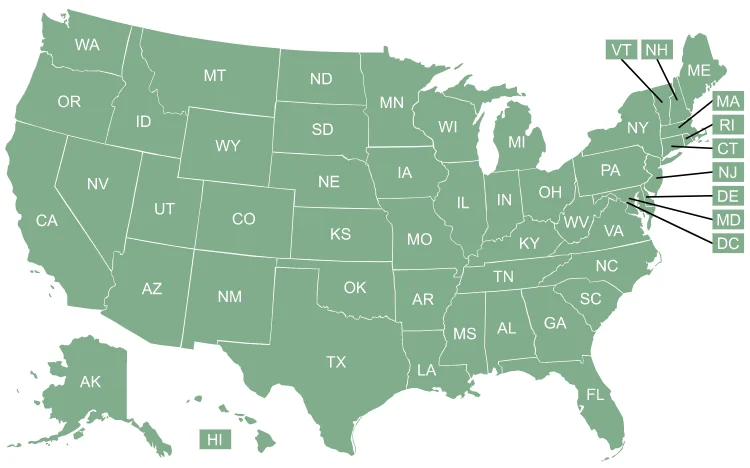
This overview answers questions about what the Marketplaces are, what they offer, and how they work. You can select a state on the map below to see specific details about that state’s Marketplace, including which carriers offer plans, enrollment deadlines, subsidy information, and state-specific rules.
Select your state below to see the options available to you
Frequently asked questions about health insurance Marketplaces
Who’s eligible to use the health insurance Marketplaces?
With the exception of people who are enrolled in Medicare coverage, virtually all people are eligible to use the health insurance Marketplace as long as they’re lawfully present in the U.S. (Note that this no longer includes DACA recipients.)
But practically speaking, the Marketplaces are for people who need to buy their own health insurance because they don’t have access to employer-sponsored coverage, Medicare, or Medicaid. This includes people who are self-employed, people who are employed by a small business that doesn’t offer health benefits, and people who have retired before age 65 and are thus too young to be covered by Medicare.
The majority of individuals under age 65 get their coverage from an employer,3 which means they don’t need to use the Marketplace. They can choose to decline their employer’s coverage and select a plan in the Marketplace instead, but they won’t be eligible for financial assistance unless the employer’s coverage isn’t considered affordable and/or doesn’t provide minimum value.
Most people under age 65 who are eligible for Medicaid can use the Marketplace to enroll in Medicaid, or at least to determine their eligibility for Medicaid. In some states, the Medicaid enrollment process is completed via the Marketplace, while in other states, the Marketplace sends the consumer’s information to the state Medicaid agency to finalize the eligibility and/or enrollment process.
When can consumers buy health insurance through their Marketplace?
During an annual open enrollment period each fall, people can enroll in coverage through the Marketplace or change their coverage for the coming year. (The same open enrollment window also applies to individual market plans that are available outside the Marketplace, purchased directly from the insurance companies.)
In most states, the open enrollment period that starts in the fall of 2026 (for 2027 coverage) will run from November 1 to January 15. A federal rule change that would have shortened the enrollment window was blocked by a judge and is not taking effect for 2027 coverage.4
Some state-run exchanges have different open enrollment schedules, so enrollees should be aware of the details in their state, including the last day to enroll in a plan with a January 1 effective date.
Outside of the annual open enrollment period, a special enrollment period is necessary to enroll in a plan through the health insurance Marketplace (or outside the Marketplace, directly through an insurer) or change to a different plan. Special enrollment periods – triggered by a variety of qualifying life events – give eligible enrollees at least 60 days to select a new medical plan.
How do health insurance Marketplaces help consumers?
In each state, the health insurance Marketplace allows consumers to select from among different qualified health plans offered by a variety of private health insurance companies. (In a few rural areas of the United States, only one insurer offers health plans for sale in the Marketplace, but there are still a variety of plan options available.)5
All qualified plans offered for sale in the Marketplace must be ACA-compliant – meeting standards established and enforced by the federal and state governments. So when a person shops in the health insurance Marketplace, they can be sure that the participating insurers will not use medical underwriting or exclude pre-existing conditions. All of the available plans will cover the ACA’s essential health benefits without annual or lifetime benefit caps.
Income-based premium subsidies and cost-sharing reductions are only available through the health insurance Marketplace, and are a key aspect of keeping health insurance premiums and out-of-pocket costs affordable for United States residents.
Learn more about cost-sharing reductions.
(Note that in the majority of the states, it’s possible to enroll through the Marketplace via an enhanced direct enrollment entity, without using the Marketplace website.)
Income-based subsidies continue to be available in the Marketplace, and most enrollees qualify for these subsidies.6 But the expiration of federal subsidy enhancements at the end of 2025 caused a sharp increase in net premiums for Marketplace plans. As a result, some people didn’t or couldn’t continue to pay their premiums, and effectuated enrollment declined.7
Use our subsidy calculator to see whether you’re eligible for a Marketplace premium subsidy.
What are the types of health insurance Marketplaces?
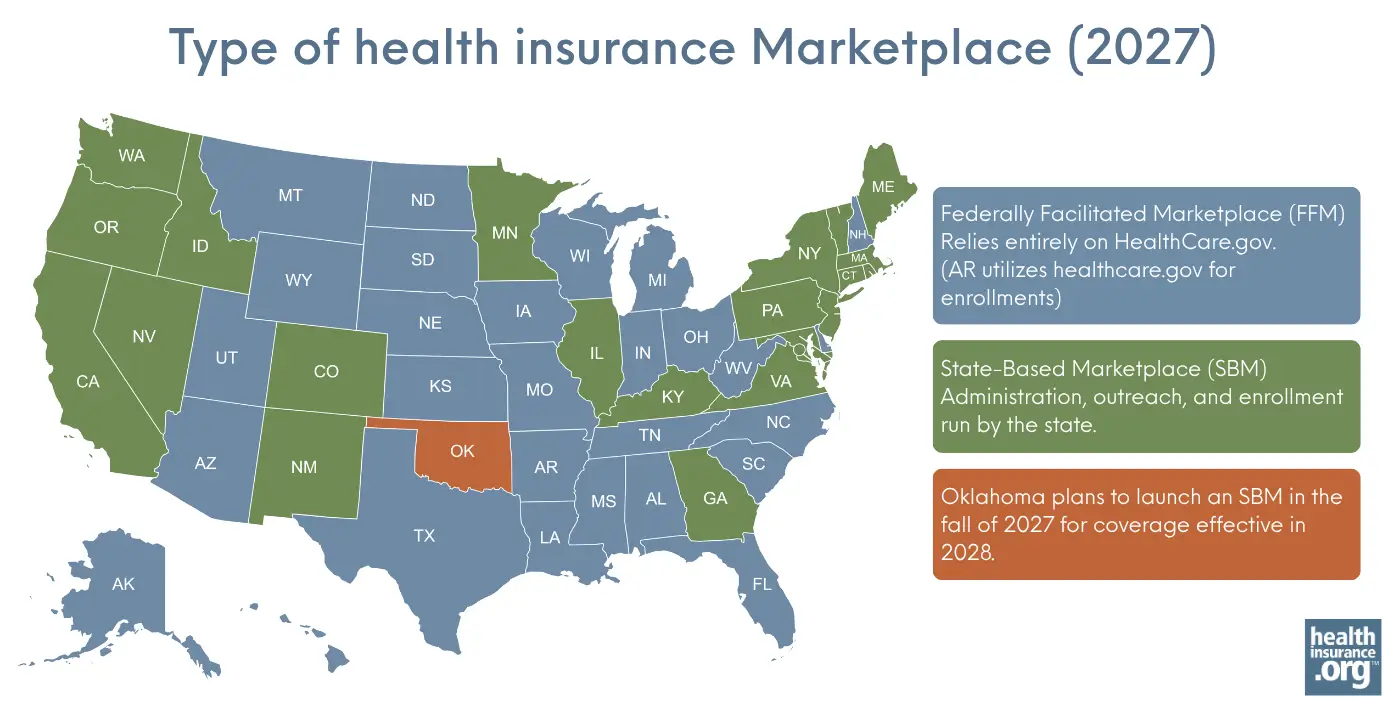
A state’s health insurance Marketplace can be run by the state, by the federal government, or both. As of the 2027 plan year:8
- Washington, D.C. and 21 states have fully state-run Marketplaces, which means they oversee the Marketplace and operate their own website and call center, and fund their own Navigator programs. (Examples are GetCoveredNJ, Pennie, Vermont Health Connect, Washington Healthplanfinder, etc.) For 2027, this list includes Oregon, which previously did not have a fully state-run Marketplace.9
- Twenty-seven states rely fully on the federal government for their Marketplaces. They use the HealthCare.gov website and customer service call center, and receive federal Navigator funding.
- Two states (Arkansas and Oklahoma) have state-based Marketplaces that use the federal platform (SBM-FP), which means they oversee their own Marketplace and fund their own Navigator programs, but rely on HealthCare.gov for enrollment.
You can find more information here about the types of health insurance Marketplaces, how they work, which model each state uses, and how states’ approaches to this have changed over time.
Do I have to buy my health insurance through a Marketplace?
There is no federal requirement that U.S. citizens buy coverage through the Marketplace. There is no longer a federal penalty for not having health coverage (although Washington, D.C. and four states have state-based penalties for people who choose to remain uninsured). And even when there was a federal penalty, people could choose to purchase their coverage off-exchange instead of buying a plan through the Marketplace (with the exception of DC, where individual and small-group coverage is only available through the Marketplace).
But if you don’t buy your coverage through the exchange (either directly, or via an enhanced direct enrollment entity that is enrolling you in on-exchange coverage), you will not be eligible for premium tax credits10 or cost-sharing reductions,11 even if you’d otherwise be eligible for them (and most exchange enrollees are eligible for subsidies, even after the federal subsidy enhancements expired at the end of 2025).1 This is one of the primary reasons people shop in the Marketplace, as full-price individual health insurance premiums would simply be too costly for most people.
How much could you save on 2026 Marketplace coverage?
Compare health insurance Marketplace plans and check subsidy savings from a third-party insurance agency.



Footnotes
- “2026 Marketplace Open Enrollment Period Public Use Files” CMS.gov. Accessed May 13, 2026 ⤶ ⤶
- “2025 Marketplace Open Enrollment Period Public Use Files” CMS.gov. Accessed July 30, 2025 ⤶
- “Employer-Sponsored Health Insurance 101” KFF.org. April 15, 2026 ⤶
- “Updated Statement Regarding the City of Columbus v. Kennedy, No. 1:26-cv-02215” Centers for Medicare & Medicaid Services. Aug. 4, 2026 ⤶
- “Plan Year 2026 Marketplace Plans and Prices Fact Sheet” Centers for Medicare & Medicaid Services. Oct. 30, 2025 ⤶
- “2026 Marketplace Open Enrollment Period Public Use Files” Centers for Medicare & Medicaid Services. Accessed Sep. 9, 2026 ⤶
- “How Has ACA Marketplace Enrollment Changed Across States in 2026?” KFF.org. July 28, 2026 ⤶
- “States by Marketplace Type (FFM/SBM-FP/SBM) for Plan Year 2027” Centers for Medicare & Medicaid Services. Accessed Sep. 9, 2026 ⤶
- “State-based Marketplace Project” Oregon.gov. Accessed Sep. 9, 2026 ⤶
- “Premium tax credit” HealthCare.gov. Accessed Sep. 9, 2026 ⤶
- “Cost sharing reduction (CSR)” HealthCare.gov. Accessed Sep. 9, 2027 ⤶