ACA Open Enrollment 2027 Guide
Here’s what you need to know about open enrollment for individual and family health coverage.


What is the Affordable Care Act’s open enrollment?
The Affordable Care Act’s (referred to as ACA or Obamacare) open enrollment period is the annual window during which individuals and families can compare the various health plans that are available and select the one that will best fit their needs for the coming year.
In most states, the health insurance open enrollment dates for 2027 coverage will run from November 1, 2026 through January 15, 2027, although as explained below, there are some states with different schedules. The open enrollment window applies to plans sold through the Marketplace/exchange as well as plans purchased off-exchange, directly from an insurance company.
Outside of open enrollment, you can only sign up for ACA-compliant individual and family health insurance (or switch to a different plan) if you’re eligible for a special enrollment period, most of which are triggered by qualifying life events.
Learn more about special enrollment periods and qualifying life events.

Need help exploring your options?
A licensed agent can help you:
- Answer coverage questions
- Understand your options
- Explore costs and eligibility
- Enroll when you're ready
When is ACA open enrollment in my state?
In the majority of the states, Obamacare open enrollment for 2027 coverage will start on November 1, 2026 and end on January 15, 2027. But some state-run exchanges have different schedules.
| State | Open Enrollment Period for 2027 Coverage | |
|---|---|---|
| Alabama | November 1, 2026 – January 15, 2027 | |
| Alaska | November 1, 2026 – January 15, 2027 | |
| Arizona | November 1, 2026 – January 15, 2027 | |
| Arkansas | November 1, 2026 – January 15, 2027 | |
| California | November 1, 2026 – January 31, 2027 | |
| Colorado | November 1, 2026 – January 15, 2027 | |
| Connecticut | October 23, 2026 – January 15, 2026 | |
| Delaware | November 1, 2026 – January 15, 2027 | |
| District of Columbia | November 1, 2026 – January 31, 2027 | |
| Florida | November 1, 2026 – January 15, 2027 | |
| Georgia | November 1, 2026 – January 15, 2027 | |
| Hawaii | November 1, 2026 – January 15, 2027 | |
| Idaho | October 15, 2026 – December 15, 2026 | |
| Illinois | November 1, 2026 – January 15, 2027 | |
| Indiana | November 1, 2026 – January 15, 2027 | |
| Iowa | November 1, 2026 – January 15, 2027 | |
| Kansas | November 1, 2026 – January 15, 2027 | |
| Kentucky | November 1, 2026 – January 15, 2027 | |
| Louisiana | November 1, 2026 – January 15, 2027 | |
| Maine | November 1, 2026 – January 15, 2027 | |
| Maryland | November 1, 2026 – January 15, 2027 | |
| Massachusetts | October 23, 2026 – January 23, 2027 | |
| Michigan | November 1, 2026 – January 15, 2027 | |
| Minnesota | November 1, 2026 – January 15, 2027 | |
| Mississippi | November 1, 2026 – January 15, 2027 | |
| Missouri | November 1, 2026 – January 15, 2027 | |
| Montana | November 1, 2026 – January 15, 2027 | |
| Nebraska | November 1, 2026 – January 15, 2027 | |
| Nevada | November 1, 2026 – January 15, 2027 | |
| New Hampshire | November 1, 2026 – January 15, 2027 | |
| New Jersey | November 1, 2026 – January 31, 2027 | |
| New Mexico | November 1, 2026 – January 15, 2027 | |
| New York | November 1, 2026 – January 31, 2027 | |
| North Carolina | November 1, 2026 – January 15, 2027 | |
| North Dakota | November 1, 2026 – January 15, 2027 | |
| Ohio | November 1, 2026 – January 15, 2027 | |
| Oklahoma | November 1, 2026 – January 15, 2027 | |
| Oregon | November 1, 2026 – January 15, 2027 | |
| Pennsylvania | November 1, 2026 – January 15, 2027 | |
| Rhode Island | November 1, 2026 – January 31, 2027 | |
| South Carolina | November 1, 2026 – January 15, 2027 | |
| South Dakota | November 1, 2026 – January 15, 2027 | |
| Tennessee | November 1, 2026 – January 15, 2027 | |
| Texas | November 1, 2026 – January 15, 2027 | |
| Utah | November 1, 2026 – January 15, 2027 | |
| Vermont | November 1, 2026 – January 15, 2027 | |
| Virginia | November 1, 2026 – January 29, 2027 | |
| Washington | November 1, 2026 – January 15, 2027 | |
| West Virginia | November 1, 2026 – January 15, 2027 | |
| Wisconsin | November 1, 2026 – January 15, 2027 | |
| Wyoming | November 1, 2026 – January 15, 2027 | |
How to enroll in the Marketplace during open enrollment
During open enrollment, you can enroll in an ACA-compliant individual or family health insurance plan – or make changes to your existing coverage – through the Marketplace in your state.



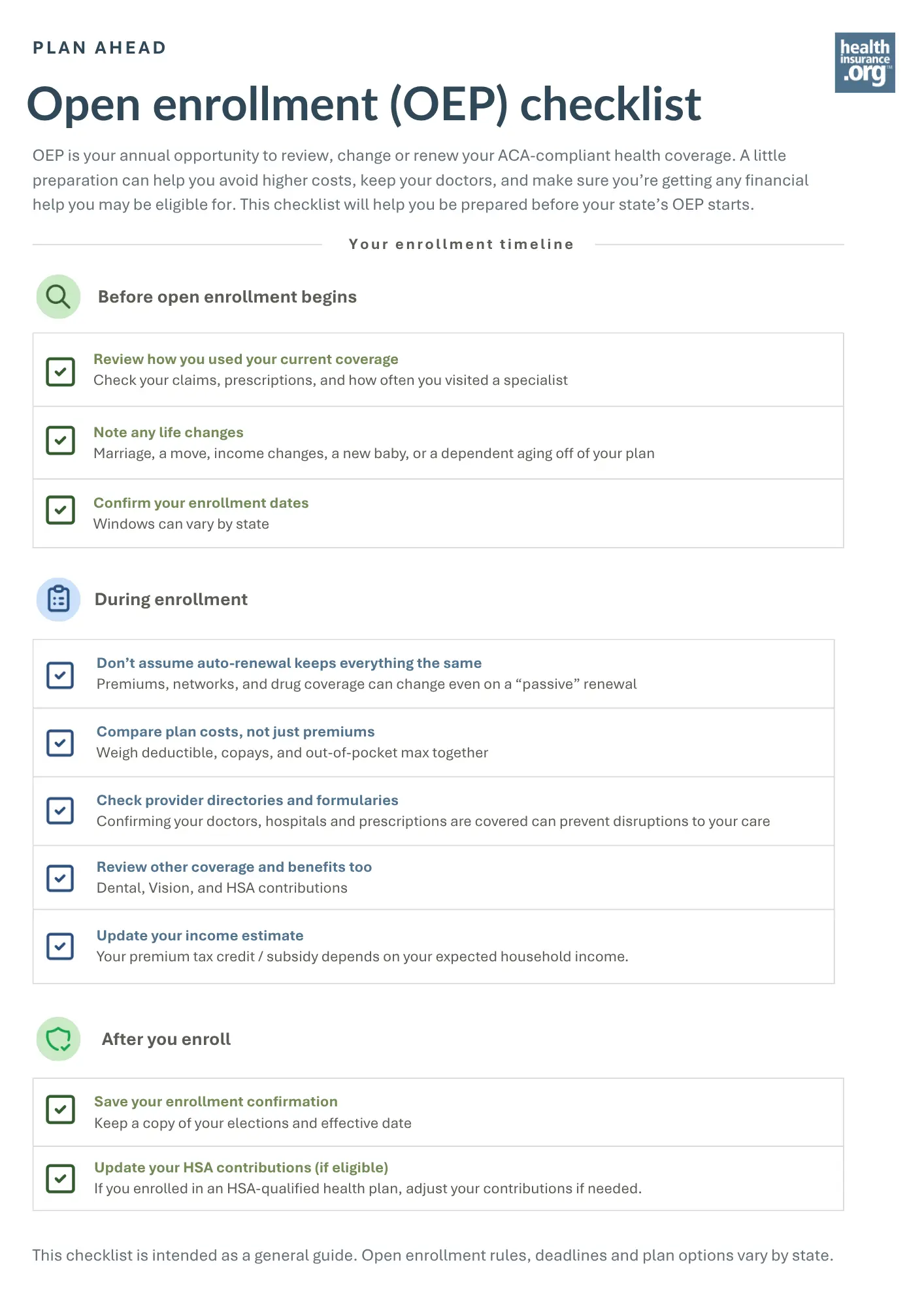
- If you have specific doctors or medical facilities you want to use, check to see if any plans have them in-network. If you take any medications, check to see if any plans have them in their formularies and what the out-of-pocket costs will be.
- If you want help with the process, assistance is available via local insurance brokers and Navigators, as well as enhanced direct enrollment entities.
Learn more about how to choose the best health plan for your situation.

Here’s what you’ll need for each enrollee:
- Name, address, Social Security Number (Here’s why it’s required.) and birth date
- Citizenship or legal residency status. (Proof may be required.)
- Payment information for the first month’s premium. (Setting up automatic payments for future months can help you avoid an inadvertent lapse in coverage.)
- If you’re 30 or older and want a catastrophic plan, you’ll need a hardship exemption.(Note that the expansion of eligibility for catastrophic plans based on ineligibility for Marketplace subsidies has been stayed by a judge, so the official hardship exemption process – used prior to the fall of 2025 – must be used if you’re 30 or older and would like a catastrophic plan.)1
- Most applicants are eligible for financial assistance.2 If you’re applying for subsidies, you’ll also need the number of people on your tax return and your total household income. (The Marketplace may require proof of your income through a variety of documentation,3 and coverage details about any employer-sponsored coverage available to you.)

- You can do this yourself or have a broker, Navigator, or enrollment assister help you with the process.
- You can apply online, over the phone, submit a paper application, or enroll in-person with a local broker, Navigator, or enrollment assister.
- You will not need to answer any medical history questions. But be sure that the plan you’re selecting has your medical providers in-network, covers your medications, and has out-of-pocket costs that you’ll be able to manage.

- Log back into your Marketplace account after you’ve completed the process, to make sure everything is in order.
- Watch your email and mail for communications from the Marketplace and your new insurer. (For example, you may be asked to provide documentation to verify income or legal residency).
- Once your policy and ID cards arrive in the mail, read through all of it and reach out to your broker, Navigator, or the health plan if you have questions.
Frequently asked questions about Obamacare open enrollment
Who is eligible for Marketplace enrollment?
To be able to enroll on the ACA’s Marketplace:4
- You must live in the United States.
- You must be a U.S. citizen or national or be lawfully present, and DACA recipients are no longer allowed to use the Marketplace. (Washington state allows undocumented immigrants to use its Marketplace, although there may be changes to that approach as of 2027.5 and Colorado has a separate platform that undocumented immigrants can use to enroll in coverage.)
- You must not be incarcerated.
- You cannot be enrolled in Medicare coverage.
Who is eligible for financial assistance when buying coverage through the Marketplace?
Being eligible to enroll in the Marketplace is not the same as being eligible for financial assistance. In short, the income-based subsidies available through the Marketplace/exchange are reserved for people who aren’t eligible for Medicaid, zero-premium Medicare Part A, or coverage offered by an employer that’s deemed affordable and comprehensive. (Here’s how to determine whether employer-sponsored coverage is affordable to you.)
You can use our subsidy calculator to get an idea of whether you’re eligible for premium subsidies, and if so, how much those subsidies could be.
Note: As of 2027, some immigrants will no longer be eligible for subsidies, including refugees, asylees, people with temporary protected status (TPS), and people with work or student visas. To be subsidy-eligible, non-citizens will need to be either lawful permanent residents (LPRs), Cuban or Haitian entrants, or COFA migrants.6
What is a premium subsidy and how do I get financial help during open enrollment?
Premium subsidies are a refundable tax credit.7 You may qualify for a subsidy based on your projected household income for the year you’ll have coverage. And then you’ll need to reconcile that with the IRS when you file your tax return for that year, based on your actual income.
Premium subsidy rules are designed to ensure that subsidy-eligible individuals won’t pay more than a certain percentage of their household income in premiums for the benchmark (second-lowest-cost Silver) plan in the Marketplace.8
The percentage of household income that people are expected to pay depends on their income. These percentages were reduced from 2021 through 2025, and there was no upper income limit for subsidy eligibility during those years. These temporary subsidy enhancements were due to the American Rescue Plan and the Inflation Reduction Act.
But those provisions were temporary, and expired at the end of 2025. For 2027, the percentage of income that people have to pay for the benchmark plan ranges from 2.15% to 10.22% of household income.9 And anyone with household income above 400% of the federal poverty level no longer qualifies for any subsidies at all – regardless of what percentage of their income they have to pay for their health insurance.
Cost-sharing reductions: The other ACA subsidy
Marketplace cost-sharing reductions (CSR)10 are another type of Obamacare subsidy. CSR assistance is designed to ensure that people with low to moderate incomes can afford to receive health care services. Enrollees who qualify for CSR usually also qualify for premium subsidies.
CSR subsidies result in lower out-of-pocket costs, including lower deductibles and copays. For applicants with eligible incomes, these subsidies are automatically incorporated into all of the available Silver-level plans. But if you’re eligible for CSR subsidies and you buy a non-Silver plan, you’ll forfeit this advantage
In addition to federal premium subsidies and CSR subsidies, some state-run Marketplaces offer their own subsidies.
I have Medicare. Can I buy supplemental insurance through the ACA Marketplace during open enrollment?
No. It is unlawful for someone to sell you a Marketplace plan (or an individual/family plan outside the exchange) if you already have Medicare, even if you only have either Medicare Part A or Part B.11 So if you’re enrolled in Medicare, the Marketplace open enrollment period does not apply to you.
Is there a penalty for not having insurance?
Should I let my existing ACA-compliant health plan auto-renew?
Auto-renewal or automatic re-enrollment (when a plan is terminating) for the coming year’s coverage is available through the Marketplaces in every state. (This will likely end after the 2027 plan year, due to the “Big Beautiful Bill” that was enacted in 2025.)17
However, it is generally not in your best interest to rely on automatic renewal. Selecting your own plan for the coming year is better than relying on auto-renewal or a Marketplace algorithm that will select a new plan on your behalf.
And there were some changes to the auto-renewal protocols for 2026 coverage, as a result of a federal rule that was finalized in 2025. Marketplace cost-sharing reductions (CSR) are only available on Silver plans. So HealthCare.gov implemented a new protocol in 2024 that would automatically move a Bronze enrollee to a Silver plan if the person was eligible for CSR and the Silver plan had the same or lower premium and the same provider network. That protocol was no longer available for the 2026 plan year, so the person in that scenario was auto-renewed into their same Bronze plan, despite the fact that they’re missing out on CSR benefits. That will continue to be the case for 2027 coverage.
As open enrollment approaches, you’ll want to pay close attention to any notices you receive from your health plan and Marketplace, as they will let you know how your benefit details, monthly premium, and premium subsidy (if applicable) are changing for the coming year. You’ll also want to carefully compare the other options available in your area, as they may not be the same as the options that were available for this year.
You may find that keeping your current plan is still the best option. But it’s better to actively make that decision than let it be the default.
Who can help me enroll in an ACA-compliant / Obamacare health insurance plan?
You can certainly choose to select a plan and complete the enrollment process on your own, through the Marketplace/exchange website (or via an enhanced direct enrollment entity if you’re in a state that uses HealthCare.gov).18
But if you prefer to have help with the process, it’s available for free online, over the phone, and from people in your community:
Health insurance Navigators
- Provide education and outreach about the Marketplace and available health plans, help applicants determine whether they qualify for subsidies or Medicaid, and assist in the enrollment process.
- Can generally provide assistance after you enroll, helping with issues like eligibility appeals and how to utilize your health coverage.
- Are funded by the Marketplace. The funding comes from the federal government in states that utilize a federally run exchange, and by the state in states that run their own exchanges. However, the Trump administration has drastically reduced Navigator funding for the states that use HealthCare.gov, so there aren’t as many Navigators available as there were during the Biden administration.19
Certified application counselors (CACs)
- Similar to Navigators, but their focus tends to be strictly on helping people enroll, without the more extensive assistance that some Navigators can provide.
- The exchange designates local “CAC designated organizations” (health centers, faith-based organizations, colleges, etc.) and people who are affiliated with or employed by those organizations are eligible to serve as CACs.20
- CAC funding can come from a variety of state and federal sources, and CACs are often volunteering their time to help people enroll in health coverage. The Marketplace does not provide funding for CAC organization.
- Learn more about certified application counselors.
Insurance brokers and agents
- Licensed by the state and certified by the Marketplace/exchange.
- Can help consumers determine subsidy or Medicaid eligibility, and they can also make plan recommendations based on a client’s particular situation.21 (Navigators and CACs cannot do this).
- Provide ongoing assistance for questions and problems regarding billing, utilization, claims, and appeals.
- Generally are required to carry errors and omissions insurance.
Footnotes
- “Health coverage exemptions: Forms & how to apply” HealthCare.gov. Accessed Aug. 11, 2026. And “Memorandum Opinion, Columbus v. Kennedy (Columbus II)” U.S. District Court for the District of Maryland. July 16, 2026 ⤶
- ”2026 Marketplace Open Enrollment Period Public Use Files” Centers for Medicare & Medicaid Services. Accessed Aug. 14, 2026 ⤶
- “How do I resolve a data matching issue?“ HealthCare.gov, Accessed Aug. 14, 2026 ⤶
- “A quick guide to the Health Insurance Marketplace®” HealthCare.gov, accessed Aug. 11, 2026 ⤶
- “Section 1332 Waiver Information” Washington Health Benefit Exchange. Accessed Aug. 11, 2026 ⤶
- ”1.4 Million Lawfully Present Immigrants are Expected to Lose Health Coverage due to the 2025 Tax and Budget Law” KFF.org. Sep. 25, 2025 ⤶
- “Premium tax credit” HealthCare.gov, Accessed Aug. 11, 2026 ⤶
- “Questions and Answers on the Premium Tax Credit” IRS.gov, Accessed Aug. 11, 2026 ⤶
- “Revenue Procedure 2026-26” Internal Revenue Service. Accessed Aug. 11, 2026 ⤶
- “APTC and CSR Basics” CMS.gov, October 2025 ⤶
- “Medicare & the Health Insurance Marketplace” Medicare.gov, Accessed Apr. 9, 2026 ⤶
- “Massachusetts Individual Mandate” Massachusetts Health Connector. Accessed Aug. 11, 2026 ⤶
- “New Jersey’s Health Coverage Requirement” NJ.gov, Accessed Aug. 11, 2026 ⤶
- “Why Are Californians Required by Law to Have Health Insurance? ” CoveredCA.com, Oct. 20, 2025 ⤶
- “Health Insurance Mandate” State of Rhode Island Division of Taxation. Accessed Aug. 11, 2026 ⤶
- “DC’s Individual Responsibility Requirement” DC.gov, March 31, 2020 ⤶
- “Health Provisions in the 2025 Federal Budget Reconciliation Bill” (The Affordable Care Act) KFF.org. July 8, 2025 ⤶
- “Entities Approved to Use Enhanced Direct Enrollment” CMS.gov, April 7, 2026 ⤶
- “CMS Announcement on Federal Navigator Program Funding” CMS.gov, Feb. 14, 2025 ⤶
- “Certified application counselor designated organization (CDO) program information” Centers for Medicare & Medicaid Services. Accessed Aug. 11, 2026 ⤶
- “Who’s helping me complete my application?” HealthCare.gov. Accessed Aug. 11, 2026 ⤶