Should I let my individual health insurance plan automatically renew?

In this article
- Should I let my individual health insurance plan automatically renew?
- When does auto-renewal of a health plan happen?
- If I expect my subsidy to change, should I auto-renew my plan?
- Subsidies won’t auto-renew as of the 2028 plan year
- Auto-renewal for Catastrophic plans
- Auto-renewal might result in a loss of your premium subsidy.
- If I have an off-exchange plan or pre-ACA plan, should I let it auto-renew?
Should I let my individual health insurance plan automatically renew?
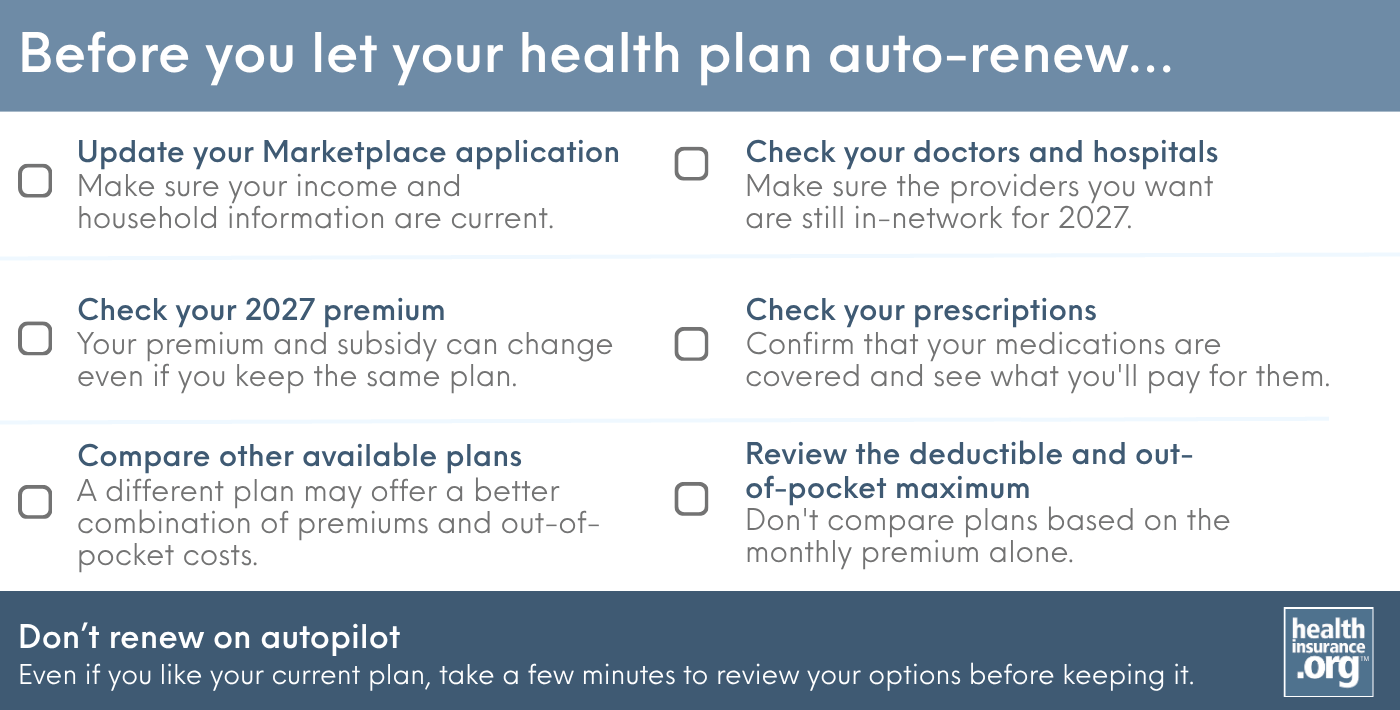
If you have a health insurance plan in the individual market, on-exchange or off-exchange, you can probably just let it renew for the coming year without doing anything during open enrollment. But this is not in most people’s best interest. It’s very useful to actively compare the available plans during open enrollment, which runs from November 1 to January 15 in most states.
You might decide to renew your existing coverage, or you might end up switching to a different plan. But one of the reasons the ACA’s health insurance exchanges were created was to foster a sense of competition and choice, and to encourage people to comparison shop for their health coverage.1 You can’t do that if you passively let your current coverage auto-renew.
Obamacare subsidy calculator †
When does auto-renewal of a health plan happen?
HealthCare.gov begins to display auto-renewals in consumers’ accounts around December 16, right after the December 15 deadline for enrollees to pick a new plan with a January 1 effective date.
But the auto-renewal process begins weeks earlier, as the system transmits renewal information to insurers.2 Most of the state-run exchanges process auto-renewals on or around December 1,3 but enrollees in all states can still make a change to their coverage at least through December 15, and in some states, through December 31.
In most states, open enrollment for 2027 coverage runs from November 1, 2026 through January 15, 2027, although there are some state-to-state variations. In nearly all states, plan changes made after December 15, 20264 will take effect February 1, 2027, rather than January 1. (There are some states that have later deadlines for a January 1 effective date, and open enrollment ends altogether in Idaho on December 15.) So if a plan auto-renews and you later select a new plan in the latter half of December or in early January, you’ll have your auto-renewed coverage for January, and then your new plan will take effect in February. This is why it’s important to pay attention to the information that the exchange and your insurer send you in the fall, and finish whatever changes you want to make by December 15.
If I expect my subsidy to change, should I auto-renew my plan?
You should expect your subsidy amount to change each year. If it decreases, auto-renewal could result in higher premiums even if your own plan’s rate doesn’t increase.
For 2027, average full-price premiums are projected to increase by about 15%, but a specific enrollee might see a much larger or much smaller premium change, depending on their plan and their circumstances.
You’ll receive communications from your insurer and the Marketplace ahead of open enrollment, detailing how much your net premium will change for 2027. Paying attention to these details, as well as other aspects of your coverage (out-of-pocket costs, provider networks, drug formularies, etc.), will give you an opportunity to comparison shop and to switch plans if a different option will better fit your needs and budget.
It’s also important to understand how carriers entering and exiting the market can affect the plans that are available in that area and possibly the subsidy amounts available to people in that area. (Subsidy amounts are based on the cost of the second-lowest-cost Silver plan in a given area. If that plan changes due to the entry or exit of an insurer, subsidy amounts will also change as they’ll be based on the new second-lowest-cost Silver plan’s premium.)
For example, Cigna is exiting the Marketplace in 11 states at the end of 2026, and several other carriers are exiting Marketplaces in various states. Enrollees with 2026 plans that are ending will need to pick a replacement plan during open enrollment. If they rely on auto-renewal, the Marketplace in most states will use an algorithm to select a replacement plan, but it might not be the one that best fits each enrollee’s needs.
And if a carrier is newly entering the Marketplace in your area – which is the case in several states for 2027 – you won’t know about those options unless you actively shop for your coverage during open enrollment.
Subsidies won’t auto-renew as of the 2028 plan year
By fall 2027, auto-renewal won’t be an option for subsidized enrollees. Under the ”One Big Beautiful Bill” that was enacted in 2025, subsidies will no longer be available for 2028 and future years if the enrollee’s eligibility information isn’t verified and updated each year.5
The coverage itself will still be able to auto-renew, but the elimination of subsidies during the auto-renewal process will effectively end the auto-renewal process that’s currently used by millions of enrollees each year.6
Auto-renewal for Catastrophic plans
For 2025 and future years, HHS finalized a change in how automatic re-enrollment is handled when a person has Catastrophic coverage and will no longer be eligible for that plan in the coming year.7
Under pre-2025 rules, there was no mechanism for the exchange to automatically select a replacement plan for a person with Catastrophic coverage if the person would no longer be eligible for a Catastrophic plan in the coming year – these plans are only available to enrollees under age 30 or with a hardship exemption – or if the Catastrophic plan will no longer be available. (Some state-run exchanges already had a protocol for this.)
The rule change allows the exchange to select a new plan in these circumstances if the enrollee doesn’t select their own new plan. It will be a Bronze plan in the same product (HMO, PPO, etc.) with a similar provider network. If a Bronze plan isn’t available, the automatic re-enrollment plan will be the lowest-cost plan in the same product with a similar provider network.8 As is always the case, consumers in this situation would still be able to select their own replacement plan during open enrollment.
Note: Some people gained access to Catastrophic plans for the 2026 plan year based simply on being ineligible for Marketplace subsidies.9 But that was subsequently blocked by a court ruling, and by August 2026, Catastrophic plans were once again only available to people 30 and older if they qualified for a hardship or affordability exemption.10 People who enrolled in Catastrophic plans for 2026 via the extended eligibility pathway will need to select different coverage for 2027, but the auto-renewal pathway will ensure that they continue to have Marketplace coverage if they don’t pick their own replacement plan.
Auto-renewal might result in a loss of your premium subsidy
Although auto-renewal is available to nearly all exchange enrollees, some caveats are particularly important for people with premium subsidies. In addition to the policy changes discussed above, regarding the loss of subsidies due to auto-renewal starting with the 2028 plan year, there are various additional caveats regarding subsidies and auto-renewal.
Details were clarified in April 2015 with CMS guidance on re-enrollments, along with a re-enrollment notice published in August 2015, and the 2017 Benefit and Payment Parameters published in early 2016. There were also some changes stemming from the COVID pandemic. Here’s how the rules currently work:
- HealthCare.gov enrollees who have not provided the exchange permission to obtain updated tax return data for use in the annual subsidy eligibility determination process are eligible for auto-renewal of coverage but without subsidies. (A subsidy can still be obtained if you return to the Marketplace and verify your updated financial information). State-run exchanges can set their own rules regarding enrollees in this situation.
- Marketplace subsidies must be reconciled yearly on the enrollee’s tax return.11 As of 2024, HHS finalized a rule change that called for subsidies to be terminated if the applicant had failed to reconcile their premium tax credit for two consecutive years (instead of after a single year of failing to reconcile, as was the case pre-COVID). HHS noted that this was a compromise solution designed to reduce the number of people who lose their advance premium tax credit (and usually, their health insurance) after a single year of failing to reconcile, while also preventing people from incurring large multi-year debts for erroneous premium tax credits that potentially have to be repaid to the IRS.12 That rule was reversed as of the 2026 plan year, making advance premium subsidies unavailable if the person failed to reconcile their subsidies for one prior year (rather than two consecutive years),13 but that provision was subsequently vacated by a court ruling. So for the 2027 plan year, subsidies are once again available if the person has failed to reconcile just one year of premium subsidies, but not if they’ve failed to reconcile for two years.1014
If you’re in a situation in which your subsidy will be changing for the coming year, you’ll receive a notice from the exchange regarding your renewal. If that happens, it’s vitally important that you communicate with the exchange to ensure your information is updated and accurate.
If I have an off-exchange plan or pre-ACA plan, should I let it auto-renew?
If you have an ACA-compliant plan that you purchased outside the exchange, it’s worth shopping again during open enrollment to see whether you’d feel better off with a plan through the exchange (or possibly with a different off-exchange plan).
Most Marketplace enrollees – 87% as of 2026 – qualify for premium tax credits (subsidies),15 which can only be used with on-exchange plans. So it’s particularly important that you comparison shop in the exchange before deciding to renew your off-exchange plan. (Some exchange enrollees lost their subsidies as of 2026 due to the expiration of federal subsidy enhancements. But most enrollees do still qualify for subsidies, and those subsidies continue to only be available through the exchange.)
If you qualify for a Marketplace subsidy, you can have the tax credit applied to your premium to reduce the amount you pay each month, or you can pay the full premium and claim the whole tax credit on your tax return. But either way, you can only get the tax credit if you have on-exchange coverage. So for people with off-exchange coverage, open enrollment is a great time to reconsider whether you’d be better off with a plan through the exchange.
If your plan is grandmothered (purchased after the ACA was signed into law but before the bulk of the ACA’s provisions took effect in January 2014), it may be eligible for auto-renewal or it may not, depending on where you live and what health insurance carrier you have. The same is true of grandfathered plans, which can continue to renew indefinitely, but with renewal at the discretion of the insurer.
If you’ve kept a grandmothered or grandfathered plan for all these years, it’s important to compare your on-exchange options during the open enrollment period for ACA-compliant coverage. If your grandmothered or grandfathered plan has a mid-year renewal date (rather than January 1), you also have a special enrollment period at that point, during which you can switch to an exchange plan instead of renewing your pre-ACA plan.
Footnotes
- “Health Insurance Marketplaces” Centers for Medicare & Medicaid Services. Accessed Sep. 3, 2025. And “Patient Protection and Affordable Care Act, Part II—Consumer Choices and Insurance Competition Through Health Benefit Exchanges” Congress.gov. Enacted Mar. 23, 2010. And “Policy Innovations in the Affordable Care Act Marketplaces” The Commonwealth Fund. Nov. 21, 2023 ⤶
- “Federally Facilitated Exchange (FFE) Enrollment Manual” Centers for Medicare & Medicaid Services. Aug. 19, 2024 ⤶
- “Schrodinger’s Open Enrollment Period Continues: 2025 OEP both down 26.5% & up 2.3% at the same time!" ACA Signups. Dec. 4, 2024 ⤶
- “When can you get health insurance?” HealthCare.gov. Accessed Sep. 25, 2026 ⤶
- “H.R.1 - One Big Beautiful Bill Act” (Section 71303). Congress.gov. Enacted July 4, 2025 ⤶
- “With Budget Reconciliation Bill Enacted, Health Care Changes Loom” Health Affairs. July 11, 2025 ⤶
- “Patient Protection and Affordable Care Act, HHS Notice of Benefit and Payment Parameters for 2025; Updating Section 1332 Waiver Public Notice Procedures; Medicaid; Consumer Operated and Oriented Plan (CO-OP) Program; and Basic Health Program” U.S. Department of the Treasury; U.S. Department of Health and Human Services. April 2, 2024. ⤶
- “Title 45 § 155.335(j)(v)” Code of Federal Regulations. Accessed Sep. 25, 2026 ⤶
- “Guidance on Hardship Exemptions for Individuals Ineligible for Advance Payment of the Premium Tax Credit or Cost-sharing Reductions Due to Income, and Streamlining Exemption Pathways to Coverage” Centers for Medicare & Medicaid Services. Sep. 4, 2025 ⤶
- “Updated Statement Regarding the City of Columbus v. Kennedy, No. 1:26-cv-02215” Centers for Medicare & Medicaid Services. Accessed Sep. 25, 2026 ⤶ ⤶
- “Premium Tax Credit – The Basics” Internal Revenue Service. Accessed Sep. 25, 2026 ⤶
- “Patient Protection and Affordable Care Act, HHS Notice of Benefit and Payment Parameters for 2024” U.S. Department of Health and Human Services. April 27, 2023. ⤶
- “Patient Protection and Affordable Care Act; Marketplace Integrity and Affordability” U.S. Department of Health and Human Services. June 25, 2025 ⤶
- “Court Stays Challenged Provisions of the 2027 Notice of Benefit and Payment Parameters Final Rule” Groom Law Group. July 17, 2026 ⤶
- “2026 Marketplace Open Enrollment Period Public Use Files” Centers for Medicare & Medicaid Services. Accessed Sep. 25, 2026 ⤶