individual health insurance
Who needs individual health insurance?
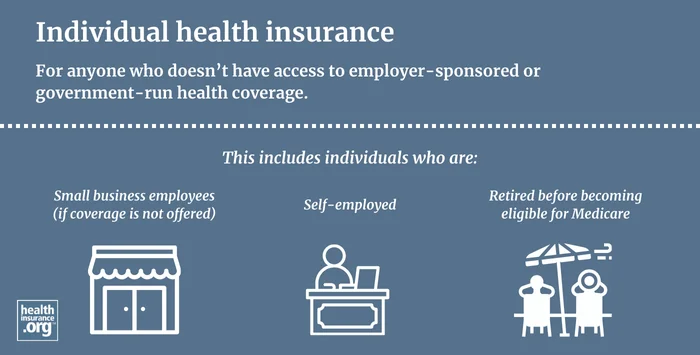
Individual health insurance is for anyone who doesn't have access to employer-sponsored or government-run health coverage. This includes people who are employed by a small business that doesn't provide health benefits, people who are self-employed, and people who retire before they're eligible for Medicare and have to obtain their own health coverage until they reach age 65.
How is individual health insurance different from employer-sponsored health insurance?
Now that the Affordable Care Act has been implemented, the differences between individual and employer-sponsored health coverage are much less significant than they once were.
Prior to 2014, individual health insurance was generally much less costly than group coverage in most states (although employers usually pay a significant portion of the premiums for group coverage,1 sometimes giving enrollees the impression that their coverage is much less expensive than it actually is). The reason for the significant price discrepancy pre-2014 was that individual plans were medically underwritten in nearly every state, making pre-existing conditions an obstacle to getting coverage.2
In addition, the level of coverage was traditionally less than what group plans offered (for example, almost all group plans had long been required to cover maternity care,3 while individual plans typically excluded this benefit before the ACA mandated it).
All of this changed in 2014 though, when the bulk of the ACA's reforms took effect. Individual plans became more benefit-rich with the introduction of the ACA's essential health benefits, and also became guaranteed issue, meaning that eligibility is no longer based on medical history and applicants no longer face higher premiums or rejected applications due to a pre-existing condition (the trade-off is that enrollment is now limited to one annual open enrollment period and special enrollment periods triggered by qualifying events, as had long been the case for group health insurance).
As a result, full-price premiums for individual health insurance are much closer to average premiums for employer-sponsored coverage:
- The average full premium (pre-subsidy) for individual health insurance purchased through the Marketplaces/exchanges in 2025 was about $7,425 for the year ($619 per month) for a single individual,4 although this grew to $8,892 ($741 per month) in 2026.5
- The average full-price premium for an employer-sponsored plan in 2025 was $9,325 for the year ($777/month) for a single employee.6
As noted above, average full-price premiums are still higher for employer-sponsored coverage. There are still some key differences that explain the price difference. For example, PPOs and broad provider networks are much more common among employer-sponsored plans, 7 while individual plans are much more likely to be HMOs or EPOs and to have fairly narrow networks and localized service areas (this is often true even for plans offered by the same insurance company in the same area, with different networks for the insurer's individual plans versus their employer-sponsored plans).
Another important difference is that average deductibles tend to be higher for the individual market plans that people select. In 2025, the average deductible for employer-sponsored coverage was $1,886 for a single employee,8 versus $2,759 for individual market plans.9
(Lower deductible options are available, but consumers who are buying their own coverage tend to be fairly price sensitive, making the very robust — but expensive — plans less popular overall; average Marketplace deductibles grew sharply in 2026, to $3,786,9 because many enrollees downgraded to Bronze plans in an effort to keep their premiums affordable after federal subsidy enhancements expired.)
Where can consumers buy individual health insurance coverage?
Individual health insurance is available via the exchange/Marketplace in every state (Select your state on this map to see more information about your state's Marketplace). There are 30 states that use HealthCare.gov as their marketplace in 2026, while DC and the other 20 states run their own exchange platforms (Covered California, MNsure, Connect for Health Colorado, etc.).
For 2027 coverage, 29 states will use HealthCare.gov, as Oregon will be switching to a state-run enrollment platform in the fall of 2026.
Individual health insurance is also available outside the Marketplace (ie, "off-exchange") nationwide, with the exception of the District of Columbia (in DC, individual health insurance can only be purchased through the marketplace).10 But premium subsidies (premium tax credits) and cost-sharing reductions are only available if the plan is purchased through the Marketplace.
In both cases — on-exchange or off-exchange — individual health insurance is only available during the annual open enrollment period or during a special enrollment period triggered by a qualifying event.
Learn more about open enrollment.
Learn more about special enrollment periods.
Plan availability and coverage options vary considerably from one area to another. Some parts of the country have only a single insurer that sells individual health insurance, although this is rare. Other areas have several different insurers and dozens of healthcare plans from which to choose. In the states that use HealthCare.gov, only 1% of enrollees have access to a single insurer for 2026, while the average enrollee can choose from among six or seven insurers' plans.11
Regardless of whether you want to purchase your plan on-exchange or off-exchange, you can obtain personal assistance from an insurance broker in your area. There are also Navigators and enrollment counselors who can answer questions and provide information and assistance with on-exchange plan selections as well as Medicaid enrollment.
How much does individual health insurance cost?
The monthly premium payments for individual health insurance plans vary greatly, depending on the applicant's age, zip code, whether they use tobacco, and the health insurance company they choose. But unlike policies issued in most states pre-2014, premiums do not vary based on gender or an applicant's medical history.
Across the more than 23.1 million people who selected Marketplace plans during the open enrollment period for 2026 coverage, the average full-price premium was about $741/month. But most people don't pay full price: 87% of Marketplace enrollees were receiving premium tax credits (subsidies) in 2026, and those tax credits averaged $650/month. Across all enrollees, including those who did pay full price, the average after-subsidy premium in 2026 was $178/month.5
But this was a 58% increase from 2025, when the average after-subsidy premium had been $113/month.12 The increase was due to the expiration of federal subsidy enhancements at the end of 2025.
For comparison, the average full-price monthly premium for employer-sponsored coverage (for a single employee) was about $777/month in 2025. But employers covered an average of $657/month of that cost, leaving the average employee to pay just $120/month out of their own pockets (payroll deducted, on a pre-tax basis).6
The ACA's rules — such as guaranteed issue coverage and inclusion of essential health benefits on all plans — helped to improve the quality of individual market coverage. And the ACA's advance premium tax credits helped to make individual health insurance roughly as affordable as employer-sponsored insurance, after accounting for the fact that most Marketplace enrollees get premium tax credits and most people with employer-sponsored insurance get a significant premium subsidy from their employer and get to pay their premiums on a pre-tax basis.
Footnotes
- ”Employer Health Benefits, 2025 Annual Survey” KFF. Oct. 22, 2025. ⤶
- "Health Insurance Market Reforms: Rate Restrictions" KFF.org. June 2012 ⤶
- "Pre-ACA State Maternity Coverage Mandates: Individual and Small Group Markets" KFF.org. Accessed Dec. 28, 2025 ⤶
- "Effectuated Enrollment: Early 2025 Snapshot and Full Year 2024 Average" CMS.gov, July 24, 2025 ⤶
- "2026 Marketplace Open Enrollment Period Public Use Files" Centers for Medicare & Medicaid Services. Accessed July 10, 2026 ⤶ ⤶
- ”Employer Health Benefits, 2025 Annual Survey” KFF. Oct. 22, 2025 ⤶ ⤶
- ”Employer Health Benefits, 2025 Annual Survey” KFF. Oct. 22, 2025 ⤶
- ”Employer Health Benefits, 2025 Annual Survey” KFF. Oct. 22, 2025 ⤶
- "Deductibles in ACA Marketplace Plans, 2014-2026" KFF.org. Nov. 6, 2025 ⤶ ⤶
- "Code of the District of Columbia § 31–3171.09a. Distribution of individual and small group health benefit plans" Council of the District of Columbia. Accessed Dec. 22, 2025 ⤶
- "Plan Year 2026 Marketplace Plans and Prices Fact Sheet" Centers for Medicare & Medicaid Services. Oct. 30, 2025 ⤶
- "2025 Marketplace Open Enrollment Period Public Use Files" Centers for Medicare & Medicaid Services. Accessed July 10, 2026 ⤶