health insurance deductible
What is a health insurance deductible?
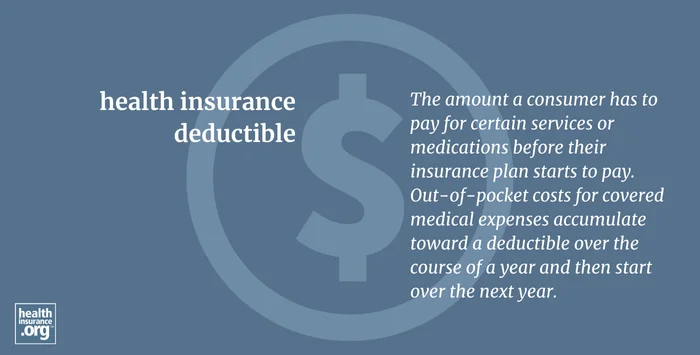
A health insurance deductible is the amount a consumer has to pay for covered services or medications before their insurance plan starts to pay. A deductible is a component of cost sharing. Covered medical expenses are added to or accumulated toward a deductible over the course of a year and then start over the next year. (Medicare Part A works differently, with deductibles that apply per benefit period rather than per year.)
Once a policyholder meets their plan's deductible, they will typically pay only a copayment or coinsurance for additional covered healthcare services or therapies used, up to an out-of-pocket maximum.
Under the Affordable Care Act, all non-grandfathered major medical plans must cover certain preventive care with no cost-sharing, which means the insurer pays for these services even if the member has not met their deductible.1

Need help exploring your options?
A licensed agent can help you:
- Answer coverage questions
- Understand your options
- Explore costs and eligibility
- Enroll when you're ready
How high can a health insurance deductible be?
Some plans have no deductibles at all, while others have deductibles as high as the maximum allowable out-of-pocket limit (this cap applies to all ACA-compliant plans, including individual and group policies). Plans can be designed with deductibles anywhere in between those two extremes.
For 2026, the maximum out-of-pocket limit is $10,600 for a single person, and $21,200 for a family policy. So those are also the upper limits for deductibles. Many plans have deductibles well below those limits (see details below about average deductibles). But Catastrophic plans have deductibles equal to the annual out-of-pocket limit.
For 2027, the maximum out-of-pocket limit will be $12,000 for a single individual and $24,000 for a family policy, so those will be the upper limits for deductibles as well. But CMS has proposed a rule change that would allow Catastrophic plans to have deductibles (and out-of-pocket limits) equal to 130% of that amount, which would be $15,600 for a single individual and $31,200 for a family.2 CMS has also proposed allowing Bronze plans to have deductibles and out-of-pocket limits that exceed the $12,000 limit.2
Why do I have more than one deductible?
Health insurance plans may have multiple deductibles. For example, your policy may have both individual and family deductibles. Most plans also have a separate deductible if you use medical providers (doctors, hospitals, pharmacies, etc.) who are outside the plan's provider network, assuming the plan provides out-of-network coverage (many plans do not). Your deductible will generally be higher if you use an out-of-network provider. Your plan may also have separate deductibles for medical and prescription drug benefits.
If you switch plans partway through the year, you'll generally have to start over with a new deductible on your new plan. This is common, for example, if you leave a job where you had employer-sponsored health coverage, and switch to an individual market plan or a new employer's health plan mid-year.
What is a typical deductible?
Deductibles can vary significantly from plan to plan. According to a KFF analysis, the 2025 average deductible for employer-provided coverage was $1,886 for a single employee ($2,631 at small companies vs. $1,670 at large companies).3
KFF also reported the average 2026 deductible for Marketplace plans sold via HealthCare.gov, (combined for medical and prescription drugs) by metal rating: $7,476 for Bronze plans, $5,304 for Silver plans without cost-sharing reductions (with cost-sharing reductions, Silver plans have much lower deductibles, and most Silver plan enrollees are in plans that include cost-sharing reductions),4 and $1,722 for Gold plans.5
How much are deductibles for high-deductible health plans?
High-deductible health plans (HDHPs) fall into one of two categories. They are either:
- A specific type of health plan that follows various IRS rules, including restrictions on minimum deductibles, maximum out-of-pocket limits, and benefit structure; it does not just refer to any health plan with a "high" deductible, OR
- Any Bronze or Catastrophic plan sold through the health insurance Marketplace in any state. This is new as of 2026, and these plans are all considered HDHPs even if their benefits aren't designed to follow the normal IRS rules for HDHPs.
For 2026 HDHPs that aren't Bronze or Catastrophic Marketplace plans, here are the IRS rules:6
- The plan must have a deductible of at least $1,700 for an individual, or $3,400 for a family. The deductible can be higher, but they can't exceed the IRS rules for out-of-pocket maximums.
- The plan must have a maximum out-of-pocket limit that isn't more than $8,500 for a single person, or $17,000 for a family (versus $10,600 and $21,200 for plans that aren't HDHPs).
How can I find out what my deductible will be?
Health plan websites or printed marketing materials provide deductible and other cost-sharing information. Don’t sign up for a plan without carefully reviewing all the terms of the coverage and comparing all costs (not only deductibles, but also premiums and copay/coinsurance amounts, and the maximum out-of-pocket limit). If you or a dependent has a chronic illness, it may be more cost-effective to select a plan with a higher premium, but a lower deductible. On the other hand, if you know you're going to need a medical service that will cause you to meet the out-of-pocket maximum on any plan, it may be less costly overall to go with a higher deductible and lower premiums — different solutions work for different situations.
If you are eligible for Medicare, one helpful resource for comparing options is the Medicare Plan Finder tool.7 This plan comparison tool helps consumers compare all types of Medicare options (Medigap and Medicare Part D vs. Medicare Advantage coverage), including the cost of premiums and out-of-pocket expenses.
If you are comparing health plan options offered by your employer, your human resources department may point you to online tools that help compare plan options. These tools help consumers evaluate the types of healthcare services they might need over the plan year and help them choose a plan that makes the best financial sense for the employee and any dependents covered under the policy.
If you are buying insurance through the health insurance Marketplace/exchange, the federal exchange platform (HealthCare.gov) — or a state-run exchange if your state runs its own platform — will help you review the available options and compare their costs.
Once you've enrolled in a health plan, your ID card will typically have the deductible amount (and any copay amounts) printed on it for easy reference. If not, you'll find it in the summary of benefits and coverage that you receive, or you can always call the health plan to ask about your benefit details.
What happens to my deductible if I switch plans?
If you switch plans mid-year — due to a job change, for example — you'll typically find that you start over with a new deductible on the new plan. Exceptions are possible if there are extenuating circumstances, such as an insurer becoming insolvent mid-year, or an insurer offering a deductible carry-over credit when a person switches to another plan offered by the same insurer. But exceptions like that are not common.
Deductibles are not prorated. So you'll still have a full deductible to meet for the remainder of the plan year before you receive post-deductible benefits, even if you join the plan mid-way through the plan year.
Footnotes
- "Preventive health services" Healthcare.gov. ⤶
- "Patient Protection and Affordable Care Act, HHS Notice of Benefit and Payment Parameters for 2027; and Basic Health Program" Centers for Medicare & Medicaid Services. Feb. 11, 2026 ⤶ ⤶
- ”Employer Health Benefits, 2025 Annual Survey” KFF. Oct. 22, 2025 ⤶
- “2025 Marketplace Open Enrollment Period Public Use Files” CMS.gov, March 22, 2024 ⤶
- “Deductibles in ACA Marketplace Plans, 2014-2026” KFF.org. Nov. 6, 2025 ⤶
- "Revenue Procedure 2025-19" Internal Revenue Service. Accessed Mar. 4, 2026 ⤶
- "Explore your Medicare coverage options" Medicare.gov. ⤶