Medicaid renewals and eligibility redeterminations

If you think you may be at risk of losing health benefits when your Medicaid redetermination is due, you have options. Learn more about the eligibility redeterminations process and Medicaid renewals.
Medicaid eligibility redeterminations
Everyone enrolled in Medicaid must have their eligibility redetermined every year. And starting in 2027, adults covered under Medicaid expansion will have their eligibility redetermined every six months.1
For perspective, the total Medicaid/CHIP population stood at just under 76 million people as of late 2025.2 Of those, a little more than 20 million were covered under Medicaid expansion.3 So most Medicaid enrollees will continue to have annual eligibility redeterminations, but a little more than a quarter of enrollees will switch to semi-annual redeterminations in 2027.
Your Medicaid eligibility will only be renewed if the state is able to determine that you still qualify for the coverage. In many cases, the renewal can be done automatically (ex parte) because the state has enough information on file to determine that the enrollee is still eligible.4
But if the state can’t automatically renew your coverage, you’ll need to provide information so that the state can process your renewal and determine whether you’re still eligible.
If the state determines that you’re no longer eligible – which will happen if you don’t respond to a renewal notice – your coverage will be terminated instead of being renewed.
Medicaid coverage in your state
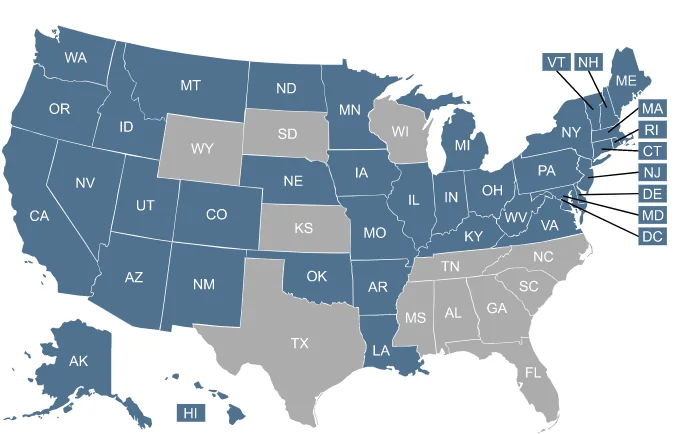
Medicaid eligibility rules vary from one state to another. Click your state below to find state-specific information.
Select your state below to see the options available to you
Steps to take if you currently have Medicaid
- Update your contact information – Make sure your address and contact information are up to date with the Medicaid department for your state. If you don’t receive your renewal notice (and thus don’t respond to it) because the state doesn’t have your updated contact information, your coverage will be terminated.
- Keep an eye on your mailbox – Carefully read any notices, letters, or forms you get in the mail about your Medicaid coverage. Take action and reply promptly to any requests for information.
- Appeal the decision, if necessary – If you receive a notice saying your coverage has been terminated, you may be able to appeal the decision. You may need to provide an account number or a case number.
- Get other coverage – If you no longer qualify for Medicaid, review other coverage options. This may include Marketplace health insurance, an employer’s plan or Medicare.
Options if you're losing Medicaid eligibility


Get an ACA Marketplace plan

Losing Medicaid will make you eligible for a special enrollment period in the Affordable Care Act (ACA) Marketplace. In most states, this special enrollment period will continue for 90 days after your Medicaid ends. But Marketplace coverage won’t be retroactive, so the longer you wait to enroll, the longer your gap in coverage will be. Depending on your household income, you may qualify for financial assistance in the Marketplace. Income-based assistance is available for both premiums and out-of-pocket medical expenses, depending on circumstances and the plan you select.
Get coverage through your employer

If you have access to an employer’s health plan, you will qualify for a special enrollment window to sign up for the plan. This could be through your employer or the employer of a parent or spouse. But don’t delay. Employer enrollment periods are typically limited to 60 days in cases where the applicant has lost Medicaid coverage.
Can’t afford employer coverage?

If your employer-sponsored coverage option seems unaffordable, you may qualify for help paying for health insurance through the Marketplace. Use our Employer Health Plan Affordability Calculator to see your potential savings.
Medicare

Medicare is a federal health insurance program for people aged 65 and older. It also covers people younger than 65 who have permanent disabilities, including those diagnosed with end-stage renal disease (ESRD) and amyotrophic lateral sclerosis (ALS).
Frequently Asked Questions about Medicaid Redeterminations
What are Medicaid redeterminations and renewals?
Medicaid redetermination – sometimes called Medicaid renewal – is the process states use to confirm people still qualify for Medicaid. Medicaid eligibility is based on financial and other criteria, and redetermination helps ensure people meet the criteria.
Medicaid redeterminations were put on hold for three years during the COVID public health emergency to help ensure ongoing access to healthcare services.
Starting in early-mid 2023, states began redetermining eligibility for everyone enrolled in Medicaid, and got back on an annual schedule for this process. If you are enrolled in Medicaid, you will need to go through your state’s renewal process at least once a year going forward. (As noted above, eligibility redeterminations will be done every six months for adults enrolled in Medicaid expansion, starting in 2027.)
In many cases, this process can be completed automatically (ex parte). But if the state doesn’t have enough information on file to determine whether you’re still eligible, you’ll need to complete renewal paperwork in order to prove that you’re still eligible.
Will I get kicked off Medicaid? and when?
Footnotes
- “Implementation of “Eligibility Redeterminations,” Section 71107 of the “Working Families Tax Cut” Legislation (Public Law 119-21)” Centers for Medicare & Medicaid Services. Mar. 6, 2026 ⤶
- “December 2025 Medicaid & CHIP Enrollment Data Highlights” Medicaid.gov. Accessed Mar. 31, 2026 ⤶
- “Medicaid Enrollment – New Adult Group” (filtered for 2025, month 6). Medicaid.gov. Accessed Mar. 31, 2026 ⤶
- “Basic Requirements for Conducting Ex Parte Renewals of Medicaid and CHIP Eligibility” Centers for Medicare & Medicaid Services. Nov. 26, 2024 ⤶